


Your books are “mostly up to date,” which usually means nobody trusts them. The bank hasn't been reconciled, payroll is approaching, invoices are floating around in three inboxes, and the leadership team is debating whether it can hire based on a cash balance that may be fiction.
That's the uncomfortable reality behind bookkeeping accounting services. The service isn't just someone categorizing transactions while you build the company. Done properly, it creates the financial operating system for cash decisions, tax readiness, payroll, reporting, and growth. Done badly, it turns cheap monthly support into expensive cleanup.
The stakes are larger than most founders realize. The global accounting services market was valued at USD 688.2 billion in 2025 and is projected to reach USD 1,275.8 billion by 2033, with bookkeeping representing 43.2% of the market in 2025, according to Grand View Research's accounting services market analysis. Bookkeeping is not a side dish. It's a core part of the machine.
A founder I know once delayed a hiring decision because the company's monthly numbers weren't ready. The bookkeeper had entered most transactions, but several bank accounts still needed reconciliation, a loan balance didn't agree with the lender statement, and accounts receivable included invoices everyone assumed had already been collected.
The business wasn't necessarily in trouble. It couldn't tell the difference between a temporary cash squeeze and a structural problem. That's how founders end up making serious decisions with a spreadsheet, a hunch, and the emotional support of a lukewarm coffee.
Good bookkeeping accounting services prevent that mess by turning financial activity into a dependable record. They capture transactions, classify them consistently, reconcile balances, preserve supporting documentation, and close the books on a defined schedule. The accounting team can then interpret the information instead of spending every meeting asking whether the information is real.
Founder rule: If your books arrive too late to influence a decision, they're historical paperwork, not operating intelligence.
Weak bookkeeping affects more than tax preparation. It can hide overdue customer invoices, make margins look healthier than they are, distort cash runway, and force accountants to rebuild basic records before they can provide useful advice. The business pays twice, first for the original work and then for the repair job.
Canada's broader accounting, tax preparation, bookkeeping, and payroll services industry generated $28.2 billion in operating revenue in 2023, after increasing 9.7% following a 9.8% increase in 2022, according to Statistics Canada. That sustained demand reflects how closely routine record-keeping sits alongside tax, payroll, and compliance work.
The practical question isn't whether you need bookkeeping. You do. The question is whether you need basic transaction maintenance, a controlled monthly close, or a finance partner who can help you act on the numbers.
Founders who want a broader grounding in the subject can use this master bookkeeping and accounting for small business resource as a useful reference. But don't stop at definitions. Your provider needs to explain who reviews the work, when reconciliations happen, and what decisions the reporting will support.
First, separate bookkeeping from accounting. The distinction determines what you're buying.
Think of bookkeeping as the kitchen prep and accounting as the chef deciding what dinner means. Bookkeeping records what happened. Accounting examines the pattern, checks whether the ingredients make sense, and helps decide what should happen next.
A bookkeeper might record a software payment, match a customer deposit to an invoice, classify a contractor expense, and reconcile the bank account. An accountant may use those records to prepare financial statements, review profitability, assess tax implications, build forecasts, or explain why revenue is rising while cash is falling.
The handoff matters. If the bookkeeper codes a payment to the wrong account, the accountant's report can be technically polished and economically wrong. Beautiful formatting won't rescue bad source data. It just gives the error nicer clothes.
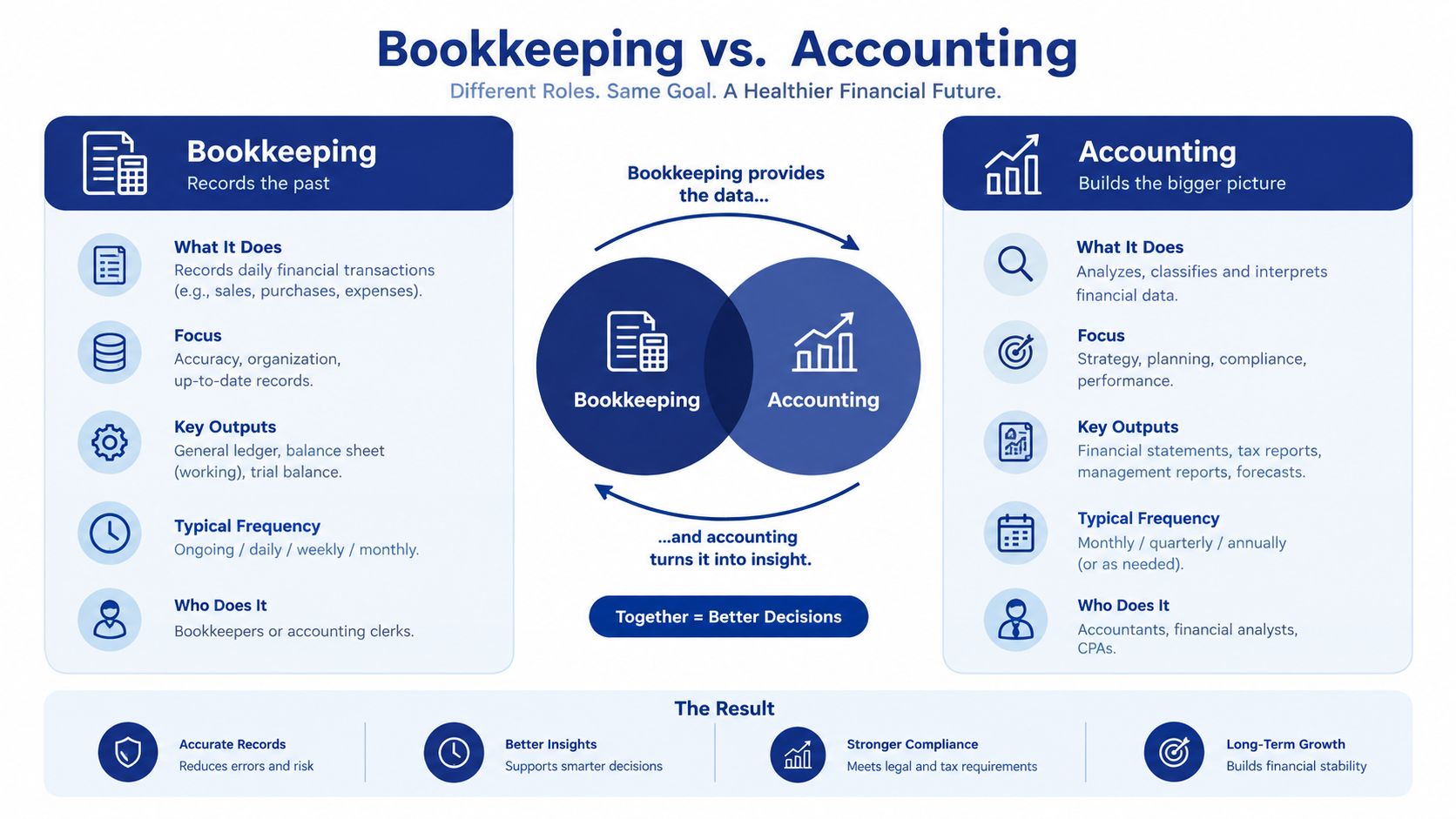
Bookkeeping usually owns the consistency of the underlying records. That includes transaction capture, account categorization, bank and credit-card reconciliation, invoice tracking, bill processing, and maintaining the documentation needed for review.
Accounting usually owns interpretation and higher-level reporting. That can include financial statements, management reporting, tax coordination, cash-flow analysis, budgeting, forecasting, and recommendations for the leadership team.
The labels vary by provider, so ask about outputs rather than titles. One firm's “bookkeeper” may handle a disciplined close. Another may only import bank feeds. One firm's “accountant” may provide monthly analysis. Another may just prepare year-end schedules.
A useful comparison of the distinction appears in this guide to the difference between accounting and bookkeeping. Read it with one question in mind: which responsibilities will remain with your company, and which will move to the provider?
A business that only needs clean transaction records shouldn't pay for a full finance department. But a growing company that needs cash-flow visibility shouldn't buy a data-entry package and hope strategy appears by magic.
The right setup often has two layers:
Some providers combine both. Others make the handoff explicit. Either can work, provided responsibility is clear and the reviewer has access to the underlying records.
The uncomfortable truth: Accounting can't outthink bookkeeping that never finished the close.
A proposal that says “full-service bookkeeping” can mean disciplined financial operations or a monthly export from QuickBooks Online. Those aren't the same product.
Audit the service menu by deliverable, owner, and cadence. If the provider can't explain what you'll receive and when, you're not reviewing a service. You're reviewing a fog machine.
Daily transaction processing covers bank-feed review, transaction coding, receipts, credit-card activity, and corrections. Good work includes consistent rules and a process for ambiguous transactions. The bookkeeper shouldn't guess repeatedly about the same vendor. They should establish a policy and document exceptions.
Month-end close and reconciliation is the quality gate. Each account balance should be compared with an independent source of truth and differences should be resolved before the period closes. For cash, that usually means the bank statement. For a term loan, it means the lender's amortization schedule. For accounts receivable, it means the aging report, as explained by MBS CPA's month-end reconciliation guide.
Accounts payable and accounts receivable connect the books to cash. A useful service tracks bills awaiting approval, payment status, customer invoices, aging, unapplied receipts, and collection follow-up. Posting bills after they're paid doesn't give you payables management. It gives you a receipt scrapbook.
Payroll coordination should connect payroll reports to the general ledger, cash accounts, benefits, contractor records, and payroll tax obligations. The bookkeeping provider may not be your payroll processor or tax filer, but somebody must own the handoff and verify that the entries agree.
Tax-ready books and compliance support mean clean account classifications, reconciled balances, organized documentation, and schedules your tax professional can use. Tax readiness isn't the same as tax advice. Put that boundary in writing.
Reporting and FP&A is where bookkeeping becomes decision support. Depending on the package, this can include monthly financial statements, budget-versus-actual reporting, cash-flow views, runway analysis, margin tracking, and explanations of material changes. The value comes from interpretation, not dashboard decoration.
| Service Bucket | What You Actually Get | How Often It Should Happen |
|---|---|---|
| Transaction processing | Categorized activity, receipt capture, and exception handling | Ongoing |
| Reconciliations | Account balances matched to independent records | At each close |
| Payables | Bill intake, approval routing, payment tracking, and aging | Ongoing, with close review |
| Receivables | Invoice status, collections visibility, and aging review | Ongoing, with close review |
| Payroll coordination | Payroll entries, account matching, and deadline ownership | Each payroll cycle |
| Tax readiness | Organized records, schedules, and support for the tax professional | Throughout the year, with formal review before filing |
| Reporting and FP&A | Statements, variance commentary, cash visibility, and forecasts | Monthly or at an agreed operating cadence |
QuickBooks Online, Xero, Stripe, Gusto, Ramp, and similar tools can reduce repetitive work. AI can suggest classifications, identify unusual activity, and support reconciliation. Resources on accounting automation with AI are useful for understanding the workflow possibilities.
But automation should route uncertainty to a person. It shouldn't approve a strange transfer, duplicate a vendor, or classify a personal expense as a business cost because the description looked familiar.
Ask for an exception queue, documented review rules, and a close checklist. That's how you distinguish technology-enabled bookkeeping from technology-themed bookkeeping.
Bookkeeping pricing usually follows the shape of the work, not the number of adjectives in the proposal. Transaction volume, account count, payroll complexity, entities, integrations, cleanup needs, reporting requirements, and review responsibility all affect the cost.
You'll commonly see four models.
Hourly work fits cleanup, catch-up, unusual projects, and businesses that don't yet know their recurring needs. The advantage is flexibility. The drawback is that incentives can become blurry, especially when weak processes create more hours.
Use hourly billing for a defined project with a written scope and a stopping point. Don't use it as a substitute for deciding what “month-end complete” means.
A monthly retainer creates predictability and encourages the provider to build repeatable workflows. It works well when account volume and reporting expectations are reasonably stable.
The trap is an attractive fee that excludes reconciliations, payroll coordination, cleanup, management reporting, or provider-side review. That's the bookkeeping equivalent of buying a car with no wheels and discovering the tires are extra.
Tiered plans can make the decision easier. A basic tier may cover transaction processing and standard reports. A more involved tier may add accounts payable, receivables, payroll coordination, close ownership, and management reporting.
The package only works if the upgrade triggers are clear. Ask what happens when you add an entity, launch a new payment processor, increase payroll complexity, or need historical cleanup.
Volume-based pricing can suit businesses with predictable activity, particularly when the provider defines what counts as a transaction and how bank-feed duplicates, transfers, refunds, and payment-processor batches are treated.
Before signing, compare proposals using the same questions. A practical bookkeeping services price list can help you understand the categories providers typically use, but the quote still needs to reflect your actual workflow.
My pricing recommendation: Pay for a completed, reviewed close. Don't pay merely for someone to touch your ledger.
You should also separate onboarding from recurring service. Historical cleanup, chart-of-accounts redesign, migration, and control setup can require a project fee or additional scope. That's reasonable. What isn't reasonable is discovering after signing that the provider priced routine posting while your business needed finance operations.
Outsourcing bookkeeping does not outsource accountability. Tasks may sit with an outside provider, but the founder, owners, and leadership team still carry the consequences of missed deadlines, misstated balances, and unauthorized payments.
Cloud accounting software improves access. Automated feeds reduce manual entry. Neither proves that the right person approved a payment, completed a reconciliation, or reviewed an unusual transaction. Cheap books become expensive when the ledger looks tidy but the controls are weak.
The first failure is usually control concentration. One person should not authorize, record, and reconcile the same transaction trail. Separate authorization, custody, recording, and reconciliation or review, following this explanation of segregation of duties for small finance teams. Build a working system of financial controls into the provider's operating process, not as paperwork added after something goes wrong.
Approval checkpoints should cover vendor setup, bills, payments, refunds, journal entries, and changes to payroll or banking information. Put approval limits, named approvers, and evidence-retention rules in writing.
Reconciliations should cover bank accounts, credit cards, payment processors, loans, payroll liabilities, accounts receivable, and other material balances. Require the provider to deliver unresolved items with an owner and next action. A completed-looking dashboard is not proof of a clean close.
Audit trails should identify who created, changed, approved, or reviewed important records. Shared logins erase accountability. Use individual access, appropriate permissions, and strong authentication.
Exception handling matters as automation expands. Transactions that fail a matching rule should enter a review queue. “The software imported it” explains the mechanism, not the decision.
Review cadence should include a close meeting or written commentary covering what changed, why it changed, and what management must do next. Statements without context are output, not decision intelligence.
Payroll adds a deadline that belongs in the outsourcing plan. Under the IRS monthly deposit schedule, employers generally deposit payroll taxes by the 15th day of the following month. If accumulated payroll tax liability reaches $100,000 or more on any day, the deposit is due by the close of the next business day. The IRS also distinguishes monthly and semiweekly depositors based on the lookback period, with semiweekly deposits due by the following Wednesday or Friday depending on payday, according to the IRS employment-tax due-date rules.
The IRS calendar includes fixed dates such as January 4, April 1, July 1, and October 2 for certain semiweekly deposit situations, as shown in the IRS fourth-quarter tax calendar. This is exactly the kind of deadline a provider contract must assign to a named owner, with a backup, in writing. “We thought payroll handled it” is not a control.
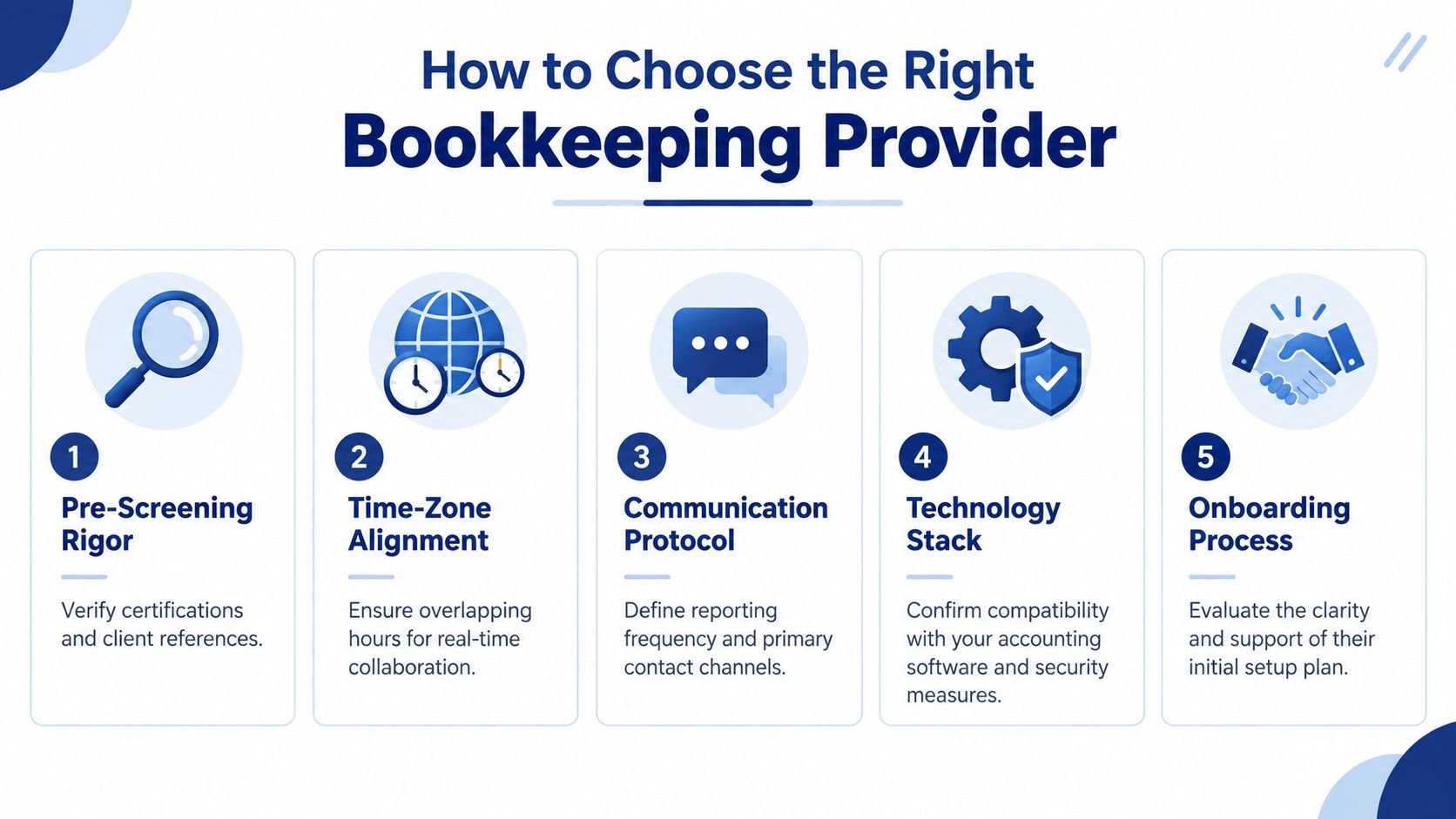
Hire the person or firm that can demonstrate control, not the one with the smoothest sales call. Every provider can promise accuracy. The serious ones can show you how they produce it.
Start with a short scorecard. Give each candidate a clear description of your systems, transaction patterns, payroll arrangement, reporting needs, and current pain. Then ask the same questions in the same order. You're testing process discipline before you test technical knowledge.
Relevant experience comes first. A SaaS business with deferred revenue and subscription billing needs a different operating rhythm than an e-commerce company managing inventory, returns, and payment processors. Ask for examples of workflows, not confidential client details.
Software compatibility matters, but familiarity alone isn't enough. Confirm experience with your accounting platform and connected tools, such as Stripe, Shopify, Gusto, Ramp, or Bill.com. Ask how the provider handles integration failures and duplicate imports.
Communication should be measurable in practice. Who is your primary contact? How quickly do they acknowledge issues? What arrives with the monthly close? Which questions require an escalation?
Security deserves direct questions. Ask about user permissions, individual logins, two-factor authentication, access removal, audit trails, and document handling. A provider who gets annoyed by security questions is saving you time by disqualifying itself.
Close ownership should be explicit. Ask for the close checklist, the review step, the unresolved-items report, and the person accountable for sign-off.
A marketplace can give you more choice and faster access to specialized talent. A white-glove recruiting model can reduce the effort required to define the role, screen candidates, and coordinate onboarding. AI matching can speed up shortlisting, but you still need to interview for judgment and control awareness.
HireAccountants is one option for US companies that want to review pre-vetted bookkeeping and finance professionals through a marketplace, with a recruiting team and AI matching engine available for role-based shortlisting. Treat that as an access model, not a substitute for your own operating requirements.
Interview question worth stealing: “Show me how you'd handle a bank reconciliation with unresolved differences at close.” The answer reveals more than a list of software certifications.
Watch for red flags:
Run a practical trial or tightly scoped onboarding phase. Give the provider a small set of known issues and see whether they ask sensible questions, document assumptions, and surface exceptions. Speed is useful. Blind speed is just a faster route to cleanup.

The first month determines whether your new provider becomes infrastructure or another login you stop checking.
Start with a clean handoff. Provide the chart of accounts, prior financial statements, bank and credit-card details, loan schedules, payroll reports, customer and vendor lists, open bills, unpaid invoices, tax correspondence, and existing approval rules. If the books need cleanup, separate that project from recurring bookkeeping so everyone knows when normal operations begin.
Create a close calendar with named owners. Include transaction cutoffs, reconciliation deadlines, payroll handoffs, review dates, management-report delivery, and the escalation path for unresolved items. The calendar should live somewhere the team can see it, not inside one person's memory.
Then decide which outputs will change decisions. A founder may need cash runway, collections aging, gross-margin movement, payroll impact, and upcoming obligations. A SaaS operator may also need subscription billing data, which is why evaluating billing software for SaaS can be relevant when invoice workflows are creating accounting noise.
Use the monthly close meeting to answer three questions:
That's the shift from data entry to decision intelligence. Your books should help you decide whether to hire, slow spending, follow up on receivables, adjust pricing, or protect runway. If they only help you file documents later, the service is underpowered.
Good bookkeeping accounting services buy back founder time, but the bigger purchase is clarity. Set the controls, insist on a defensible close, and demand reporting that earns a place in operating meetings.
HireAccountants helps US companies connect with pre-vetted bookkeepers and finance professionals through a marketplace, recruiting support, and AI-assisted matching. Visit HireAccountants to compare bookkeeping talent for transaction processing, reconciliations, close ownership, reporting, and broader finance support.
Let's simplify your finances today!