


Most advice on projections vs forecast gets this dead wrong. It treats them like polite synonyms, then acts surprised when a startup blows through runway because the team spent real money against a fantasy model that was never meant to be a commitment.
Here's the blunt version. A forecast is the plan you'll run the business against. A projection is the sandbox where you test what happens if you change the rules, like hiring faster, delaying spend, or pushing into a new market. Confuse the two, and you'll either overcommit to wishful thinking or ignore a real signal because it feels too conservative.
| Line Item | Forecast View | Projection View |
|---|---|---|
| Revenue | Current pipeline, existing churn, current pricing | New hires, new market, pricing changes |
| Headcount | Hold flat unless already approved | Add roles to test the impact |
| Spend | Near-term operating plan | Strategic bets and what-if decisions |
| Cash | What you expect to have | What happens if assumptions move |
| Decision Use | Monthly accountability | Board cases and scenario testing |
Startups don't usually die because the spreadsheet is ugly. They die because someone treated a hypothetical projection like a binding promise, then signed up for payroll, ad spend, or office space as if the model had magical powers.
The clean distinction matters because cash discipline lives or dies on it. The Australian Bureau of Statistics draws the line clearly, a projection depends on assumed future patterns and is not a prediction, while a forecast is framed as what is expected to happen based on current and past evidence, which is why forecasts suit near-term planning and projections suit scenario analysis ABS guidance on estimates and projections.
Founders get into trouble when they use a rosy projection to justify next month's spend. That's how you end up mortgaging your office ping-pong table and calling it strategy.
Practical rule: If the number is driving payroll, vendor commitments, or the next board conversation, it needs to behave like a forecast. If it's testing a decision, it belongs in projection land.
The other failure mode is just as ugly. Teams dismiss a sober forecast because it looks too cautious, then keep spending against the prettier projection. That's not optimism. That's bad budgeting with a smile on top.
Operationally, this is about budget ownership and rolling planning cadence, not glossary trivia. The forecast belongs to the people who need to be right next month. The projection belongs to the people deciding whether to change the company's shape. If you keep those roles blurred, your monthly planning meeting turns into a seminar in self-deception.
A forecast says what you expect to happen if current pipeline, hiring, churn, and pricing stay roughly where they are. It should map straight into your next-quarter spend, your hiring pace, and your cash plan. If it doesn't affect how you run the business in the near term, it's probably not a forecast.
A projection says what would happen if a specific assumption changes. Hire five reps, double ad spend, enter the UK, launch an enterprise tier, and the model should answer a different question. That's not a prediction, it's a controlled what-if.
The regulatory world keeps this sharper than most startup blogs do. The Public Company Accounting Oversight Board defines a financial forecast as prospective financial statements based on assumptions the responsible party expects to exist, while a financial projection uses one or more hypothetical assumptions instead PCAOB AT301. That's the cleanest line you're going to get.
If the team is debating revenue, COGS, opex, or cash, ask one question. “Are we talking about what we expect to happen, or what happens if we change an assumption?” That question cuts through a lot of fluff.
A forecast should answer the survival questions. Can we cover payroll? Do we have room for one more hire? Will collections land when expected? A projection should answer the strategic questions. What happens if we move faster? What breaks if demand softens? What if we bet on a new geography?
For finance teams that need a broader planning structure, financial planning and analysis guidance gives useful context around how forecasts fit into the bigger FP&A rhythm.
A forecast is the model you defend with actual operating evidence. A projection is the model you use before you take the leap.
Let's keep this grounded. Say you've got a Series A SaaS company with $2M ARR and 600 customers. Same business, same P&L, two different lenses. The difference is not cosmetic, it's the decision.
Under the forecast view, you book the current pipeline at stage-weighted probabilities, keep headcount flat, and model current churn. That produces a year-end view of $2.6M ARR with cash burn tied to the current operating plan. Nothing fancy, nothing heroic, just a sober read on what happens if the business behaves the way it's behaving now.
Under the projection view, you add five AEs in Q3, launch an enterprise tier, and enter the UK in Q4. Now the same business can show $4.1M ARR, but it also picks up $1.3M of extra burn and runway drops from 18 to 11 months. Same company. Same base P&L. Different assumptions, different story, different risk.
The numbers didn't change because the model got smarter. They changed because the question changed. The forecast asks, “What's the most likely outcome if we keep doing what we're doing?” The projection asks, “What happens if we make a deliberate move?”
That's the point founders miss when they start worshipping one spreadsheet. You can't use a forecast to justify a growth bet you haven't made yet, and you can't use a projection to decide whether your current cash is safe. One is for operating the machine. The other is for modifying it.
| Line Item | Forecast View | Projection View |
|---|---|---|
| ARR | $2.6M | $4.1M |
| New Hires | Flat | Five AEs in Q3 |
| Market Expansion | None | UK entry in Q4 |
| Burn | Current run rate | $1.3M additional burn |
| Runway | 18 months | 11 months |
This is the part where bad founders start celebrating revenue and forget to check the runway. Don't be that person.
A rolling plan needs both tools, but not for the same job. The forecast is the short fuse. The projection is the scenario lab. Mix them together and you lose the discipline that makes either one useful.
Your team should run a 13-week cash forecast that updates every week, because cash doesn't care about your strategy deck. On top of that, layer 12 to 36 month projections for hiring, pricing, and market-entry decisions. That's how you keep today honest without pretending tomorrow is fixed.
Who owns what? The FP&A lead should own the forecast, because that person is closest to actuals, variances, and the weekly cash pulse. The founder and department heads should own the projection, because they're the ones making the strategic calls that change headcount, margin, and timing.
A useful resource on this sort of cash discipline is cash projection documentation, especially if your team needs a tighter way to think about timing, balances, and runway.
The forecast gets revised when actuals land off-plan. Collections slip, a big customer churns, payroll lands early, or spend runs hot. That's a forecast problem, and it needs a quick correction.
The projection gets revisited when an assumption changes. CAC payback gets longer, the hiring plan moves, pricing shifts, or the board wants to see a new expansion case. That's not a weekly cash tweak. That's a strategic reset.
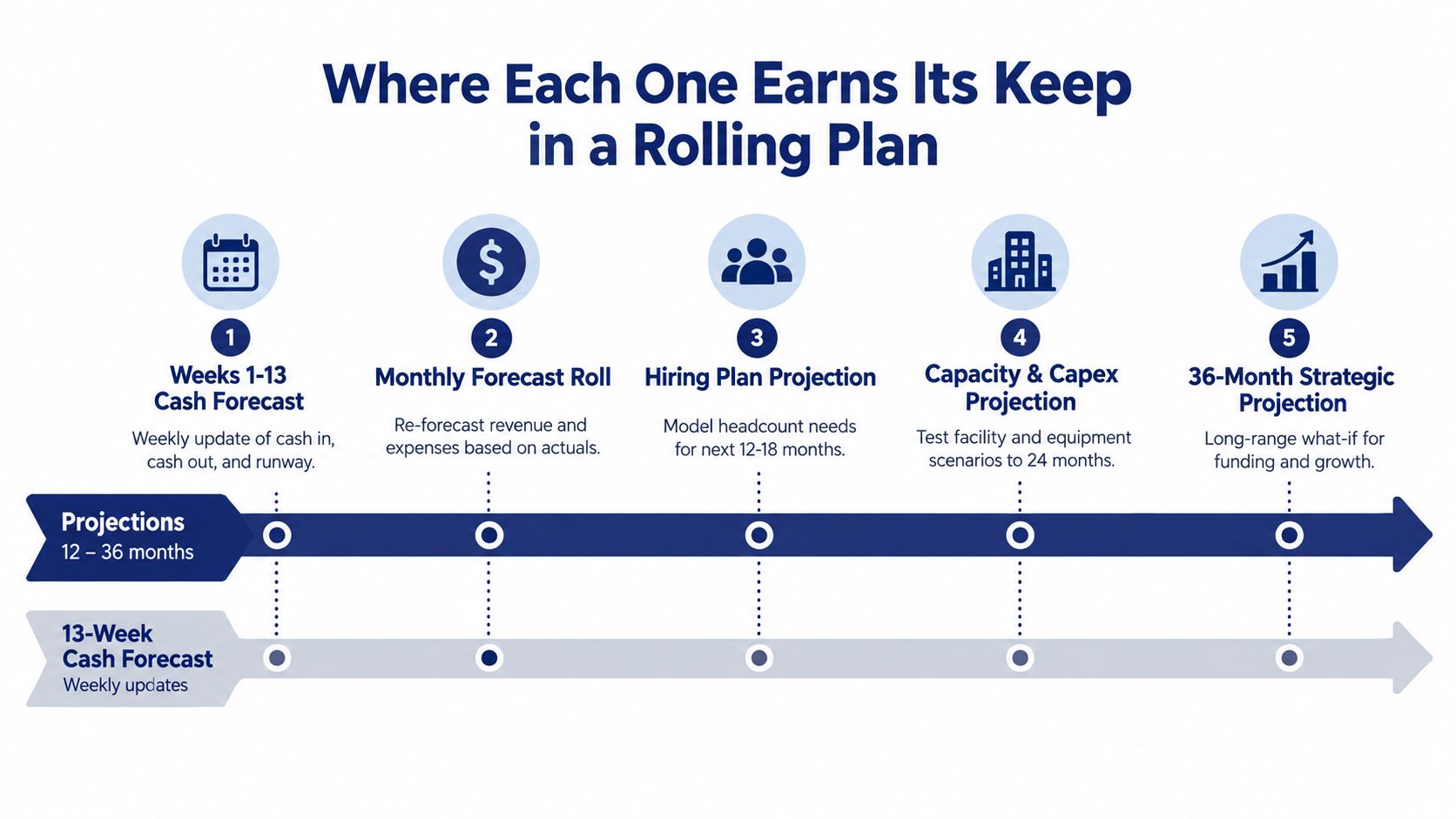
The reason this separation matters is simple. It stops a rosy 18-month projection from contaminating a sober 6-week cash view. That mistake has killed more startups than bad software ever did. If your monthly meeting can't distinguish between what's happening and what might happen, you're not planning. You're improvising with numbers.
Maya ran a seed-stage SaaS company and built a detailed 24-month projection before a fundraise. She modeled three hires and a sharp price increase, then used that projection to tell a clean story to investors. The money came in, but what saved her company was revisiting the assumptions early when the forecast started to wobble. The projection helped her raise. The forecast kept her from drifting into payroll trouble.
Jon ran a DTC brand and became obsessed with weekly forecast discipline. He tracked shipping label costs, supplier invoices, and cash down to the penny, which is better than chaos, but not enough. He never projected what a second SKU line would do to working capital, so inventory trapped cash before he saw the hole. The forecast kept him accountable. The projection would've warned him sooner.
One founder needed a projection to make a big bet look sane. The other needed a projection to see a trap hiding inside a nice-looking operating run rate. In both cases, the forecast alone was not enough.
That's the part many teams miss. A forecast is great at telling you whether you can keep the lights on. It is lousy at telling you whether a strategic move will starve the business six months later. And a projection can make a dangerous bet look tidy if nobody comes back to the forecast and asks, “Did reality agree?”
If you've ever had a board member ask why your numbers changed, you already know the answer. Because the business changed. The point is to know which model should have changed first.
A forecast should be driver-based, not wishful. Revenue should come from volume, price, and conversion, not from one magical growth assumption scribbled into a cell and prayed over like a lucky coin.
Start with a base case, then add an upside and downside case that each changes explicit drivers. Don't just rename the tabs and call it a strategy. Tie the cases to things the company can move, like pricing, churn, headcount, or margin.
For the variables that matter most, use sensitivity tables. Usually that means headcount cost, gross margin, and customer churn, because those are the knobs that move the outcome fast. If you need help choosing between testing one variable or a bundle of variables, the distinction between sensitivity and scenario analysis is worth keeping straight, and this practical guide is a decent starting point.
Monte Carlo simulation has a place too, but only after the underlying drivers are stable. If your inputs are still moving every week because the business itself is changing shape, a fancy simulation just gives you a prettier version of confusion.
| Technique | Best For | Cadence | Owns Decision |
|---|---|---|---|
| Driver-based forecasting | Near-term operating plan | Weekly or monthly | FP&A lead |
| Scenario stacks | Strategic what-ifs | Monthly or on decision trigger | Founder and department heads |
| Sensitivity tables | Isolating the biggest levers | On model refresh | Finance lead |
| Monte Carlo simulation | Stable, mature drivers | Periodic, not constant | Finance team |
A flat-line projection is acceptable for a pre-revenue idea if you're using it to prove a funding case or sanity-check an early plan. It becomes dangerous the moment people start treating it like evidence of traction. That's just hand-waving with nicer formatting.
A model earns complexity only when its output changes a decision the team was about to make.
If the extra scenario doesn't change hiring, pricing, or funding timing, don't spend another afternoon polishing it. You're not being rigorous. You're feeding the spreadsheet habit.
The threshold is simpler than most consultants want it to be. Pre-seed and seed teams should default to one quarterly forecast plus one annual projection tied to board asks. That's enough structure to stay honest without turning the company into a spreadsheet monastery.
By Series A and beyond, both tools need to live together, and they need to be updated monthly. One artifact keeps the operating plan grounded. The other tests strategic moves before they become expensive mistakes.
If the question is pricing tests, use a projection first. You're not describing the current business, you're testing a change.
If the question is hiring plans, use both, but don't pretend they're the same thing. The forecast tells you whether you can afford the next hire. The projection tells you what the hire changes in revenue, output, and timing.
If the question is runway extension, the forecast owns the answer. Cash discipline beats optimism every time.
If the question is vendor contracts, use the forecast for near-term commitments and the projection for longer commitments that depend on future scale. Buying now because a projection looks pretty is how teams end up explaining themselves to a board with a straight face and a broken balance sheet.
For a broader planning lens, business planning and financial forecasting guidance is useful if your team is building the cadence from scratch.
If your finance lead is spending ten hours a week maintaining scenarios, the SMB has crossed from discipline into debt. Simplify ruthlessly. Fewer scenarios, cleaner drivers, faster updates. Otherwise the model starts working for itself instead of for the business.
| Situation | Use Forecast When | Use Projection When |
|---|---|---|
| Near-term cash | You need to know what happens next month | You're testing an assumption that changes burn |
| Hiring | The role is already approved | The role is still a strategic option |
| Pricing | You need next-quarter accountability | You want to test a new package or discount model |
| Expansion | You're tracking current markets | You're evaluating a new geography |
| Vendor spend | Commitments are already in motion | The contract depends on future scale |
Confirm last month's actuals and close the books before anyone starts storytelling.
Refresh the 13-week forecast with current collections, payables, and payroll timing.
Compare forecast versus actuals, then write down the three biggest drivers of variance.
Run the projection layer against the next strategic decision, not every possible idea under the sun.
Approve only the hires, spend, or funding triggers that still make sense after the scenario check.
Share the updated plan with the team and board so nobody keeps operating on last month's fiction.
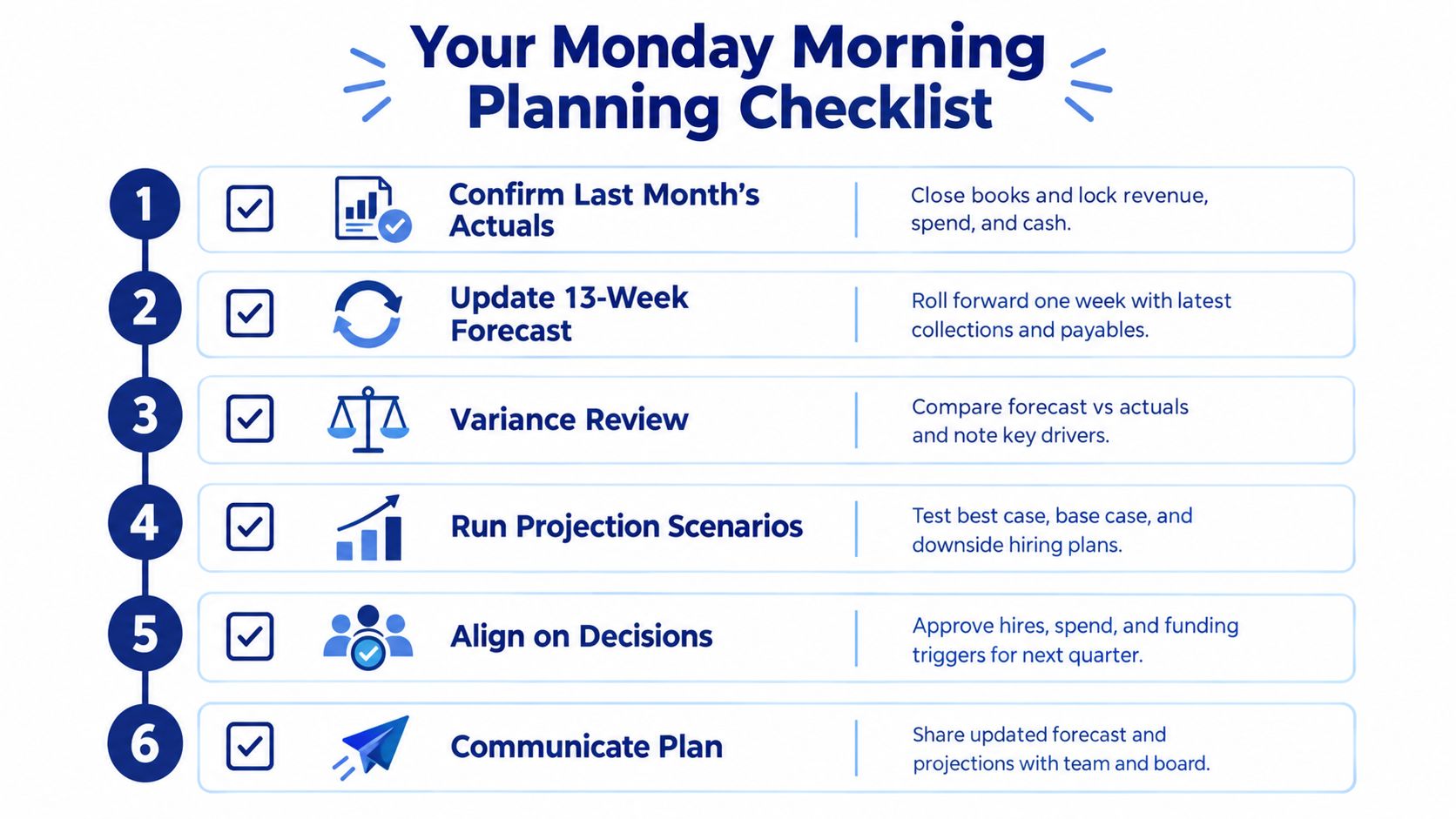
Guardrails that keep the room honest: keep a variance tolerance band, cap the scenario count, and ask one brutal question before every new hire, “What happens to cash if this takes longer than we think?”
If your team keeps mixing up projections and forecasts, HireAccountants can help you bring in the finance support to separate cash discipline from scenario work without slowing the company down. Visit HireAccountants if you want pre-vetted accounting and finance talent that can keep the forecast tight and the projection work useful.
Let's simplify your finances today!