


Bookkeeping handles daily transaction recording and reconciliation, while accounting interprets those numbers for tax, compliance, and strategic decisions. Most US startups should start with bookkeeping, then add accounting as financial complexity grows.
You're probably not choosing between two tidy boxes. You're staring at unreconciled bank accounts, invoices that may or may not have been recorded, and a cash balance you trust about as much as a weather app in spring. Then someone asks whether you need a bookkeeper, a CPA, or a person promising to do “everything.”
That last option sounds efficient. It can also create a spectacular mess if nobody defines who owns the records, who reviews them, and who signs off on judgment-heavy work.
The practical distinction is simple. Bookkeeping keeps the financial engine fed and organized. Accounting explains what the engine is doing and what you should do next. The hard part is knowing where your business sits between those two needs.
A founder I know hired an accountant when what the company really needed was a bookkeeper. The accountant produced thoughtful reports, discussed tax positions, and offered sensible advice. Unfortunately, the underlying bank reconciliations were late, vendor bills sat uncategorized, and the monthly numbers arrived after the decisions had already been made.
The company didn't have an accounting problem first. It had a recordkeeping bottleneck. Paying for higher-level judgment before fixing the daily inputs was like hiring a race-car strategist while leaving the wheels in the parking lot.

A bookkeeper usually owns the recurring flow of financial activity:
An accountant works with those records to make them useful for decisions and compliance. That can include adjusting entries, financial statements, tax planning, forecasting, analysis, and review of whether the books fairly represent the business.
The confusion persists because modern software can produce reports, and modern bookkeepers often do more than enter data. A competent bookkeeper may reconcile accounts, prepare accruals, support payroll, and produce management reports. That still doesn't automatically make the person responsible for tax strategy or financial interpretation.
The CPA versus bookkeeper comparison is useful when you're evaluating credentials and responsibility, but don't let a title make the decision for you. Ask what the person will deliver, what they review, and what they're qualified to approve.
Practical rule: Hire for the problem sitting on your desk today, not the impressive job title you hope to need someday.
The cleanest way to compare bookkeeping vs accounting services is to compare ownership, not job titles. A bookkeeper owns the accuracy and timeliness of the transaction layer. An accountant owns interpretation, adjustments, compliance support, and decisions that require professional judgment.
| Dimension | Bookkeeping services | Accounting services |
|---|---|---|
| Primary purpose | Capture and organize financial activity | Interpret financial activity and guide decisions |
| Typical work | Transaction recording, invoicing, expense tracking, reconciliations | Adjusting entries, statements, tax planning, forecasting, analysis |
| Main deliverables | General ledger, reconciliations, transaction reports, organized records | Financial statements, tax support, forecasts, management analysis |
| Workflow position | Early accounting cycle, capture and posting | Later accounting cycle, adjustment, summarizing, and reporting |
| Decision ownership | Keeps information complete and consistent | Explains implications and recommends action |
| Compliance role | Maintains supporting records and process discipline | Supports tax, reporting, audit readiness, and compliance judgments |
| Best fit | Businesses that need reliable financial operations | Businesses making complex financial or regulatory decisions |
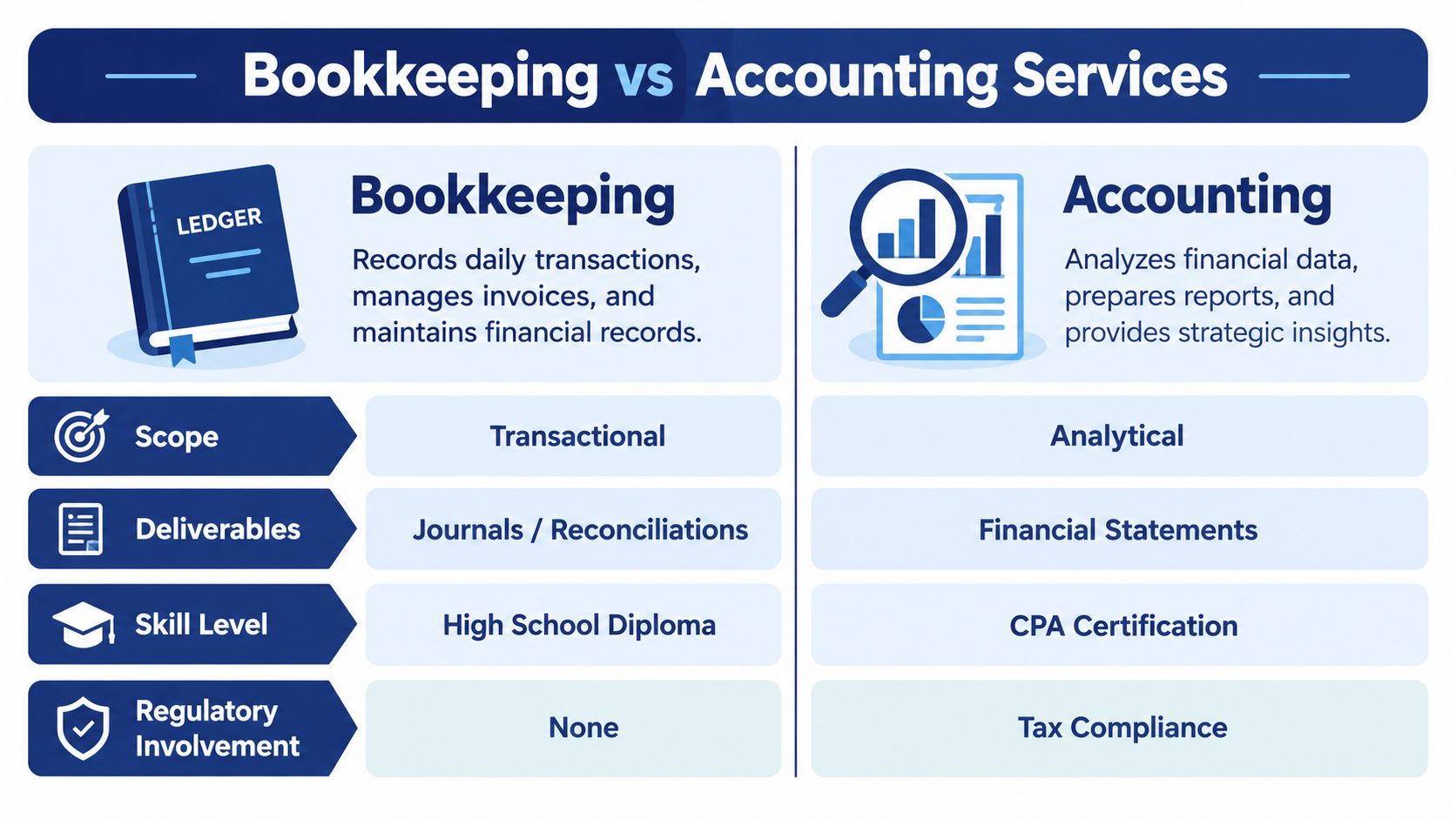
Good bookkeeping isn't glamorous, but it prevents expensive surprises. The work includes recording transactions, categorizing activity, managing invoices, tracking expenses, maintaining the ledger, and reconciling bank accounts. A proper cycle also posts journal entries to a general ledger and makes adjusting entries for accruals, deferrals, depreciation, and prepaid expenses, with bank accounts reconciled at least monthly, as described in this bookkeeping cycle guide.
That means “data entry” is an unfairly narrow description. Bookkeeping creates the evidence base that lets an owner see whether cash, receivables, payables, and expenses are moving as expected.
Accounting takes the organized records and asks harder questions. Are expenses recognized in the right period? Does the reporting reflect the business's actual position? What tax treatment applies? Can the company support its filings and explain its results to lenders, investors, or owners?
Accounting also translates reports into choices. It can help a founder assess profitability, model cash needs, plan for taxes, prepare for an audit, or decide whether a new hire is affordable.
For a second plain-English explanation of the boundary, Business Loan Warrior's accounting basics gives readers a useful reference without pretending that every business needs the same setup.
The old picture says a bookkeeper enters numbers and an accountant sits above the ledger with a calculator and a serious expression. Real companies are messier, thankfully.
A modern bookkeeping service may handle bank reconciliations, payroll preparation, cash-flow visibility, accrual support, depreciation postings, and management reporting. Those tasks can look like accounting because they require more than copying figures from receipts. The dividing line is usually the level of judgment and accountability, not the software screen where the work happens.
The accounting cycle offers a practical map:
Bookkeepers often own stages one through three and may support parts of stage four. Accountants usually take responsibility for the judgment-heavy stages four through six. The exact handoff depends on the person's training, scope, and the complexity of the company.
Ask a provider to describe the last month-end close they completed. Not the software they use, not the services listed on their website. Ask what they reconcile, which adjusting entries they make, how exceptions are escalated, and who reviews the final reports.
A provider that only promises “monthly books” may be selling record maintenance. A provider that explains close controls, documentation, tax coordination, and management reporting may be offering a broader accounting function.
The distinction matters because clean books support defensible tax positions and reliable financial statements. An accountant can't produce trustworthy analysis from uncategorized transactions and unreconciled accounts. Conversely, a bookkeeper shouldn't be expected to invent tax strategy or approve positions that require specialized judgment.
Small-business services often bundle these tasks, which is convenient when the boundaries are explicit. Convenience becomes risky when “full service” means nobody can tell you who owns the final answer.
Start with financial maturity, not vanity. A young company doesn't need a miniature finance department because it opened a business bank account. It needs someone to keep transactions current, reconcile the records, and make the numbers usable.
Bring in a bookkeeper first when the pain is operational:
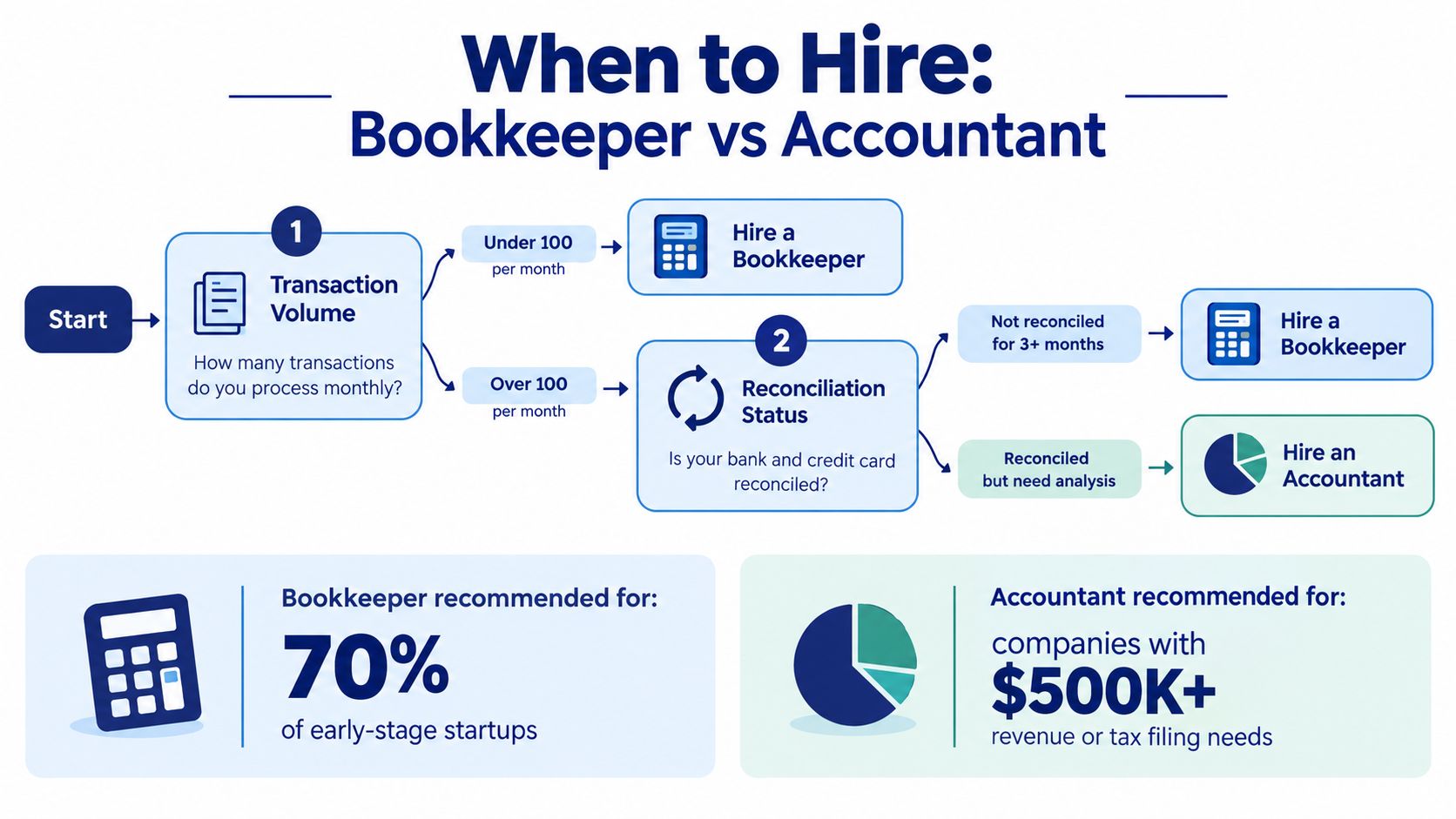
Accounting support becomes the right next layer when the company needs more than accurate records. That includes tax planning, complex filings, financial statement interpretation, forecasting, investor or lender reporting, audit preparation, multi-entity consolidation, and analysis of margins or cash requirements.
Don't wait for a crisis to make that upgrade. If every financial question ends with “we need to ask our tax person,” or if management reports exist but nobody can explain what they mean, accounting judgment is already missing.
The guide to hiring a bookkeeper can help you define the operational role before you add senior expertise. That sequence matters. A bookkeeper who produces reliable records gives an accountant something solid to review, adjust, and interpret.
A sensible progression looks like this:
Most founders should resist hiring a CPA to perform every transaction task from day one. You'll pay for judgment while still waiting for the bank feed to be reconciled. That's not sophistication. It's expensive disorganization wearing a blazer.
Finance support usually comes in four pricing shapes: monthly retainers, hourly work, project fees, and employment. Each can work. The mistake is buying a pricing model before defining the workload.
A monthly retainer suits recurring bookkeeping, reconciliations, close support, and routine reporting. Hourly work can make sense for cleanup or intermittent advice, but it rewards unresolved ambiguity if nobody caps the scope. Project pricing fits a historical catch-up, system migration, or chart-of-accounts redesign. A full-time hire makes sense when the company needs daily ownership, institutional knowledge, and expanding responsibilities.
The cheapest hourly rate can become the most expensive choice when the person needs constant correction. The highest credential can also be wasteful if the role is mostly transaction processing.
A recent small-business survey found that bookkeeping was the top task respondents wanted to delegate, at 30%, while the most common monthly fee band reported by US firms for accounting services was $250 to $749, according to OnPay's small-business outlook. Those figures point to a practical reality: many companies buy a focused layer of help rather than a complete finance function.
The same source reports that tax preparation dominated outsourcing at 80.8%, which reinforces the need to distinguish record maintenance from tax expertise. A business may need ongoing bookkeeping and only periodic accounting or tax support.
In-house hiring offers control, context, and closer collaboration. It also brings recruiting time, payroll, benefits, onboarding, management overhead, and the risk of hiring one person whose skills don't match the full job description.
A traditional firm can provide a broader bench, but you may get less control over who performs the work. A specialized talent platform can offer a middle route. HireAccountants connects US companies with pre-vetted accountants and finance professionals, supports part-time and full-time arrangements, and lists bookkeeper pricing of $1,100–$1,999 per month, according to the company's published service information.
Use those figures as a reference point, not a promise for every role. Scope, experience, timezone, systems, tax complexity, and review requirements still determine the actual fit.
Before signing anything, demand a written service boundary:
For a more focused cost discussion, review this bookkeeping service cost guide, then compare the proposed scope against the work your business needs.
The best finance setup is not the one with the most titles. It's the one that creates a clean handoff from transaction capture to financial judgment without making the founder act as the quality-control department.
| Business Stage | Primary Role | Key Responsibilities | When to Add Next Layer |
|---|---|---|---|
| Early-stage startup | Bookkeeper | Record transactions, reconcile accounts, organize invoices and expenses, support payroll preparation | Add accounting review when tax, reporting, or financial decisions become more complex |
| Growing startup or SMB | Bookkeeper plus accountant | Maintain the ledger, complete close routines, prepare statements, make adjustments, coordinate tax work | Add forecasting or finance leadership when planning and cash decisions consume management time |
| Mature SMB | Bookkeeping, accounting, and financial analysis | Separate transaction processing, reporting, compliance, forecasting, controls, and decision support | Add specialized tax, audit, FP&A, or controller capacity as risk and complexity expand |
At the earliest stage, assign one dependable person to keep records current and reconciled. The founder should review cash and key reports, but shouldn't spend evenings classifying every software subscription.
An accountant can review periodically rather than owning every daily transaction. That keeps the company from paying senior rates for routine work while still providing professional oversight where judgment matters.
As the business adds employees, products, entities, financing, or more complicated revenue and expense patterns, use a deliberate two-layer model. The bookkeeper maintains the operating records. The accountant reviews the close, prepares or oversees adjustments, supports tax work, and turns reports into decisions.
Many businesses get the most value from specialization. The bookkeeper protects consistency. The accountant challenges assumptions and spots issues before they become filing or cash-flow problems.
A more established SMB may need separate ownership for bookkeeping, accounting, and financial analysis. A controller or accounting manager can oversee close and controls, while a finance analyst handles forecasting, budgets, dashboards, and scenario planning.
The handoff should be visible. Bookkeeping supplies reconciled records. Accounting approves the reporting logic. Finance uses the approved information to plan. If those layers blur, errors become harder to locate and accountability gets foggy fast.
The most common mistake is hiring for status instead of workload. A CPA can be excellent and still be the wrong first hire if your books are months behind. A bookkeeper can be diligent and still be the wrong person to design tax strategy, interpret complex reporting, or lead an audit response.
Some providers actually cover bookkeeping and accounting. Others use the phrase as a sales shortcut. Ask for named deliverables and a named reviewer. “Full service” does not tell you whether the provider reconciles accounts, prepares adjustments, explains variances, coordinates tax filings, or just exports reports from QuickBooks.
The IRS says the general recordkeeping rule is three years, but the period extends to seven years for claims involving worthless securities or bad debt deductions and to six years when gross income is underreported by more than 25%. If no return is filed or fraud is involved, the retention period can become indefinite, as explained in IRS Publication 583.
Employment tax records deserve their own process. The IRS says businesses should keep them for at least four years, according to its small-business recordkeeping guidance.
Store source documents with transactions, preserve reports, and make ownership clear. Future-you will be grateful, which is rare enough to count as a financial control.
A bookkeeper shouldn't work in a vacuum, especially as the business grows. Set a monthly review with an accountant or qualified finance lead to inspect reconciliations, unusual balances, adjustments, tax-sensitive items, and management reports.
Founder's rule: If nobody can explain why the numbers changed, the reporting process isn't finished.
Start with bookkeeping when the business needs reliable records. Add accounting when the business needs interpretation, compliance judgment, forecasting, or strategic advice. That sequence keeps costs aligned with capability and prevents the classic mistake of building an impressive finance function on top of unreliable data.
HireAccountants helps US companies find pre-vetted bookkeepers, accountants, CPAs, analysts, and other finance professionals for part-time or full-time work, with bookkeeper pricing of $1,100–$1,999 per month. If your books are behind or your finance needs have outgrown your current setup, visit HireAccountants and build the right layer before the mess gets expensive.
Let's simplify your finances today!