


There is no single set of CPA candidate requirements in the United States. The standard licensure framework uses three pillars, education, examination, and supervised professional experience, and the widely used route requires 150 semester credit hours, all four CPA Exam sections, and documented experience.
The popular advice says, “Get 150 hours, pass the exam, and you're a CPA.” That advice is tidy, memorable, and incomplete. It can also send candidates toward unnecessary coursework or leave employers calling someone “licensed” when that person has only cleared the exam stage.
CPA candidacy is a state-board decision. Your education, exam eligibility, experience category, supervisor, character documentation, and final application all depend on the jurisdiction you choose. The smart move isn't memorizing one national checklist. It's matching your actual education and experience to the right state pathway before you spend money, time, or several weekends with a transcript evaluator.
The CPA pathway rests on three pillars, but state boards don't build them to identical specifications.
Education is the pillar that causes the most confusion. A widely used route requires 150 semester credit hours, usually a bachelor's degree plus additional undergraduate or graduate coursework, together with the required accounting and business subjects. But exam eligibility and licensure eligibility aren't automatically the same thing. New York, for example, permits some candidates to sit for the exam after 120 semester hours when they have completed the required accounting coursework. Under the traditional 150-hour licensure pathway, New York requires at least one year of full-time experience, or the part-time equivalent, with qualifying supervision and documentation. (New York State Education Department explains the distinction)
Examination is the second pillar. You must pass the required sections, but passing the exam doesn't erase the board's remaining conditions. Think of it as clearing a locked gate, not receiving the keys to the building.
Professional experience is the third pillar. The work must fit the jurisdiction's definition, and many pathways require supervision by an appropriately licensed U.S. CPA. Experience may come from public accounting, government, private industry, or education, depending on the applicable board rules.
Practical rule: Never write “licensed CPA” on a resume, job posting, or candidate profile until the state board has approved the license.
Candidates and hiring managers should separate three labels:
Those labels matter because a candidate can meet the education threshold to sit in one jurisdiction while still needing more education or supervised experience for licensure. A person who passed all four exam sections may still need board review, experience verification, ethics requirements, or other documentation.
The AICPA roadmap to the CPA Exam and licensure describes the common model as a bachelor's degree, enough additional coursework to reach 150 credit hours, one year of experience, and successful exam completion. That's a useful baseline, not a universal law carved into an accounting textbook.
The blunt recommendation is simple. Choose the jurisdiction before choosing your graduate program or piling on random credits. Otherwise, you may spend tuition building the wrong pillar.
The modern CPA Exam isn't one giant accounting quiz. It combines three Core sections with one selected Discipline section, testing financial reporting, auditing, tax, technology, controls, and analysis across the full program.
Candidates must pass four separate sections, each lasting four hours. The Core sections are:
The candidate then selects one Discipline:
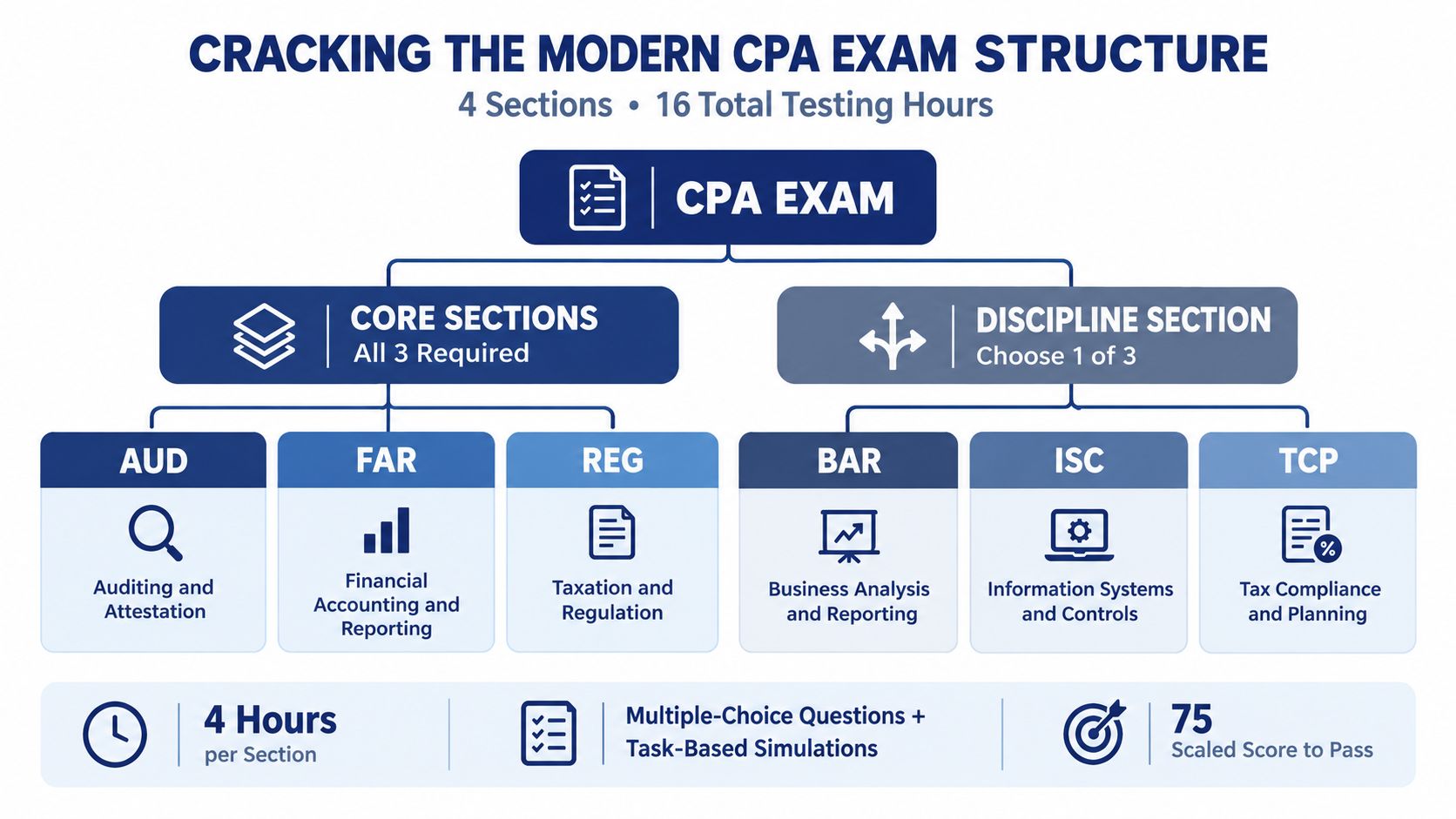
Under standard NASBA candidate guidance, you need a minimum score of 75 on each section and must complete all four sections within an 18-month period. Candidates may take the sections in any order. (NASBA's CPA Exam Candidate Guide details the current structure)
The Discipline choice isn't decorative. It lets you emphasize a professional direction, but it also creates a planning decision. A candidate drawn to systems, technology, and controls may find ISC more aligned with existing work. Someone focused on tax work may prefer TCP, while BAR may suit a candidate whose role leans toward reporting and analysis.
Don't choose based on whichever acronym looks friendliest. Choose the option that matches your strongest academic base and the work you want to perform after qualification. The exam already asks you to prove broad competence through AUD, FAR, and REG. The Discipline section is your chance to add a credible specialization rather than create a fourth unrelated mountain.
Passing every section demonstrates exam completion. It doesn't independently prove that you hold a state license, that your experience qualifies, or that your education satisfies the final licensing route. State boards separately determine eligibility to sit, including education, residency, and documentation rules.
That distinction saves candidates from a costly assumption: the exam is standardized, but the path around it isn't. Study for the national exam with discipline. Handle the state paperwork with equal seriousness.
The 150-hour rule isn't universal, and treating it as universal is lazy advice. The candidate's selected U.S. jurisdiction controls the pathway, which means two people with identical degrees may face different education and experience requirements.
Recent model-law changes recognize a third route built around a bachelor's degree with an accounting concentration, 120 credit hours, a passed CPA Exam, and two years of qualifying experience. Maryland recognizes an alternative route based on a 120-credit bachelor's degree, exam passage, and two years, or 4,000 hours, of relevant professional experience. Tennessee made a comparable “Less is More” pathway effective January 1, 2026. (AICPA describes the newer pathway developments)
That doesn't mean every candidate should shop for the lowest education threshold. The right jurisdiction depends on where you plan to work, whether your credits fit its subject requirements, whether your supervisor qualifies, and whether the board accepts your evidence.
| State | Education Requirement | Experience Requirement |
|---|---|---|
| Maryland | 120-credit bachelor's degree under the alternative route | Two years or 4,000 hours of relevant professional experience |
| Tennessee | Comparable 120-credit bachelor's degree route effective January 1, 2026 | Two years of qualifying experience under the applicable pathway |
| Traditional model | 150 semester hours, typically a bachelor's degree plus additional coursework | Commonly one year of supervised professional experience |
Use the CPA requirements by state guide as a starting point, then confirm the current rule directly with the selected board. A guide can help you spot the right questions. It can't replace the board's decision.
Start with education. Count total credits, then separate accounting and business credits. A transcript with enough total hours can still fail a subject-specific review.
Next, identify the target jurisdiction. Don't choose a state solely because it lets you sit earlier. Ask whether the final license will support your intended work and whether your experience can be verified there.
Then map experience evidence. Record employer, dates, duties, hours, supervisor license status, and the category of work. “I worked in accounting” is not evidence. It's a conversation starter.
Finally, check transition rules and timing. State pathways can change, and a candidate who assumes yesterday's 150-hour explanation still governs every route may either over-qualify or miss a legitimate alternative.
The experience requirement is where candidates get sloppy. They assume passing the exam and working in accounting will carry them through. It will not. State boards care about how the time was measured, what work you did, and whether a properly licensed CPA can verify it.
Texas makes the point clearly. Under Texas Pathway A, full-time experience means 12 calendar months of employment. Part-time experience can qualify at 2,000 hours completed over no more than two consecutive years, with at least 20 hours per week continuously (Texas board certification requirements). Those are not interchangeable labels. One route is measured by elapsed time. The other is measured by hours under a defined schedule.
Pennsylvania uses a different split. A candidate with a bachelor's degree and 150 semester credits needs at least 12 months and 1,600 hours of qualifying experience within the 60 months before applying. A candidate with fewer than 150 credits needs 24 months and 3,200 hours. The board also allows qualifying work across public practice, government, industry, academia, and functions such as advisory, tax, accounting, attest, compilation, or consulting, with verification rules tied to the reporting period and the supervising CPA's active license status (Pennsylvania State Board experience verification guidance).
That is the hidden hurdle.
A candidate can be eligible to sit for the exam and still fail the licensing stage because the experience record is weak, the supervisor cannot verify the work, or the hours were tracked badly. This is why the 150-hour conversation misleads people. Credits get attention. Documentation gets people licensed.
Build the file before you need it:
Pennsylvania's verification rule catches a lot of applicants. If the CPA who supervised the work cannot verify the relevant period, valid experience can become unusable.
The paperwork is part of the qualification. If the board cannot verify the experience, your recollection does not matter.
Keep contemporaneous records from day one. Hours, dates, duties, supervisor details. Candidates who wait until after the exam usually discover that memory is not evidence.
International and Latin American candidates can pursue the U.S. CPA pathway, but they don't get a separate, easier track. NASBA states that applicants outside the United States must meet the same eligibility and licensure requirements as U.S. counterparts, select a qualifying jurisdiction, apply through that jurisdiction's board or CPA Examination Services, and follow the required credential evaluation process. (NASBA outlines international exam eligibility)
The bottleneck is usually not motivation. It's document equivalency.
A candidate may hold strong accounting education and substantial professional training, yet still need to prove that the coursework matches the selected state's accounting and business-credit rules. Foreign education doesn't automatically satisfy those rules, and professional training completed solely through a Chartered Accountant-style program doesn't automatically count as academic credit toward the U.S. exam.

Hawaii requires an equivalency summary, credential analysis, course-by-course listing, and separate totals for accounting and business credits. Original evaluation materials must be sent directly to CPAES, and photocopies aren't accepted. (NASBA's international candidate guide explains foreign education documentation)
That sequence changes the sensible order of operations. Don't book an international testing appointment first and hope the transcript issue sorts itself out later. Choose the jurisdiction, identify the approved evaluation process, send the required documents, and wait for authorization.
Keep a clean file containing:
If you're also looking for flexible finance work while navigating the process, work-from-home CPA jobs can help you assess roles that fit your current credential stage. Just label yourself accurately. An accountant with foreign credentials, a U.S. exam candidate, and a U.S.-licensed CPA aren't interchangeable profiles.
The transcript cupboard can absolutely become the bottleneck. Handle it before the exam calendar.
Employers make one expensive mistake repeatedly: they treat “passed the exam” as shorthand for “licensed CPA.” It isn't. Texas, for example, may require either 120 or 150 semester hours depending on the pathway, at least 27 upper-level accounting hours, a three-semester-hour board-approved ethics course, a background investigation, work experience, and an exam on the Board's Rules of Professional Conduct. Texas also requires the relevant education to be completed within 36 months of passing all exam sections under the applicable certification rules. (Texas explains education and certification conditions)
Passing the exam is reaching the lobby before the paperwork marathon begins.
This is also where employers should avoid confusing adjacent credentials. A CPA, bookkeeper, accountant, and other finance professional can fill different operational needs, so a practical comparison such as CPA versus bookkeeper responsibilities is useful before writing the job description.
Credential screening works best when it resembles a hiring control, not a casual resume glance. The same discipline applies to other professional certifications, where candidates must distinguish eligibility, exam completion, and awarded certification. Benely's SHRM certification guide offers a useful parallel for understanding that distinction.
Recruiter rule: Ask for the board, the status, the evidence, and the date. If one is missing, keep the label conservative.
A candidate may be highly capable without being licensed. Hire for the work you need, but describe the credential you verified.
Start with the state, not the exam prep course. The jurisdiction determines your education credits, exam eligibility, experience rules, supervision requirements, and final documentation.
Then take these actions:
The best CPA candidates don't merely pass tests. They manage the administrative trail with the same care they bring to financial statements. That's how you avoid building a polished career plan on the wrong state rule.
HireAccountants helps companies find pre-vetted accountants and finance professionals, including candidates who can support bookkeeping, tax, audit, and broader finance work while CPA credentials are being verified. Visit HireAccountants to review talent options and connect your role requirements with finance professionals who fit them.
Let's simplify your finances today!