


Most businesses don't need to choose between a tax accountant and a CPA: use a tax accountant for routine compliance and reserve a CPA for IRS representation, audit authority, or attest work, with $1,000–$1,499 as a business-return pricing benchmark rather than a CPA-specific quote.
The popular advice is to hire a CPA and stop worrying. That's tidy advice for someone who doesn't have to approve the invoice. My recommendation is less glamorous: buy the capability your business needs, assign responsibility clearly, and stop treating every finance task like it requires the same professional.
A founder hires a CPA to reconcile bank transactions, organize receipts, prepare a return, and answer investor questions. Everything lands in the same engagement because having one person sounds simpler.
That's not necessarily a bad hire. It's a poorly designed workflow if the founder never separates routine execution from specialist judgment.
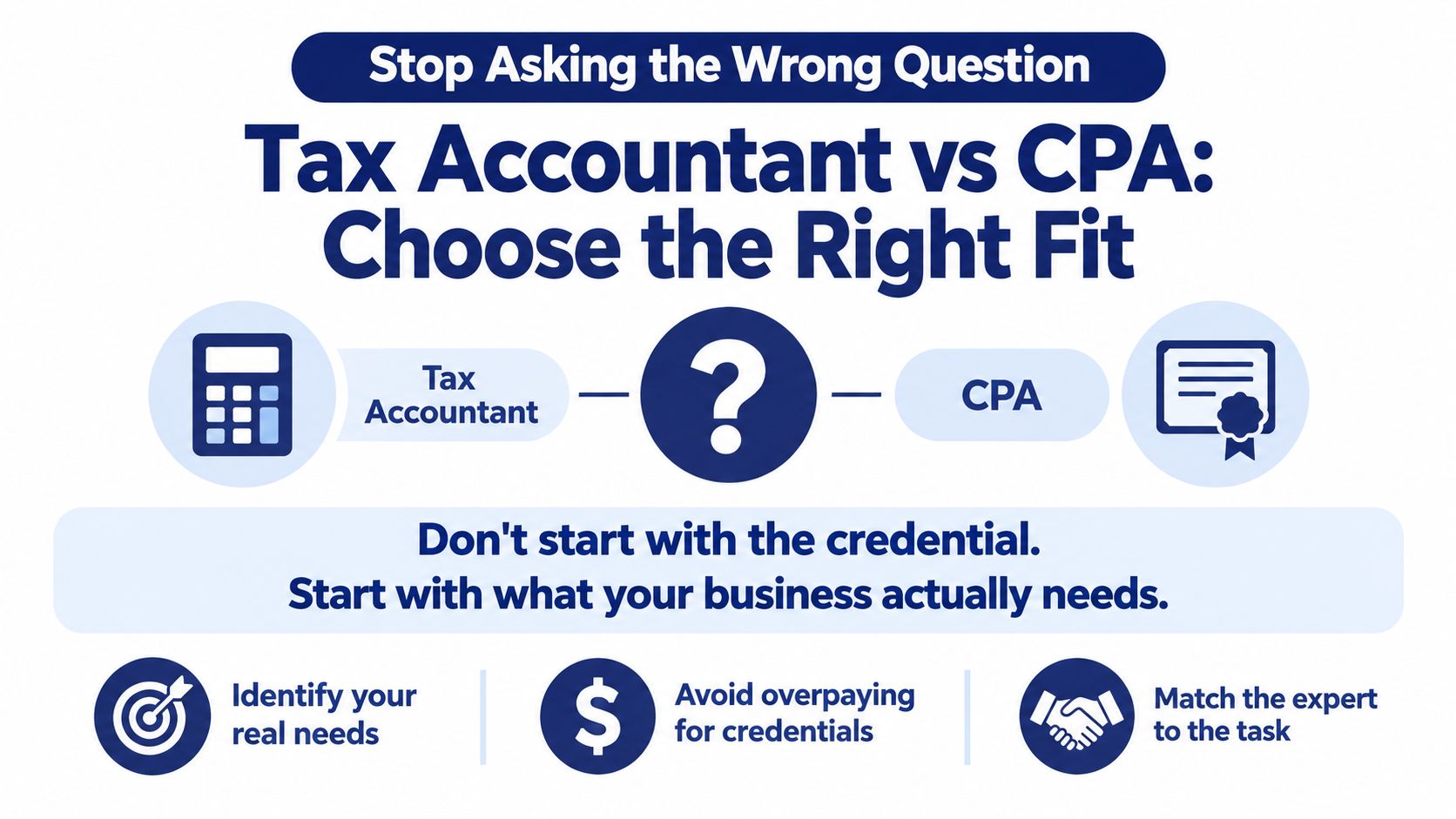
Tax accountant vs CPA is a staffing question before it's a credentials question. Start with the work sitting on your desk, not the letters sitting on someone's profile.
| Your immediate need | My starting recommendation |
|---|---|
| Recurring reconciliations and organized records | A bookkeeper or accountant |
| Routine tax compliance and return preparation | A vetted tax specialist |
| Formal financial-statement assurance | An appropriately licensed CPA |
| A disputed IRS matter | A professional with the required representation authority |
I'd separate the finance workload into execution, review, and escalation. Execution means maintaining records and completing established processes. Review means checking that the treatment and documentation make sense. Escalation means bringing in someone whose authority or expertise the situation requires.
Accountants belong to a broader occupational category than licensed CPAs, a distinction reflected in the Bureau of Labor Statistics' accountants and auditors overview. A job title tells you where someone works; a credential tells you something different about their qualifications.
A blended arrangement needs clear handoffs, not a group chat where everyone assumes someone else checked the numbers. Put the responsibilities in writing:
My hiring rule: Don't pay for authority you aren't using. Don't delegate authority your hire doesn't have.
The useful outcome is a hiring playbook, not a framed essay about credentials.
“Tax accountant” tells you the work someone does. Certified Public Accountant, or CPA, tells you they hold a state-issued professional license. Those labels can overlap: a CPA may specialize in tax, while a tax accountant may not be a CPA.
The Government Accountability Office's report on paid tax preparer oversight explains that paid preparers generally need an IRS Preparer Tax Identification Number, or PTIN, while CPAs hold state-issued licenses. The report says more than half of individual taxpayers used a paid preparer during fiscal year 2024. It also notes that most paid preparers were not subject to mandatory testing or education requirements.
A PTIN identifies a preparer. It doesn't prove industry expertise, familiarity with your filing jurisdictions, or authority to represent you in an IRS dispute.
So don't screen candidates with “Can you do our taxes?” Ask what filings they handle for businesses like yours, what records they need, and who reviews the work. You are hiring a workflow, not a pair of initials.

Use a specialist for recurring preparation when their experience fits your business. Bring in a CPA selectively when the work calls for that credential or a higher level of review. Before hiring, ask candidates to:
A capable specialist will state their boundaries plainly. If someone promises to handle everything, press for specifics before handing over access to your books. The title earns a conversation; relevant experience and a clear division of responsibilities earn the work.
A CPA license signals that its holder met formal education, examination, and experience requirements. It does not tell you whether that CPA has handled your company's tax work.
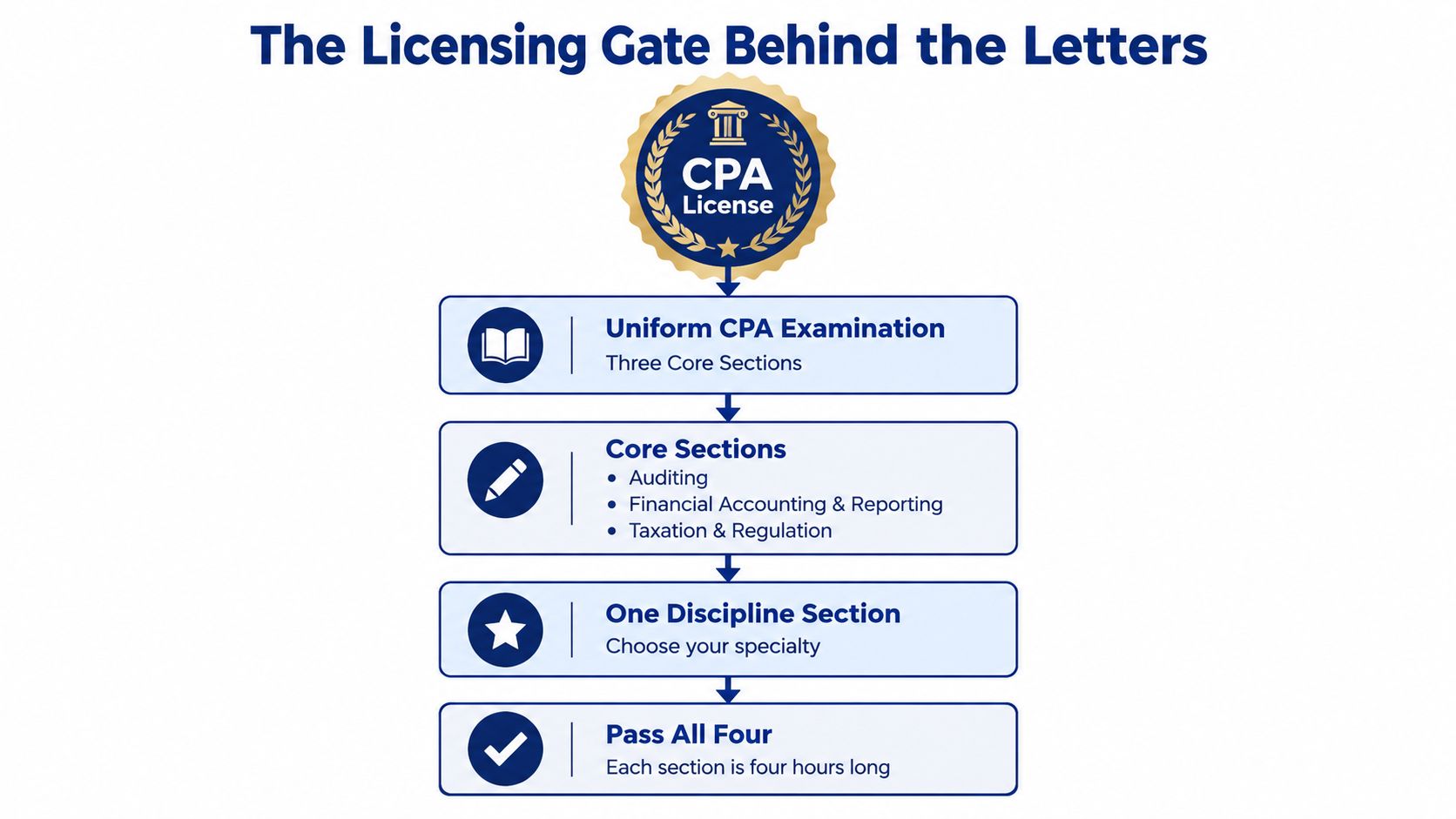
The AICPA's roadmap to the CPA examination and licensure describes an exam with three four-hour Core sections and one four-hour Discipline section, each requiring a minimum passing score of 75. Common licensing pathways include 150 college credit hours and approximately one year of qualifying experience. Requirements vary by jurisdiction, so check the rules where the candidate is licensed.
That credential is useful evidence of broad technical preparation. It is not proof of tax specialization. A CPA whose work centers on assurance may be a poor fit for recurring tax preparation, while a non-CPA specialist may know your filing workflow well but lack the authority required for another engagement.
Match the hire to the work. Use a tax specialist for repeatable preparation when their experience fits your business, then escalate specific assignments to a CPA when the credential or review is needed. For credential-dependent work, consult this guide to CPA requirements by state and verify the candidate's license with the relevant jurisdiction. Passing the exam alone does not establish that the candidate holds an active license for your engagement.
For a non-CPA tax accountant, assess the skills that support the workflow: relevant training, experience with your filing jurisdictions, and familiarity with the software and review process your records require. Ask how they handle questions outside their expertise and who they would involve.
Try a practical test: present an unresolved bookkeeping balance and ask how they would investigate it before preparing a return. A good answer should identify the supporting evidence they would check and the point at which they would escalate the issue. You are evaluating their judgment, not how quickly they can make a return appear complete.
Hire the credential when the engagement requires it. Hire the specialization when the workflow requires it. One person may bring both, but verify that fit rather than assuming it from the initials.
A tax return preparer and an IRS representative do different jobs. Choosing the person who files your return does not automatically give you someone authorized to handle a dispute.
The IRS explanation of tax preparer credentials and qualifications distinguishes unlimited representation rights, held by licensed CPAs, from the limits on uncredentialed preparers. Participation in the Annual Filing Season Program can provide limited representation rights for returns the preparer completed and signed, and only in specified IRS interactions.
Use this as a workflow decision, not a title contest. A non-CPA tax specialist can handle recurring preparation when their experience fits the work. Bring in a CPA or another credentialed professional for the specific task that requires their authority or expertise.
| Work you need done | Tax accountant | CPA |
|---|---|---|
| Prepare returns | Can prepare returns with appropriate competence and required preparer status | Can prepare returns with relevant tax expertise |
| Calculate liabilities and advise on compliance | Can advise within their expertise | Can advise within their expertise |
| Maintain books and supporting schedules | Can do this if the engagement includes it | Can do this, though the license alone is not a reason to hire for bookkeeping |
| Represent you before the IRS | Depends on additional credentials or limited program eligibility | Has unlimited representation rights |
| Handle audits, collections, and appeals | The job title alone does not grant this authority | Authorized to represent clients, including when they did not prepare the return |
| Provide formal audits, reviews, or attest services | The tax-accountant title does not establish authority to provide these services | A suitable route when the engagement requires licensed assurance services |
| Oversee complex financial reporting | Assess the person's demonstrated accounting expertise | A strong credential-based starting point, alongside relevant experience |
The right hire depends on the assignment. For recurring sales-tax compliance, prioritize experience in the relevant jurisdictions and a documented filing process. For quarterly estimates, choose a tax professional who can explain the assumptions and keep the supporting records organized.
For an IRS examination or appeal, put representation authority and dispute experience first. Enrolled agents and attorneys can also have unlimited IRS representation rights, so a CPA is not the only credential to consider for a tax dispute.
Filing a return and representing a taxpayer are separate responsibilities. Confirm who can do each before a problem arises.
Use the table to ask what someone is authorized and qualified to deliver. It does not mean every CPA is an auditor or every tax accountant excels at bookkeeping.
Set responsibilities in the engagement before work begins:
My recommendation: hire for defined deliverables, not a vague promise of accounting support. Let a specialist own repeatable tax work, then escalate only the assignments that call for a CPA or another authorized representative. The credential sets an important boundary; the engagement letter makes responsibility clear.
These are hypothetical hiring scenarios, not client case studies. They're useful because the hiring decision changes with the task, even when every founder starts with the same question.
A bootstrapped SaaS company needs reconciled books, organized subscription-related records, and an annual business return. Nobody has asked for formal assurance, and there's no active tax dispute.
I'd hire an accountant or bookkeeper for the recurring records, then engage a tax specialist for preparation and planning. The preparer should receive a reviewed package, not a folder of receipts named “final-final.”
The failure mode is hiring a CPA as a catch-all, then spending specialist time locating ordinary documentation. A CPA can still provide selective review when an accounting question exceeds the recurring team's competence.
The handoff: Reconciled balances, supporting schedules, unresolved questions, and an identified person responsible for answering them.
An e-commerce founder has messy marketplace records, questions about sales-tax filings, and incomplete contractor information. The immediate need is a specialist who can organize the compliance workflow and identify what remains unresolved.
I'd hire for demonstrated e-commerce tax experience, not just a CPA title. Have the candidate explain how they separate transaction cleanup, filing responsibilities, documentation, and technical questions that need escalation.
The failure mode is assuming a generalist will discover every obligation without being given a complete view of the business. Hand over the actual channels, jurisdictions, records, and existing filings so the professional can scope the job.
A startup receives an IRS notice requesting an examination of a prior return. The founder's first instinct is to forward it to whoever prepared the filing.
I'd appoint a qualified representative with examination experience and have the existing accounting team assemble the supporting records. The representation work and the evidence-gathering work should run alongside each other, with clear ownership.
Avoid the expensive detour: Don't replace a capable bookkeeping team just because a specialist engagement has appeared.
There's no defensible scenario-specific price quote without reviewing the scope. Use the service benchmarks below to start the budget conversation, then obtain separate quotes for cleanup, preparation, review, and representation.
The useful pricing comparison is between services, not between labels. A tax return, recurring bookkeeping, a financial-statement review, and an IRS examination aren't interchangeable purchases.
A 2025 survey of 219 US accounting professionals reported the most common business-return price range as $1,000–$1,499, while monthly bookkeeping and accounting most commonly fell at $250–$499, as summarized in UpCounsel's overview of corporate tax-return fees. These are reported price bands, not universal quotes or a verified CPA-versus-non-CPA rate comparison.
I wouldn't use those figures to promise your particular bill. I'd use them to ask why a quote includes, excludes, or bundles certain work.
Clean records can reduce the cleanup a professional needs to perform before preparing a return. That's a workflow argument, not a guaranteed savings percentage: someone still needs to review the tax treatment, resolve exceptions, and complete the engagement.
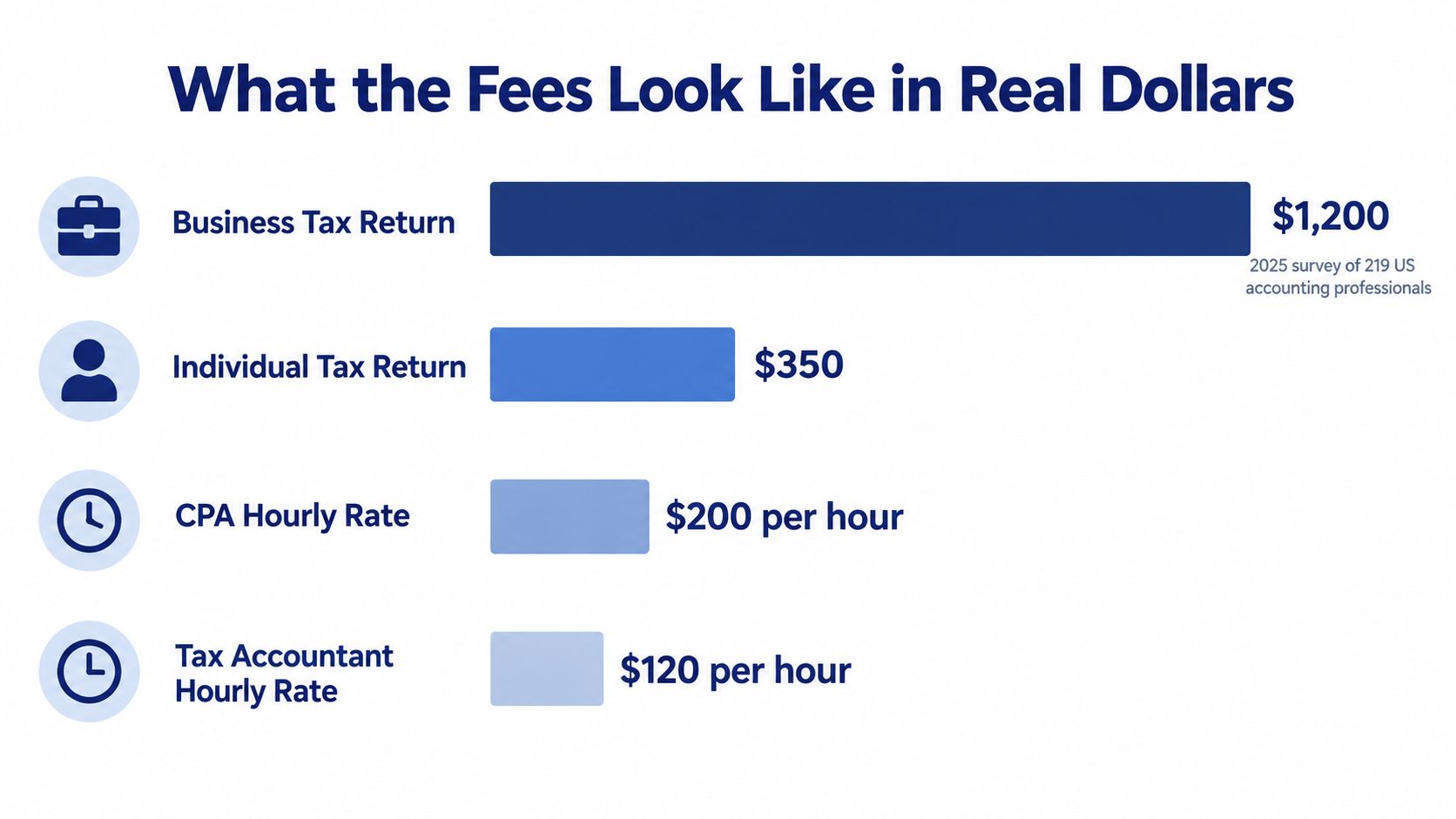
For budgeting, use the sourced service bands above rather than treating the illustration's individual-return or hourly-rate figures as established benchmarks. Your quote needs to reflect your actual workload.
Before approving it, ask for these distinctions:
Use this guide to the cost of hiring a CPA to prepare for the conversation, then insist on an engagement-specific proposal.
I'd pay for relevant CPA judgment when investor-facing financial reporting, a complex restructuring, or an active examination makes it valuable. I wouldn't automatically purchase that same level of involvement for routine record maintenance.
The goal isn't the cheapest accountant. It's a finance workflow that doesn't require your tax professional to become an expensive receipt detective.
An eligible representative still needs the right authorization. Credentials don't automatically appoint someone to act for your company.
The IRS Internal Revenue Manual's guidance on representation explains that taxpayers generally appoint a CPA, attorney, enrolled agent, or another authorized representative using Form 2848, Power of Attorney and Declaration of Representative. The authorization identifies the tax type, forms, and relevant periods; a properly represented taxpayer typically needn't attend an interview unless formally summoned.
Ask the proposed representative to explain exactly what they'll handle. Your preparer's prior involvement doesn't replace a scoped authorization or a new agreement covering the dispute.
Also review where correspondence will reach you. If you're relocating overseas, Cloud Residents provides a resource on how to change IRS mailing address abroad, a useful administrative issue to address separately from appointing a representative.
Don't make the founder the default coordinator of every document and deadline just because their name is on the notice. Assign an internal point person and keep the representative informed.
The cheapest time to clarify responsibility is before the notice arrives. That's not dramatic advice, but neither is searching your inbox for an engagement letter while a deadline approaches.
For a pre-revenue or bootstrapped business, start with reliable recurring accounting and a tax specialist. For a growing company, add CPA oversight where reporting complexity or assurance requirements justify it. For a dispute, hire the appropriate representative, not another generalist.
| Task | Hire this, not automatically the most credentialed person |
|---|---|
| Recurring bookkeeping | A vetted bookkeeper or accountant |
| Tax preparation | A specialist with relevant filing experience |
| Sales-tax workflow | A professional familiar with the applicable jurisdictions |
| Audits and formal assurance | An appropriately licensed CPA |
| Complex investor-facing financial reporting | An accountant with the necessary expertise and selective CPA oversight |
| IRS disputes | A CPA, enrolled agent, or attorney with relevant authority |
Use these questions to ask accountants to test scope, review procedures, and escalation boundaries. Require the candidate to explain how their work reaches the next professional without gaps or duplicate cleanup.
Buy execution consistently, buy specialist judgment deliberately, and keep ownership explicit. A properly scoped finance team deserves a small victory toast. Toot, toot.
HireAccountants offers a talent marketplace and recruiting support for US businesses seeking pre-vetted accountants and finance professionals. Bring a task-based role description, whether you need recurring bookkeeping, a tax specialist, or selective CPA support, and explore candidates against that scope. Verify the credentials and engagement authority your work requires before making the hire.
Let's simplify your finances today!