


The most common advice on accounting manager vs. finance manager gets the hiring question backward. Founders are told to compare titles, as if one role were the more senior version of the other. They're not rungs on one ladder. One role protects the reliability of your financial records; the other uses those records to help decide what the business should do next.
That distinction matters most when a company is growing and the books-to-forecast handoff starts getting messy. Hire for the capability your business lacks, not the title that looks impressive on an org chart.
The key question isn't which title is higher. It's whether your biggest problem is unreliable financial information or not knowing what to do with reliable information. Those are different problems, and hiring for the wrong one can leave you with polished forecasts built on shaky books, or immaculate reports that don't help leadership make a decision.

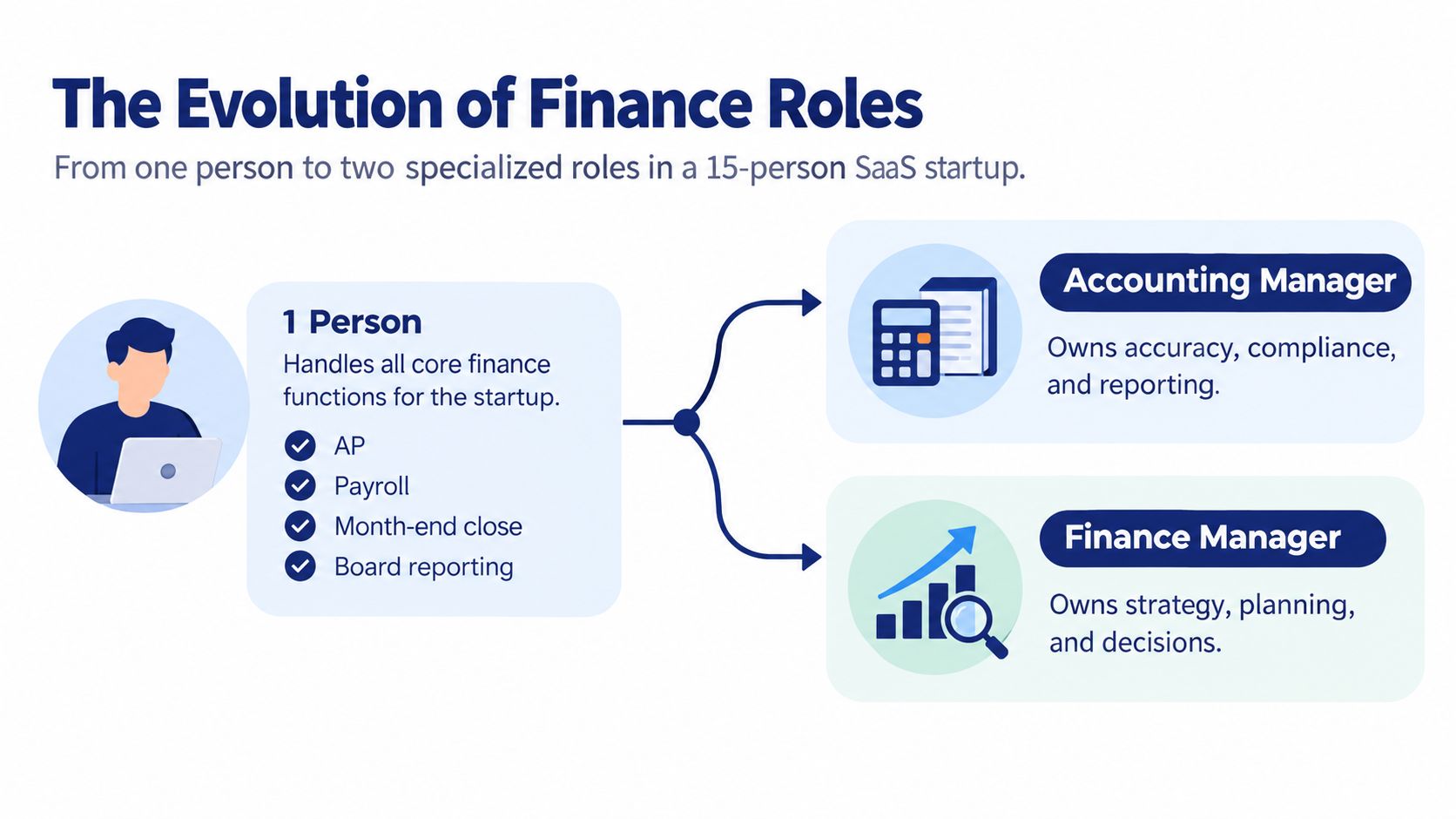
In a small company, one person may handle bookkeeping, close, cash management, budgets, and forecasting. That can work for a while. But as the business grows, somebody has to own the accounting engine room, while somebody has to turn its output into useful decisions. Sometimes that means hiring different people. Sometimes it means writing one job description that explicitly covers both capabilities.
The usual progression is from bookkeeping support to stronger accounting management, then to dedicated finance planning as the business's needs change. That isn't a rigid career ladder or a rule that every company needs to follow. It's a way to spot what's missing: transaction processing, control over the close, or forward-looking planning.
The hiring test: If you can't trust the balances, hire for accounting capability. If you trust the numbers but still can't make a sound cash, pricing, or hiring decision, hire for finance capability.
This framing is more useful than asking which role is more senior. A finance manager isn't automatically a better accounting manager, and an accounting manager isn't automatically ready to own forecasting. Titles vary; deliverables are harder to misunderstand.
Growth does not create new finance work. It splits the existing work in two.
Take a small SaaS startup. One finance-minded operator pays vendors, tracks payroll, reconciles accounts, closes the books, prepares the board deck, builds a cash forecast, and advises the founders on pricing. Lean, until it is not. The close slips, the board deck needs revisions, and the forecast is stale before the leadership meeting starts.
Nothing changed about the operator's skill. The workload divided into two jobs. Accounting needs someone to make transactions complete, correctly classified, reconciled, and reported. Finance needs someone to use that trusted history to assess cash needs, test plans, and guide decisions.
The divide has a long history. Luca Pacioli's Summa de Arithmetica, published in 1494, helped systematize double-entry bookkeeping. The American Association of Public Accountants was established in 1887, and the CPA title was formally recognized in 1896. That lineage explains accounting's durable focus on records, evidence, controls, and standardized reporting. McKinsey's discussion of changing finance demands reflects the broader modern finance remit, where finance teams shape planning and organizational goals rather than only recording transactions.
The U.S. Bureau of Labor Statistics describes financial managers as professionals who plan, direct, or coordinate financial activities, including accounting, investing, banking, insurance, and securities. The BLS reported 787,340 U.S. financial-manager jobs and a mean annual wage of $174,820 in May 2023 (BLS financial managers profile). Read those as occupational-category figures, not a direct salary comparison with accounting managers.
Here is the part founders get wrong. For a company under $20 million, the title on the org chart is the least useful signal in the hiring decision. One mandate looks backward at the integrity of the record; the other looks forward at capital allocation and performance. Write the job description around whichever mandate is missing, and let the title follow the deliverables.
An accounting manager owns the reliability of the company's accounting engine room. That means the general ledger, journal entries, reconciliations, accounts payable and receivable controls, close calendar, financial statements, and supporting records. The job isn't to make a spreadsheet look tidy. It's to make sure the numbers are complete, accurate, properly supported, and reported consistently.
A detailed accounting manager job description can help founders turn that scope into concrete hiring requirements. Look for demonstrated ownership of the chart of accounts, accruals, revenue recognition, intercompany activity, and a documented close checklist. A candidate who has only entered transactions may not be ready to lead the process or review other people's work.
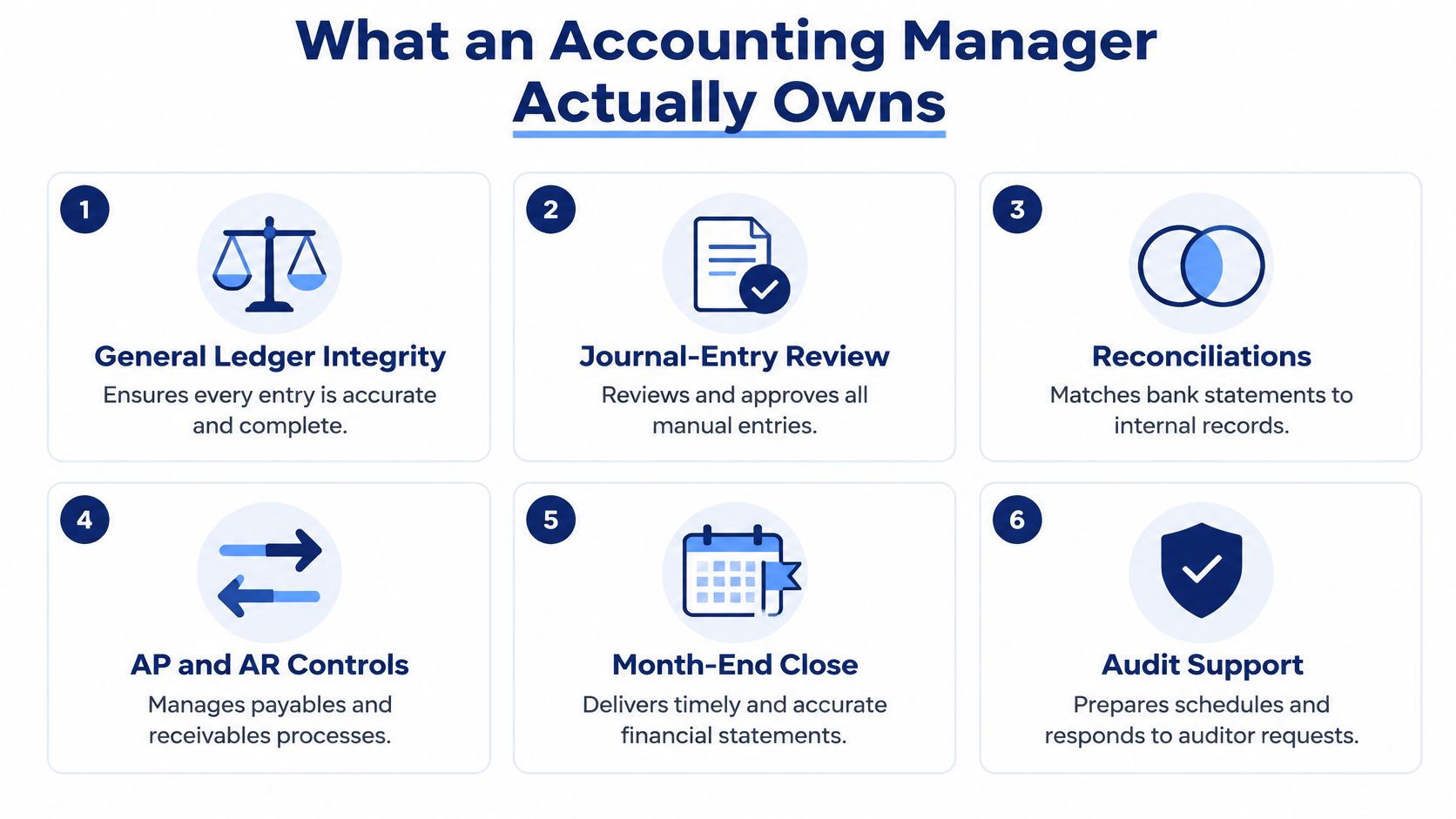
The useful scorecard is operational. Track close-cycle time, post-close adjustments, unreconciled balance-sheet items, how long reconciliations remain outstanding, audit adjustments, and on-time delivery of financial statements. These measures help answer whether the accounting function is becoming more dependable, rather than merely busier.
Ask candidates how they'd investigate an unexplained balance, document a reconciliation, or handle a manual journal entry that lacks support. Ask what they'd change if the same close issue keeps recurring. Strong answers should show a manager who can find root causes, maintain evidence, and improve the process, not just push the deadline harder.
Robert Half's accounting-manager role descriptions emphasize operational accounting, reconciliations, financial-statement preparation, close management, and adherence to accounting standards. Those are the foundations to test in an interview. For teams that want to reduce manual payables work, this overview of accounts payable automation benefits can help frame the process improvements an accounting manager might evaluate.
For a startup, success means clean, GAAP-consistent, audit-ready books. Don't measure this hire primarily on revenue growth or investment returns. If the books are unreliable, finance can't plan confidently on top of them.
A finance manager takes dependable accounting information and uses it to help the business make choices. That typically includes budgeting, forecasting, cash-flow planning, scenario analysis, working-capital decisions, management reporting, and financial guidance for executives or the board.
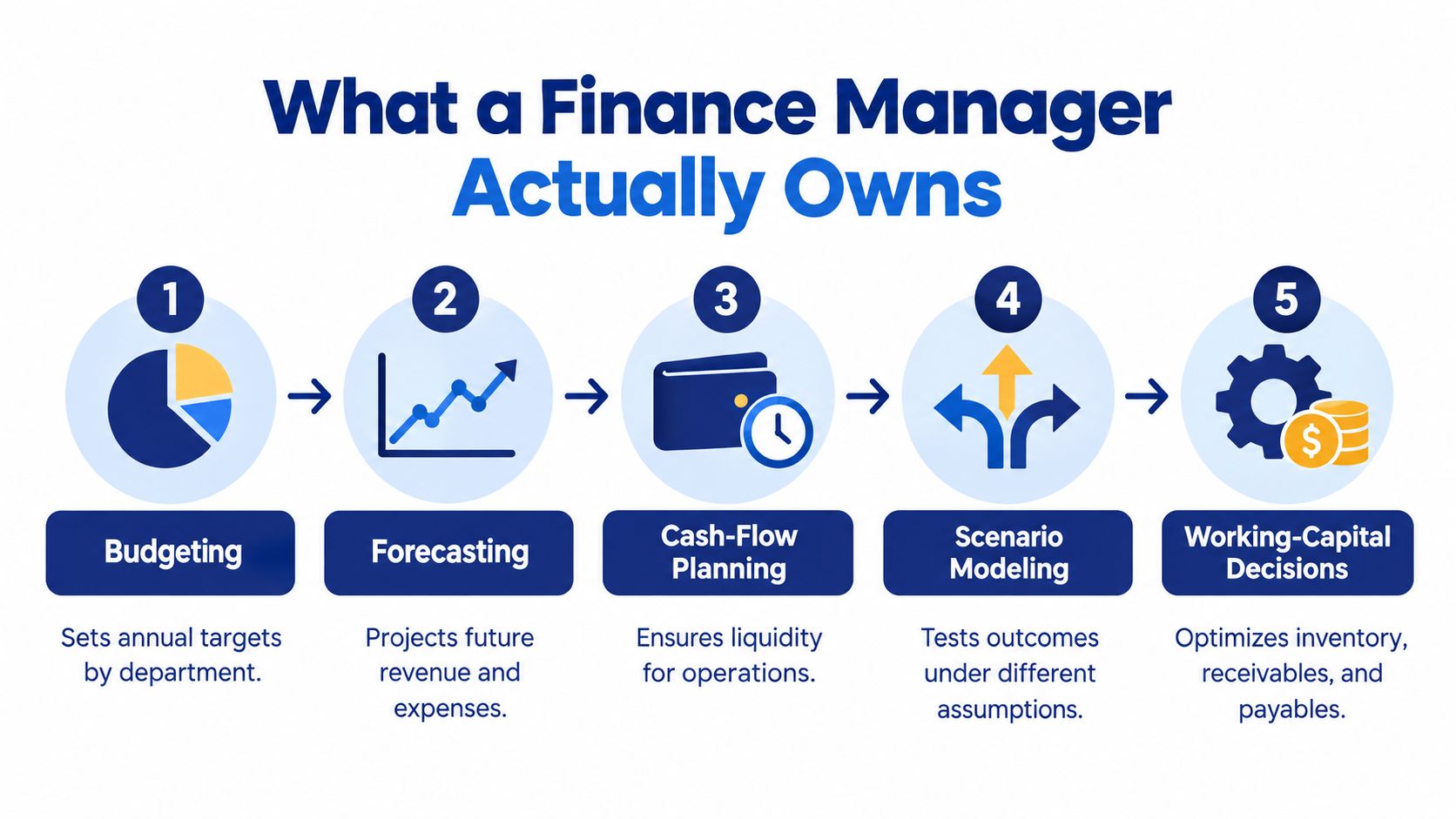
A finance manager's work should influence what leaders do. Should the company hire now or preserve cash? Does pricing cover the costs that matter? Can an e-commerce business afford to bring in more inventory? What happens to liquidity if sales miss plan? The role connects financial assumptions to operating choices, then makes those assumptions visible enough to challenge.
Measure forecast accuracy, cash-runway variance, the quality of budget-versus-actual explanations, scenario-model turnaround time, and working-capital improvement. These measures tell you whether leaders are getting useful answers, not just more spreadsheets. For a SaaS or e-commerce business, the job may involve testing hiring plans, pricing options, inventory decisions, margin pressure, and cash needs.
The BLS describes financial-manager duties that include preparing forecasts, reviewing costs, analyzing market trends, and helping executives make financial decisions. Its financial-manager occupational profile also describes developing plans for an organization's long-term financial goals. Those responsibilities make finance management broader than producing a forecast: the manager has to explain assumptions and help leadership use the results.
If reporting is slow or scattered, a discussion of automated financial reporting can help clarify where process improvements may free up time for analysis. For a useful overview of the planning discipline, see what financial planning and analysis involves.
Accounting tells leadership what happened and provides evidence for it. Finance argues about what should happen next.
A job title won't tell you whether a candidate can fix the close, build a credible forecast, or explain what leadership should do with the numbers. The deliverables will. Use this table to screen for them.
| Dimension | Accounting Manager | Finance Manager |
|---|---|---|
| Primary scope | General ledger, reconciliations, close, statements, and accounting controls | Budgeting, forecasting, cash planning, scenario analysis, and decision support |
| Time horizon | Historical activity and dependable reporting | Future performance, liquidity, and resource allocation |
| Core KPIs | Close-cycle time, post-close adjustments, unreconciled items, reconciliation aging, and audit adjustments | Forecast accuracy, cash-runway variance, budget explanations, model turnaround, and working capital |
| Typical placement | Accounting team, often under a controller or finance leader | Finance or FP&A, often partnering with executives and operating leaders |
| Strengths to screen for | Accounting standards, close ownership, reconciliation discipline, evidence, and controls | Modeling, planning, analysis, communication, and business judgment |
| Control relationship | Runs and documents accounting processes and checks | Uses reliable information to assess risk and guide decisions; shares responsibility for sound controls |
| Success looks like | Complete, accurate, timely, supportable records | Clear analysis that helps leaders choose and adjust a course of action |
| Compensation reference | Set pay against the scope of close ownership and controls responsibility, not against the financial-manager benchmark | BLS reported a mean annual wage of $174,820 for financial managers in May 2023, as noted earlier; it is an occupational benchmark, not a matched comparison |
The org-chart distinction is real, though it tells you less than founders expect. An accounting manager may report to a controller or run the accounting team. A finance manager may sit in FP&A or partner with operations. In a lean company, either one can end up reporting directly to you and owning work that spills across both columns, so hire against the rows that match your gaps rather than the label on the org chart.
After an accounting manager joins, expect a disciplined close, clean reconciliations, and fewer surprises in the financial statements. After a finance manager joins, leadership should see budgets, cash, and the financial consequences of operating choices with far more clarity. One raises confidence in the records. The other raises the quality of the decisions made on top of them.
On pay, treat that wage figure carefully. It describes financial managers as an occupational group, not a matched comparison across companies, seniority, or job descriptions, so don't use it as a shortcut for setting accounting-manager compensation. And if the person you need sits above both roles, financial executive recruiters can help you scope where an executive search differs from an operational hire.
My standing advice stays the same: don't pay for forecasting before anyone can trust the source data. That's modeling noise at a premium.
In smaller and midsize businesses, the neat line between accounting management and finance management often blurs. One person may own books, reporting, budgeting, cash, and planning, with a title chosen by whoever wrote the job post. Independent recruiting guidance on hiring a CFO for a smaller company notes that a single person can carry broad financial responsibility in smaller organizations, while a midsize company may have a wider finance team.
So ask what capability is missing right now.
Don't ask, “Which title is more senior?” Ask, “What must this person deliver that nobody can reliably deliver today?”
For a small company, a part-time accounting manager may be a better hire than a finance manager if the books need foundational work. The reverse is true when accounting is dependable but leadership lacks forward-looking analysis. The title is a label. The missing capability is the hiring decision.
There's no universal revenue threshold at which a company must split the roles. Choose the arrangement based on workload, control needs, and the decisions leaders need help making. This is a practical sequence, not a rigid rulebook.
If transactions are falling behind or the close is unreliable, begin with accounting support. That could mean a senior accountant or a part-time accounting manager, depending on how much review, process design, and team oversight the company needs. Don't hire someone to own FP&A if the immediate job is getting reconciled books and consistent reporting in place.
When the accounting foundation is reliable but founders still own every budget conversation and cash forecast, add finance capability. One workable arrangement is to have an accounting manager own close and controls while the founder, fractional CFO, or finance manager handles planning. As the workload grows, make the responsibilities explicit rather than adding them to someone's plate without clarity.
For a larger or more complex finance function, separate the roles. Give the accounting manager clear ownership of accounting operations and reporting, and give the finance manager clear ownership of planning, analysis, and decision support. A guide to accounting department organizational structure can help founders think through reporting lines and role boundaries.
Automation changes the work, but it doesn't remove the need for a person who can spot a bad output. A 2025 survey reported that 57% of finance leaders' teams were already using AI for tasks such as data entry, reconciliations, and forecasting, while 4.6% identified AI or machine-learning expertise as the single most important skill when building finance teams (CFO survey coverage).
Test how candidates handle exceptions, document assumptions, and protect data integrity. Ask an accounting candidate how they would validate automated journal postings and preserve audit-ready evidence. Ask a finance candidate how they would check model assumptions, explain uncertainty, and communicate a decision risk. Tool fluency helps; sound judgment is what keeps automation from making a bad process faster.
Remote and part-time arrangements can work when ownership is clear. Spell out who approves payments, records transactions, performs reconciliations, and reviews the forecast. If you use a recruiting platform, compare the candidate's actual deliverables and experience with the role before getting dazzled by a title or a polished profile.
If you remember nothing else, remember this: hire for the missing capability, define deliverables in the job description, and don't pay for forecasts before you trust the books. Titles help organize teams. They don't substitute for clear ownership.
Can one person own both roles? Yes, especially in a lean company, provided the workload is realistic and responsibilities are explicit. As the business grows, separate ownership when the close and planning work start competing for the same person's attention.
Do internal controls change the answer? They can. The U.S. Government Accountability Office's internal-control guidance states that management has primary responsibility for establishing adequate internal-control systems. Covered public companies must annually assess internal control over financial reporting under the Sarbanes-Oxley framework. Don't assign one person every incompatible step and call it efficiency.
How do you spot a real accounting manager? Ask how they manage close, investigate unreconciled balances, review journal entries, and document controls. A polished bookkeeper may record transactions well; an accounting manager must also own the process and its reliability.
HireAccountants connects US companies with pre-vetted bookkeeping, accounting, and finance professionals through a marketplace and recruiting support. If you've identified the missing capability but don't want to spend your afternoons fact-checking resumes, browse candidates at HireAccountants.
Let's simplify your finances today!