


The popular advice is tidy and wrong. Buy a paperless stack, hire one cheap bookkeeper, and the back office financial mess supposedly fixes itself. I have watched that movie. The dashboard looked healthy. The bank did not. A 12-day-old Stripe payout got waved off as a rounding error while payroll sat two days out.
Software did not cause that. A missing review did. Faster tools just moved the bad batch down the line.
You know the scene. Tuesday morning, the SaaS dashboard says the month is fine. The operating account disagrees by a number big enough to ruin lunch. Someone opens a processor report, squints, and calls a stale payout a timing difference. It might be. It also might be a refund batch nobody booked, a vendor draft that cleared twice, or revenue that was recognized before the cash had any intention of arriving.
That is the failure mode paperless marketing skips. Nearly two-thirds of surveyed SMB financial decision-makers said they could not access current cash positions across their accounts, even as 90% expected to become fully paperless within five years, according to CFO reporting on SMB finance leaders. A paperless ledger is not a reliable ledger. It is a faster filing cabinet.
Automation is useful when the input is boring and the rule is stable. It is dangerous when nobody owns the exception. An AI categorization that files a contractor payment as software, every month, will not confess. It will just make the P&L look clever until a lender asks for the tie-out.
I am not anti-software. I am anti the story that a tool, or one underpriced bookkeeper working nights, creates trustworthy cash. If the same person creates the vendor, codes the bill, and releases the payment, you did not build a back office financial system. You built a single point of failure with a login.
A current number you cannot explain is not a current number. It is a rumor with a decimal.
If you run a 5 to 50 person company, the work worth doing is narrower than a software tour.
I will be biased later. Neutral tours of logos waste a founder's afternoon. If you already need judgment above the books, a separate conversation about fractional CFO services for growing businesses is often the right layer. It does not replace the daily tie-out. It tells you whether the tie-out is worth showing a lender.
Treat the back office as one kitchen, not five dictionary entries. Software is the prep line. It chops, labels, and moves ingredients fast. The accountant tastes the sauce and stops a bad batch. You still own the menu. If the books cannot support a hiring decision, a vendor term, or a payroll date, the menu is fiction.
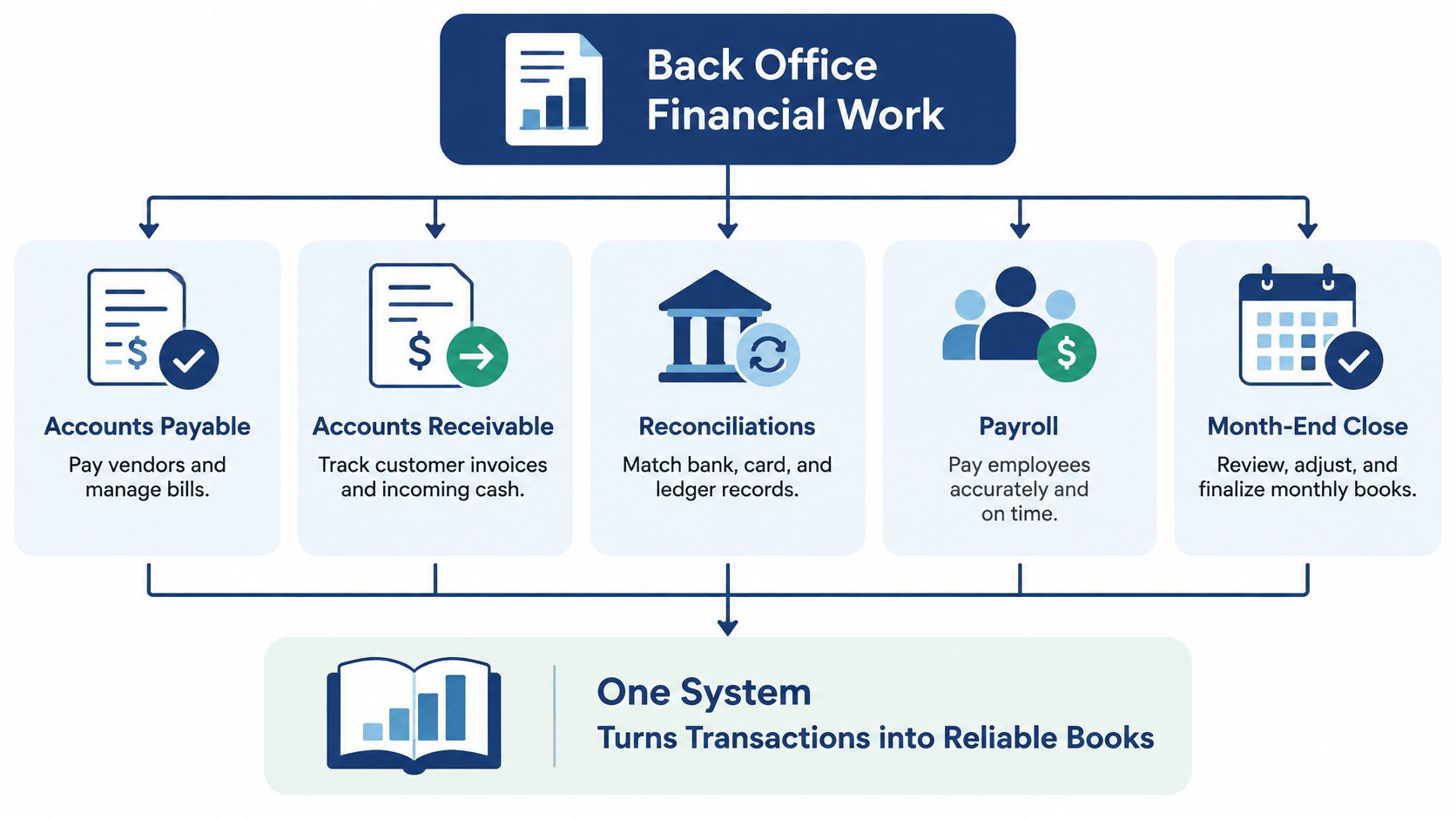
Accounts payable decides who gets paid, on which terms, and whether the vendor master can be abused. A clean AP file stops duplicate bills, mystery ACH drafts, and the classic trick where a "new banking detail" email reroutes a real supplier. The decision it protects is simple. Did we owe this, to this party, at this amount?
Accounts receivable decides whether revenue is collectible and whether cash timing is real. An invoice is not cash. A usage spike is not cash. AR protects the ugly question founders avoid. Who is late, why, and what does that do to next Thursday?
Reconciliations are the taste test. The subledger, the bank, the card, and the general ledger each tell a story. They are allowed to disagree for a day. They are not allowed to disagree for a month. Payouts, refunds, and that Stripe batch either become facts or stay folklore.
Payroll is a people promise and a fraud surface at the same time. Miss it and you break trust. Let one person change a bank account and release the file, and you have built a theft lane. Accuracy and separation matter more than a prettier portal.
Month-end close is the moment those stations have to agree. Adjustments, cutoffs, and a short narrative turn transactions into a decision. If close is "whenever someone has a Sunday," you do not have a close. You have a scramble.
The clerical army that used to key every line is shrinking, and that is not a tragedy if you redesign the job. The Bureau of Labor Statistics occupational outlook for bookkeeping, accounting, and auditing clerks reported about 1,532,400 jobs in 2025. It projects employment to decline 6% by 2035, about 85,600 fewer jobs, to 1,446,800, because software eats routine entry. The same outlook still expects roughly 144,100 openings a year, mostly to replace people who leave.
Read that as a hybrid, not a eulogy. Software should take repetitive capture. Skilled people should own exceptions, controls, and interpretation. A founder who wants a cheaper keypuncher is shopping for a job the market is already retiring.
| Station | Software should | A person must |
|---|---|---|
| AP and AR | Capture, match, remind | Judge exceptions and chase what software cannot |
| Reconciliations | Suggest matches | Explain breaks and sign the tie-out |
| Payroll and close | Assemble files and checklists | Review cutoff, fraud risk, and the story |
If your "accountant" never tastes the sauce, you hired prep. Prep is fine. It is not the whole kitchen.
The leak rarely looks like a department chart. It looks like a Tuesday. Bills sit in a shared inbox because the only person who understands the exception is on a sales call. A customer aging report is three weeks old, so nobody chases the invoice that would have covered rent. Payroll and vendor setup live with the same login that releases payments. Close starts Friday night and ends when someone gives up.
Small firms are not imagining the squeeze. In the Federal Reserve's Small Business Credit Survey series, 94% of firms with fewer than 500 employees reported at least one financial challenge in the 2025 data, matching 94% in 2024, after 93% in 2023 and 85% in 2021. Separate 2024 findings in that same survey pattern said rising costs of goods, services, or wages were cited by 75% of employer firms, 56% struggled with paying operating expenses, and 51% had uneven cash flow.
Those are operating problems, not tax-season hobbies. If you cannot see cash, you cannot tell a cost spike from a collections failure. Accounting support here is survival infrastructure.
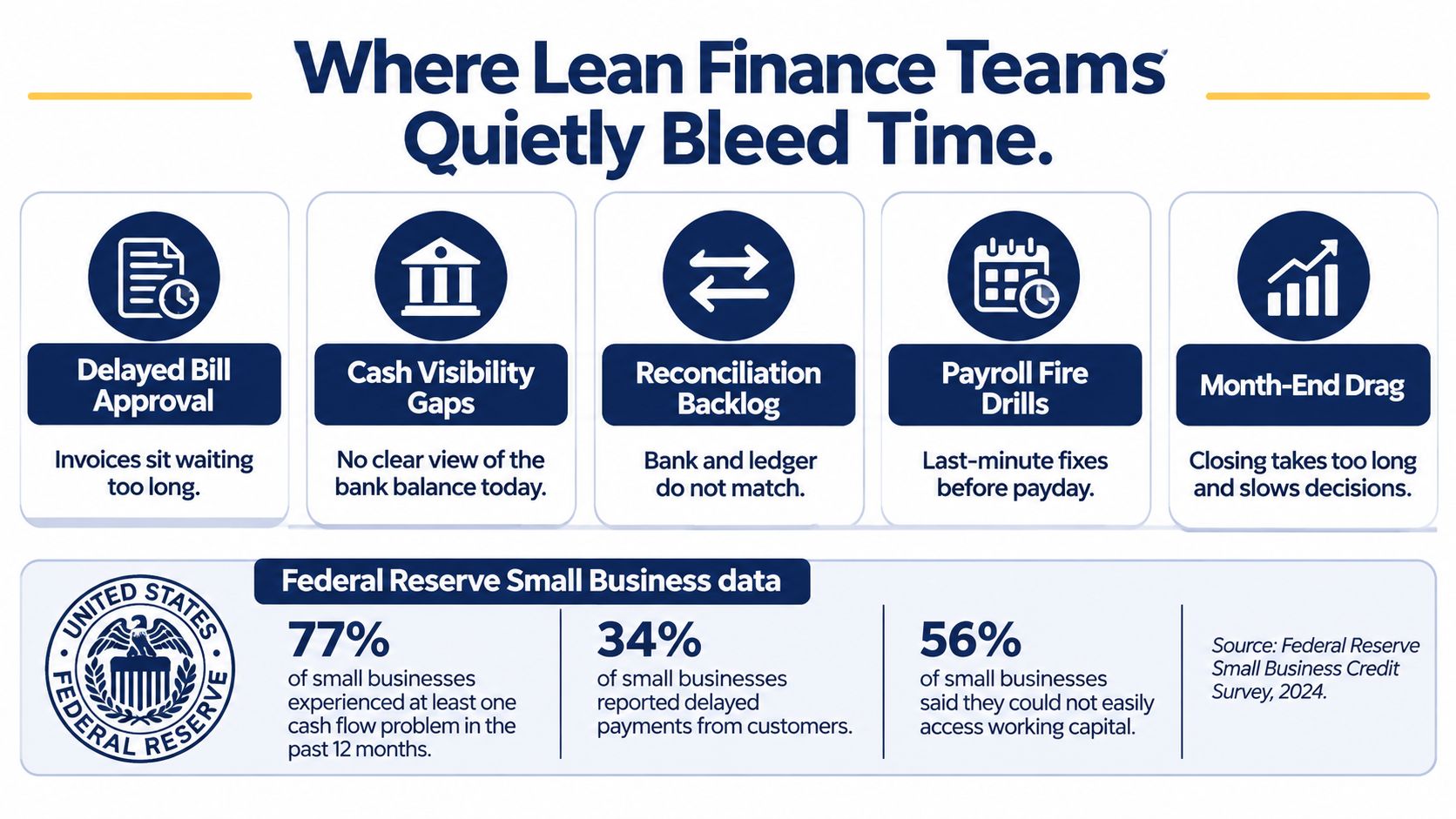
Invoices wait on a hero. Average shops do not have an exception owner. They have a founder who "will get to AP." Missing POs, tax mismatches, and duplicate PDFs pile up. The bill is not hard. The ownership is missing.
Receivables age without a calendar. Someone sends the invoice and hopes. Hope is not a dunning schedule. Cash timing goes uneven, then payroll becomes a negotiation with the bank.
One login does too many jobs. The person who adds a vendor also approves the payment. That is convenient until it is a fraud, or until an auditor asks a question you cannot answer without blushing.
Close becomes archaeology. You are not reviewing the month. You are reconstructing it from Slack, a processor export, and a spreadsheet named FINAL_v7.
Ask these before you buy another tool.
Do not redesign the whole workflow in the same breath. Name the leak first. The rhythm comes next, and it only works if these three answers stop being embarrassing.
A remote close does not get reliable because the team moves its spreadsheets online. It gets reliable when people own the exceptions and managers can trust the numbers without rebuilding them.
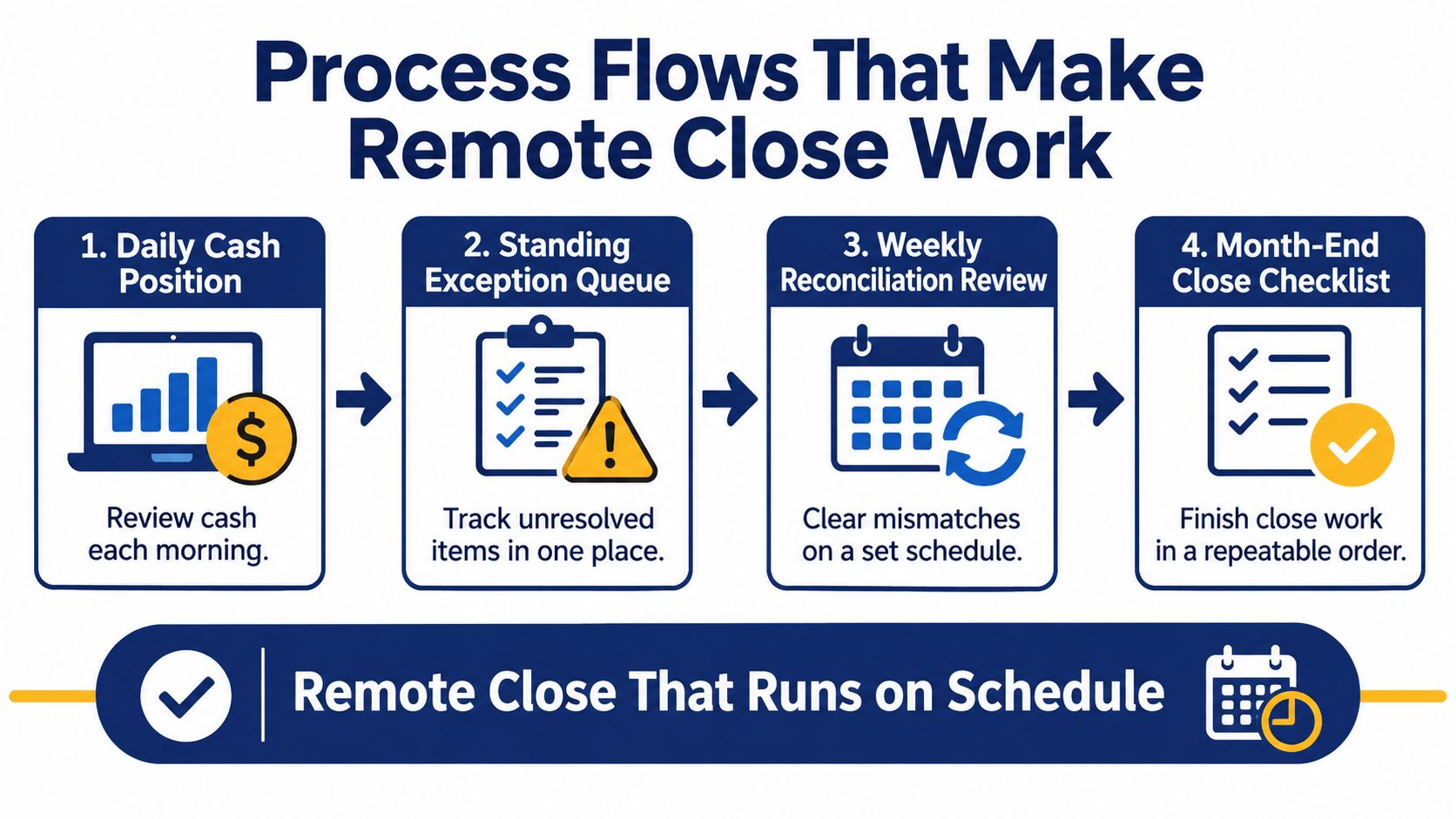
Daily cash position. A preparer matches bank, card, and processor balances to the ledger each morning, then names every break. You review the result in five minutes. You should not have to reconstruct it.
One exception queue. Unmatched payouts, missing bills, duplicate vendors, and unusual payroll changes need a named owner and an age. Put every break there, with a next action. An exception hiding in email is an exception without an owner.
Weekly reconciliation review. Clear breaks or escalate them once a week. Leave them until month-end and you turn close into a rescue operation.
Monthly close with a named owner. The owner runs the checklist. A manager reviews the work, approves adjustments above a defined threshold, and signs off on the explanation of what changed. Remote work still needs visible accountability.
Software should handle repeatable preparation. A remote specialist should chase exceptions and document decisions. Management keeps approval rights. For the mechanics of capture, matching, and handoffs, use this guide to accounting process automation. Keep a person responsible for the breaks.
Deloitte's analysis of finance automation reports that best-in-class invoice processing costs about €2 to €3 per invoice and takes roughly three days. Other organizations spend about €10 to €15 and take more than two weeks. The gap comes from fewer manual touches: standard intake, automated capture, approval workflows, exception routing, and a maintained supplier master.
Track cost per invoice separately from elapsed days. Then sort exceptions by cause. Missing purchase orders, duplicate bills, tax mismatches, and payment-term disputes need different fixes. One blended “AP is slow” metric hides the problem.
Before increasing automation, baseline four measures:
Apply the same human-in-the-loop split to AR, payroll, and close. Software can draft a reminder, prepare a payroll file, or suggest a reconciliation. A person documents the follow-up, change, or break. Management releases funds and accepts the books.
Practical rule: Paying the wrong vendor faster is not efficiency. It is a control failure with better cycle time.
The preparer must not approve their own payment. The person who changes vendor details must not release the wire. Speed matters only when the right person still checks the decision.
The wrong finance hire can make a bad close look polished. Choose staffing by the work that needs doing, who reviews it, and where decisions must stay with management. A tidy ledger is not the goal. Current numbers a lender can trust are.
You, at 11 p.m. You can start immediately, and approvals stay with you. You also become the bottleneck: every exception competes with customer work and sleep. Founder-run books fit a low transaction count. Once payroll, investor requests, and vendor bills collide, the “free” option starts charging in lost attention.
A local full-time hire. Hire locally when the role needs regular in-person work, policy ownership, or close coordination with the team. A full-time employee brings salary, benefits, tools, and management overhead. One person also means a coverage gap when they are away.
A traditional outsourced firm. This can work for a defined compliance package or year-end deliverables. It is a poor fit when you need visibility into open exceptions and the reasoning behind adjustments. If the work disappears into a portal and returns as a PDF, you have bought a result without enough control over the process.
A vetted remote specialist. This model can add capacity for preparation, reconciliations, and exception queues while management keeps review and approval authority. HireAccountants offers pre-vetted remote accountants for those tasks, full-time or part-time, in US time zones. Set the role around the work, then define who prepares, reviews, and approves. A clear accounting department organizational structure helps keep those responsibilities separate.
| Model | Best fit | Who approves | Cost shape |
|---|---|---|---|
| Founder at night | Pre-revenue or very low transaction volume | Founder, who also prepares the work | No new salary, but founder time |
| Local full-time hire | Work requiring an on-site finance lead | A separate manager, where possible | Salary, benefits, tools, and management time |
| Traditional firm | Defined compliance work with limited need for queue visibility | Management approves the output | Retainer, with less day-to-day visibility |
| Vetted remote specialist | Preparation, reconciliations, and exception evidence | Management retains review and approval | Hourly or monthly |
My recommendation: buy capacity for repeatable finance work, then keep judgment and sign-off close to the business. Do not hire a remote controller and disappear. Make the role accountable for current, supportable numbers, not just a clean-looking ledger.
A modern finance stack can still leave a founder guessing about cash. A 20-person ecommerce company might have Shopify, bill pay, payroll, and a polished general ledger, yet struggle to explain Wednesday's balance. The failure is usually in the handoffs: software records activity, while people must verify exceptions and keep the numbers current enough for a lender, owner, or board member to trust.
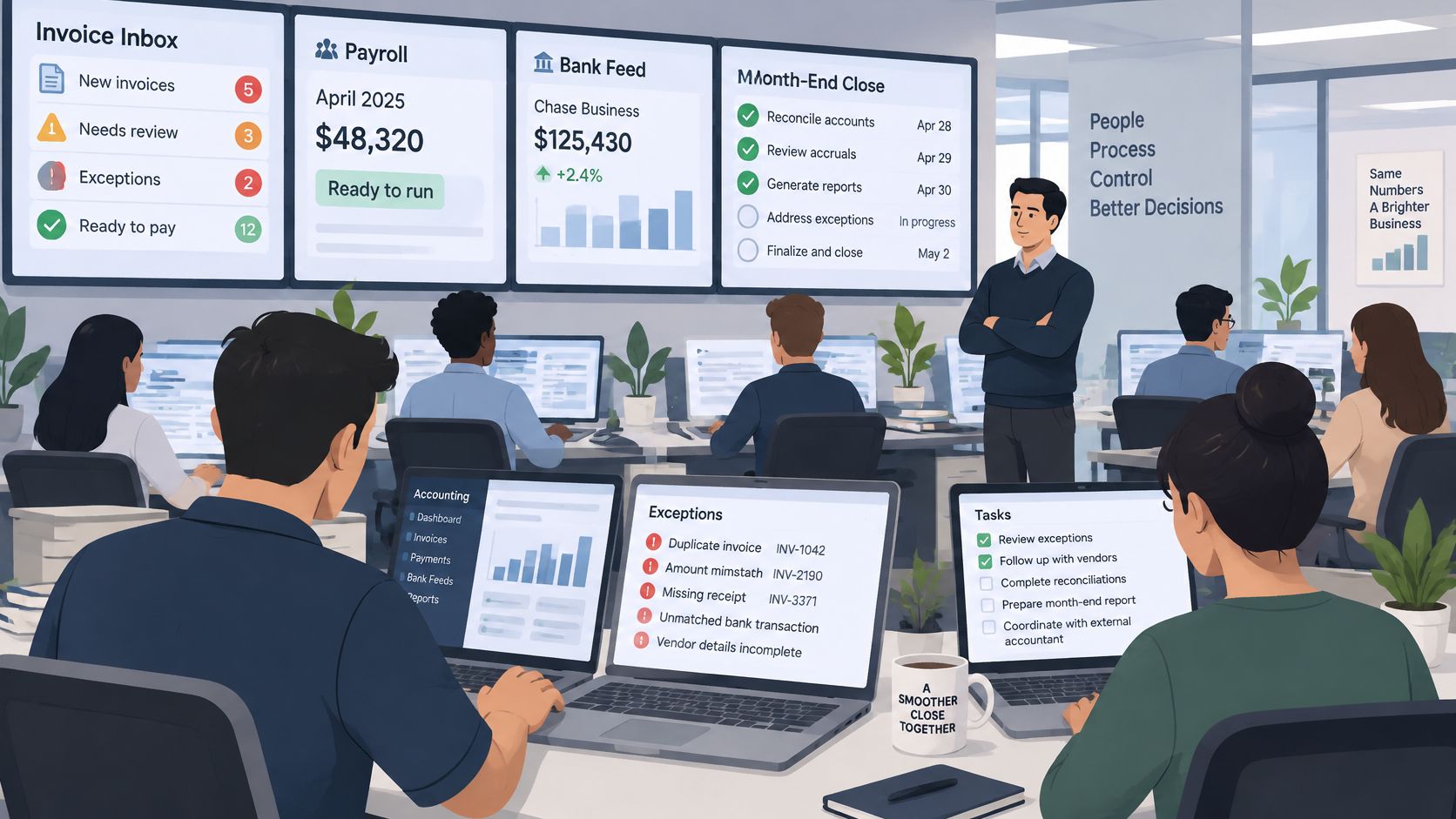
Give one person responsibility for the daily cash tie-out, vendor follow-up, and evidence behind reconciliations. That person records each break, attaches support, and flags anything unresolved after two days. The founder or finance lead reviews the numbers weekly and approves payments above a written threshold. A second person releases payments below it. The preparer never releases their own batch.
Keep the monthly close checklist short enough to use and specific enough to catch bad numbers:
The COSO Internal Control Integrated Framework offers a useful structure for controls. Its 2013 framework covers five components: control environment, risk assessment, control activities, information and communication, and monitoring. For a small company, the practical test is simpler: name the owner, keep the evidence, and check that the control works.
Start with four risks: unauthorized payments, cutoff errors, payroll fraud, and incomplete reconciliations. Assign a visible control to each.
Separate vendor creation from payment release. Put different people on those tasks. If staffing is tight, separate the steps and require another person's approval.
Write approval thresholds down. Specify what finance can release, what needs the founder, and what requires two approvers. Verbal limits disappear on a busy Friday.
Review the exception report. An unattended queue is decoration, not control.
Check access and preserve the audit trail. Record who can change vendors, payroll accounts, or ledger periods, then review those permissions on a schedule. This guide to financial controls for small businesses can help turn the rules into assigned responsibilities.
A specialist can gather evidence and flag problems. Management must review the work, decide what to escalate, and fix the underlying issue. Outsourcing the tasting does not outsource the menu.
Track error rate, close days, and whether you can confirm yesterday's cash without a scavenger hunt.
Those measures show whether the control system is keeping numbers current and trustworthy. If they stall, another dashboard is not the fix.
The fastest way to waste money is to buy another finance tool before you can name the cash problem it should fix. Pick one visible leak: stale cash numbers, invoices stuck for approval, or a close that misses its deadline. Start with the work that would change a decision this week.
Set a baseline, then check the same measure after 30 days. Track invoice approval time, the share of accounts reconciled on schedule, or whether you can state yesterday's cash without chasing six tabs and a group chat. If the measure stays flat, assign a named owner before changing software.
Give one person responsibility for exceptions and another authority to release money. One person can cover both roles in a small company, but the same person should not control the full path from flagging an issue to moving cash. If no one can own the exceptions, hire a remote accountant for a defined queue: bookkeeping, reconciliations, vendor follow-up, or a weekly cash tie-out. Do not hire a supposed finance leader to re-enter data your systems already capture. I learned that lesson the expensive way. The metaphorical ping-pong table did not enjoy it.
A payroll exception needs a timely response, so set working-hour expectations and name the approver before the queue starts. Full-time or part-time support can work; ownerless work cannot. Make the target plain: current books that a human has reviewed, with exceptions resolved or escalated.
Lenders, investors, and payroll all depend on numbers that are recent, reviewed, and supported by a clear audit trail. A paperless ledger can still be wrong. Measure one improvement, keep a human accountable for the exceptions, and hold off on the next tool until the numbers are trustworthy.
HireAccountants connects US startups and SMBs with pre-vetted remote accountants for bookkeeping, reconciliations, and exception follow-up, on full-time or part-time terms in US time zones. If a slipping close comes down to an ownerless queue, HireAccountants can help you assign a named owner before you shop for another tool.
Let's simplify your finances today!