


The popular advice is tidy and wrong. Outsource the books, buy your week back, stop living in QuickBooks. That pitch is how founders end up with a clean invoice and a ledger they cannot explain to a banker, a CPA, or themselves.
Outsourcing QuickBooks bookkeeping is a control decision. Treat it like a discount on data entry and you get exactly that: entries typed fast, questions answered slow, and approvals nobody remembers giving. You can hand off the recurring clicks. You cannot hand off the steering wheel and then act shocked when a journal entry moves cash you never approved.
A messy handoff usually shows up as shared logins, unexplained categories, and reports that look official until someone tries to trace them to the ledger. The fix is a hybrid, and it costs more than the cheapest quote. A remote bookkeeper runs the repetitive work while you, a controller, or a fractional CFO approve the weird stuff. Price the engagement on a completed close you can defend. Hours you cannot see are the wrong unit.
Send the recurring execution out. Keep the decisions that change the story of the business. Cheap categorization is a fading product. Software already eats a lot of it, and a bookkeeper who only types what the feed suggests is not a finance function.
The mess usually starts in the app pile, not the hourly rate. The 2025 Intuit Accountant Technology Survey found that firms use an average of eight applications for core operations. 44% cited subscription costs, 41% integration difficulties, 41% time-consuming data entry, and 33% staff-training burdens. Two-thirds felt overwhelmed by technology complexity at least weekly. In that same survey, 95% of accounting firms had adopted automation in the prior year, and 64% planned to invest in or upgrade AI over the next year.
Outsourcing into that stack without written rules doesn't shrink risk. It spreads it across QuickBooks, a bank feed, a sales-tax app, and a person who doesn't own any of them.
Paste this into the proposal. If a vendor wants a row flipped, make them say why in writing.
| Workstream | Who does the work | Control that stays inside |
|---|---|---|
| Transaction classification | Outsourced bookkeeper under written rules | Owner approves rule changes and reviews uncategorized or low-confidence items |
| Bank and credit-card reconciliation | Outsourced bookkeeper | Owner reviews every unexplained difference before the period locks |
| Accounts payable and receivable processing | Outsourced bookkeeper prepares | Owner approves payments, write-offs, and unusual terms |
| Payroll detail | Separate restricted role only if in scope | Default is no payroll visibility for the day-to-day bookkeeper |
| Month-end close package | Bookkeeper prepares reconciliations, exception log, and workpapers | Founder, controller, or fractional CFO approves and releases reports |
| Chart of accounts, policies, and app ownership | Internal owner | Bookkeeper may recommend mappings but cannot redesign the file alone |
| Unusual journal entries | Bookkeeper drafts with support | Named approver signs off before posting |
| Cash, tax, and pricing decisions | Internal leadership | Bookkeeper supplies clean data, not the decision |
Name the approver on day one. Founder is fine if the books are still small. A controller or fractional CFO is better once exceptions show up every week. That person owns rule changes, unusual journals, and the release of reports. The bookkeeper does not redesign the chart of accounts, does not own historical data, and does not see payroll unless a separate role needs it.
Practical rule: If a task moves cash, changes tax, or rewrites an account, it stays inside. Everything else can leave.
Skip the logo pageant. The only test that matters is whether this person can finish a close you would sign.
An April 2025 survey of more than 2,200 US small businesses found that 68% used AI regularly, up from 48% in July 2024, and bookkeeping was already an AI use case for 29%. Paying someone to retype what the feed already coded is a shrinking product. Pay for judgment on the leftovers: duplicate feeds, bad tax mappings, and the uncategorized pile nobody wants to open.
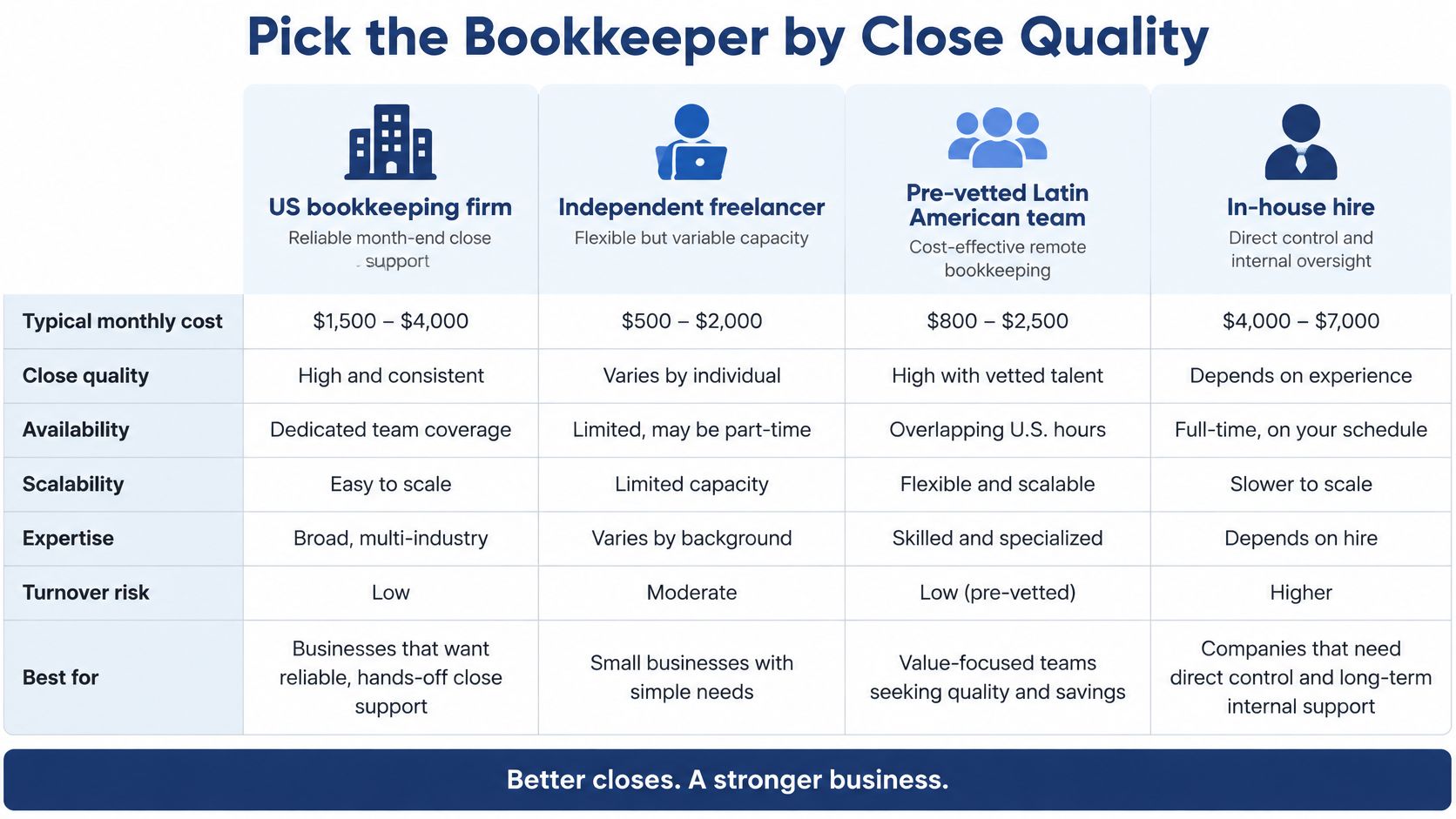
| Path | Cost signal | Time to start | Who owns the close | Best fit |
|---|---|---|---|---|
| US bookkeeping firm | Higher monthly retainer | Often a few weeks | Firm prepares, you still approve | You want a bench and a formal close package |
| Independent freelancer | Hourly, highly variable | Days to weeks | You manage the person daily | Simple books and you enjoy being the controller |
| Pre-vetted LatAm talent via HireAccountants | $1,100–$1,999/month for bookkeepers | Often about 24 hours | You keep approvals; they run the recurring work | Ongoing bookkeeping without a US salary |
| In-house bookkeeper | Salary, benefits, and recruiting time | Slow | Full internal control | Multi-entity complexity that needs someone in the business all day |
A US firm brings a process and a bench. It also brings a retainer and a slower hello. A freelancer can be excellent and still vanish the week your Amazon payouts go sideways. An in-house hire buys proximity and costs salary, benefits, and months of recruiting. For ongoing QuickBooks work, a pre-vetted remote bookkeeper is often the sane middle. HireAccountants screens English-fluent finance talent in Latin America on US hours, full-time or part-time, with complimentary HR, payroll, and compliance support. That's one path among four, not a personality cult.
Price the completed close, not the hours. Ask whether you're buying time, transactions, or a monthly package with a date, reconciliation coverage, an aging list of open items, a sampled error rate, and a response window. Interview on a real mess. Hand them a duplicate bank feed, a wrong sales-tax mapping, and a stack of uncategorized expenses. The winner explains who gets the exception and when. The loser recites a software slogan.
Hours are a terrible proxy for a close you can defend.
A contract that says "independent contractor" is not a magic wand. I've signed that sentence and still built an employee by accident.
The IRS classifies the worker from the whole relationship: behavioral control, financial control, and the type of relationship. Behavioral control is whether you direct what the person does and how. Financial control covers pay, reimbursements, and who supplies the tools. The relationship test looks at the contract, benefits, how permanent the seat is, and whether the work is a key part of the business.
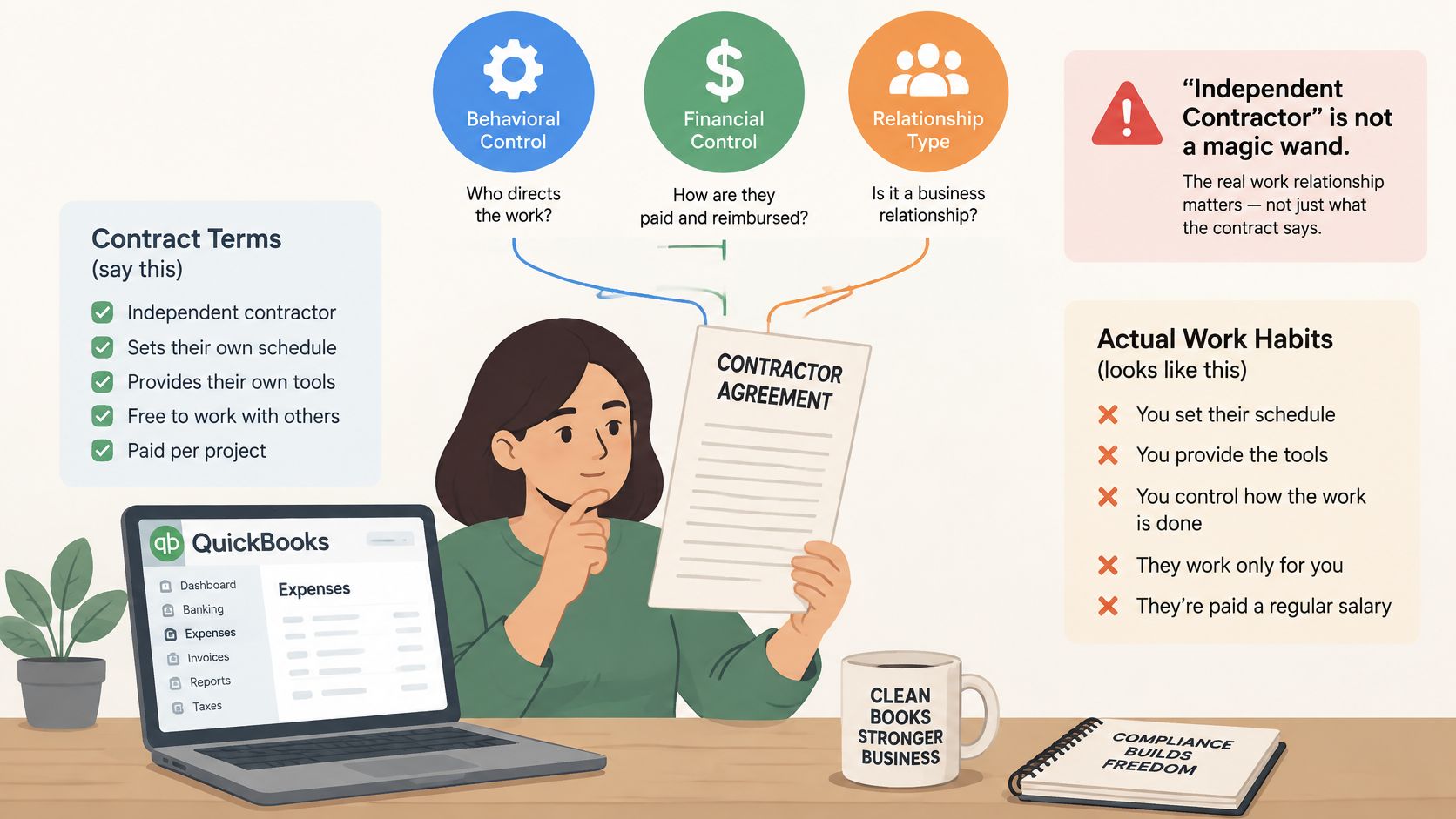
If you set the daily method, lock the hours, and keep an open-ended seat inside the company, you may be looking at an employee. Employees generally bring income-tax withholding, Social Security and Medicare withholding, the employer match, and unemployment tax. Independent contractors generally do not. When the facts are muddy, either side can file Form SS-8 and ask the IRS to decide. Do that before a payroll audit does it for you.
Watch for patterns that should stop the month, not get shrugged into next month's notes.
Duplicate feeds, stale sales-tax mappings, and recurring manual overrides sit in the same family. Fix the design. Narrow the role, put a named owner on every exception, or end the engagement. Do not add another shared login and hope next month behaves.
Do this before the first transaction. Not after a stranger has the admin login and a cheerful Slack message that says "all set."
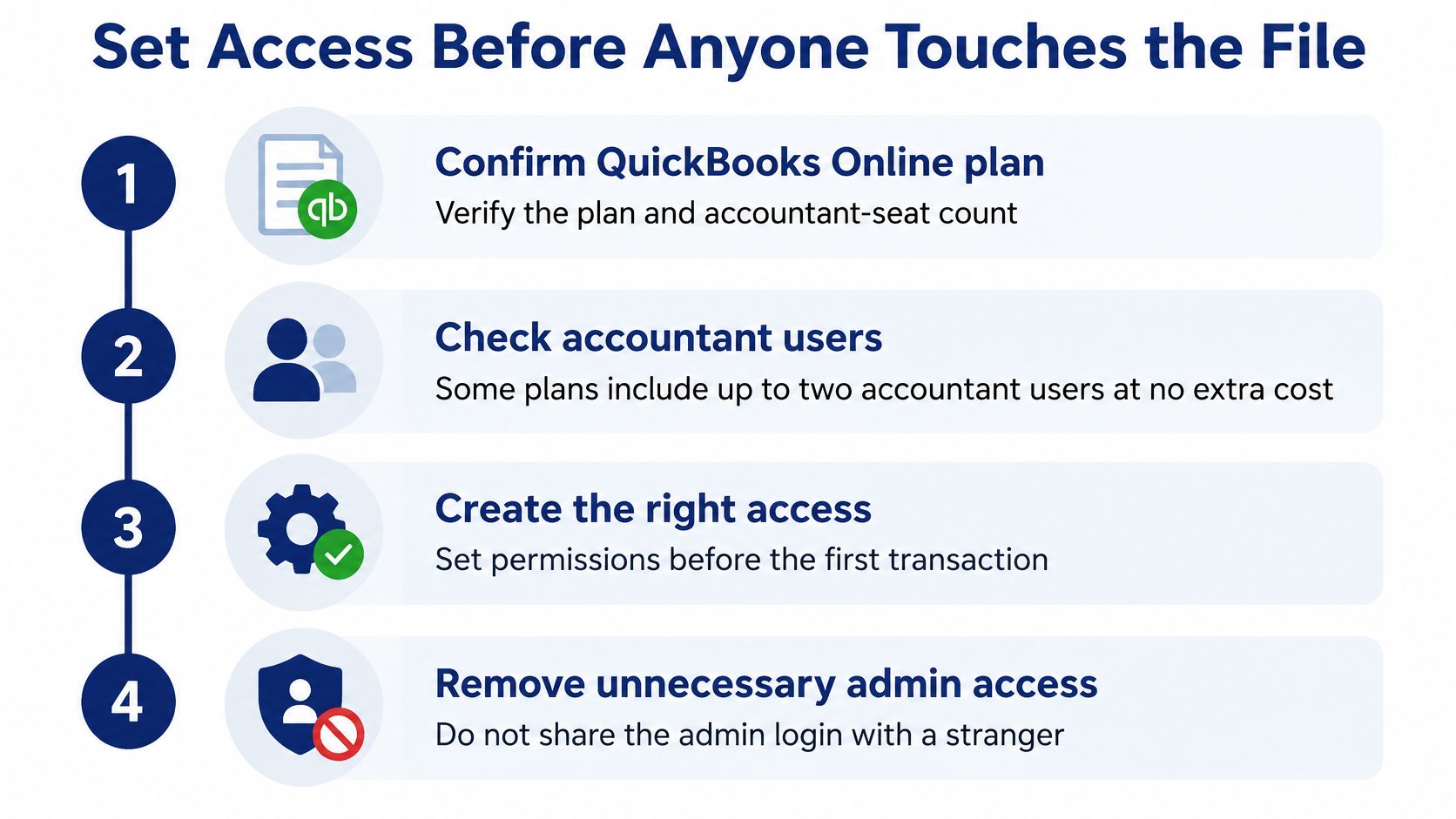
Intuit's role documentation is blunt about the mechanics. Accountant users can receive broad bookkeeping, account, and reporting capabilities. Non-billable roles may not have access to the audit log. QuickBooks Online supports up to two accountant users at no additional charge on some plans. QuickBooks Online Advanced supports up to three. A three-person firm plus your CPA can blow that allowance and invent a shared login. That workaround does not belong near the general ledger.
Pair this list with a short note on what financial controls actually look like so the approver and the bookkeeper are arguing about the same rules. You should finish with an invite ready to send and a written list of permissions you refused. Payroll is the usual refusal. Admin is the other one.
Access without a workflow is a logged-in stranger and a blank close. Build the rails before anyone codes a transaction.
Put three numbers on one page and have the bookkeeper and the approver both sign it. Close date. Exception response window. Sampled error rate. Unsigned targets are wishes. Signed targets are how you send a package back without a personality fight.
Run the same close every month. Charm is not a control.
Before the handoff, capture a baseline: days to close, unreconciled items, post-close journal entries, classification error rate in a sample, and exception response time. Write the targets into the agreement. QuickBooks' internal-controls guidance treats close quality, not transaction throughput, as the metric that matters, and it tells you to match reconciliation frequency to scale, volume, and account risk. Clerical failures keep showing up in the same costumes: transposition mistakes, missing substantiation, bad apportionment, calculation errors.
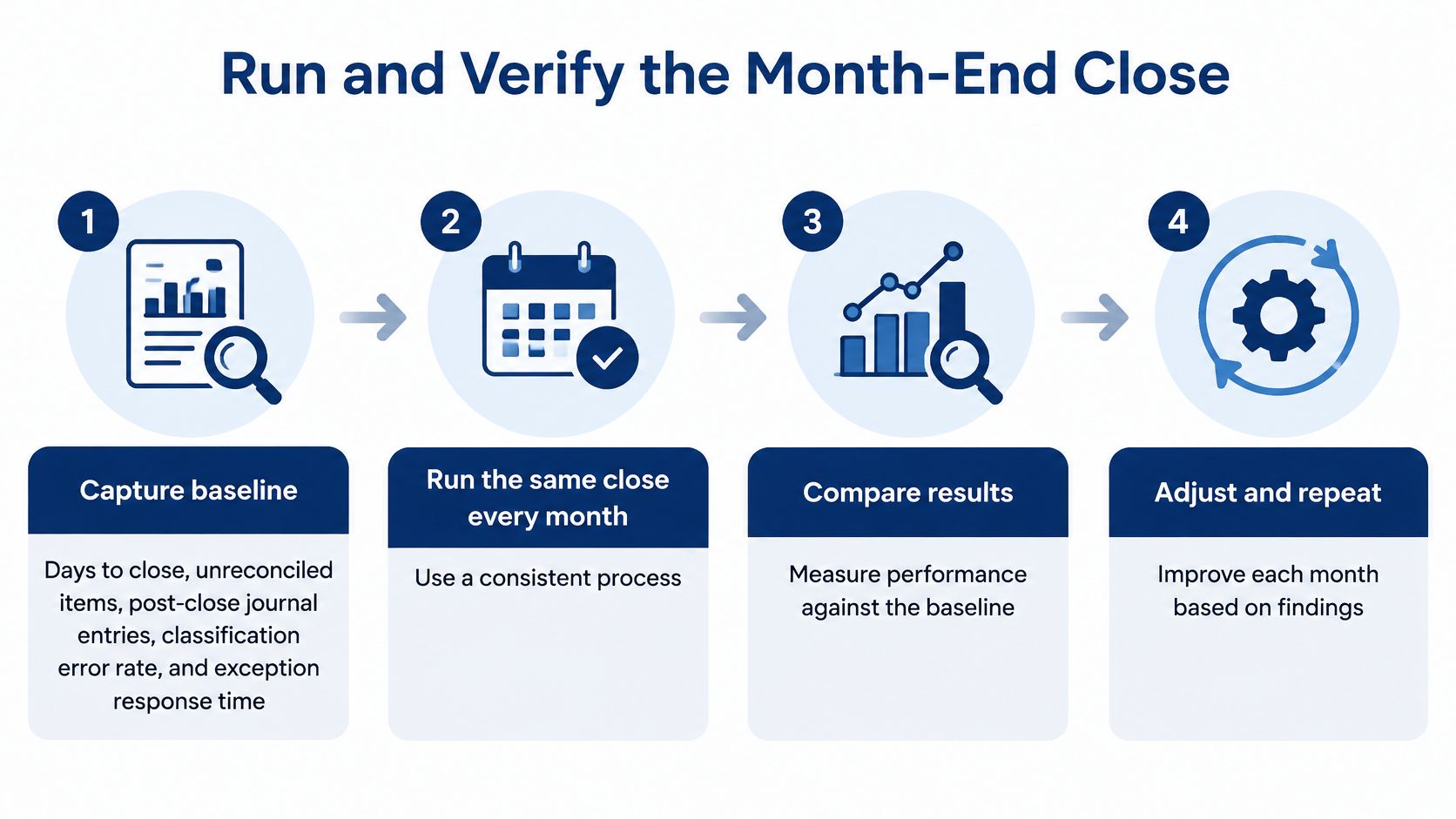
Release the books only when unexplained differences are zero, every material balance-sheet account is reconciled, and every exception has an owner. Then verify. Reperform a few reconciliations yourself. Trace a sample of transactions back to source documents. Open the QuickBooks Online audit log and filter by user, date, and event. Intuit's log tracks sign-ins, settings changes, and edits to customers, vendors, employees, and payroll submissions. It will not stop a bad category. It makes a silent edit hard to shrug off, which is the point when someone works remotely.
A fuller checklist of month-end close best practices belongs in the same folder as this agreement so the ritual doesn't live only in someone's head.
| Metric | Acceptance standard | Send it back when |
|---|---|---|
| Days to close | A date agreed before work starts | The package arrives after that date with no warning |
| Unreconciled items | Zero unexplained differences | Any difference nobody can explain |
| Balance-sheet coverage | 100 percent of material accounts reconciled | A material account is skipped or rolled forward |
| Post-close journal entries | Rare and pre-approved | Entries keep appearing after the period was called done |
| Classification error rate | A sampled rate you agreed to watch | The same miscodes show up month after month |
| Exception response time | A response window in the agreement | Open items age with no owner |
Escalate unexplained balance changes, recurring manual overrides, late reconciliations, and unsupported entries. Those are not normal operating noise. They are the month you don't release.
Do not migrate five years of chaos on a Monday. Pick last month. Run it as one scoped close.
Send the scope table, the permission list, and the close checklist to one person or one firm. Agree the acceptance bar in writing before they touch the file. Let them run that single month while you still know the numbers well enough to argue.
Measure the package against the bar. Close date. Unreconciled items. Balance-sheet coverage. An owner on every open item. Compare days to close and the error sample with the month you did yourself. If the package is late, unsupported, or full of mystery journals, stop. If it's clean, expand the scope and keep the same approver.
A pre-vetted bookkeeper can speed the pilot. HireAccountants matches US companies to screened, English-fluent finance talent, often within about a day, and it sits in the comparison above as one path among four. Keep the hybrid either way. They run the recurring QuickBooks work. You approve the weird stuff and read the audit log.
Toot, toot. The point was never to escape the books. It was to stop doing the boring parts badly.
HireAccountants connects US companies with pre-vetted, English-fluent bookkeepers in Latin America who already work in QuickBooks, reconciliations, AP and AR, and month-end close, often on US hours and without a full US salary. If you're ready to outsource the recurring work and keep the approvals, start with one scoped month instead of a five-year cleanup. Visit HireAccountants and match a bookkeeper you can test against a close you'd sign.
Let's simplify your finances today!