


The most popular advice about outsourcing bookkeeping overseas is also the least useful: find the lowest hourly rate and move the work. That's how you buy inexpensive transaction entry and accidentally promote yourself to unpaid cleanup controller.
Buy capacity, not abdication. For a US startup or small business, my default recommendation is a Latin America bookkeeper working your hours, paired with a US owner, controller, or CPA who keeps financial judgment and final approval. Geography matters less than the operating arrangement, but answering a reconciliation question before lunch beats discovering it tomorrow morning.
A low hourly rate does not tell you what the books will cost to run. Compare the full job: production, review, software, corrections, and backup coverage.
Typical costs by model
| Model | Sticker rate | Costs still on you | Where savings land |
|---|---|---|---|
| US in-house clerk | $24.36/hour median wage, $50,670/year, May 2025, according to the Bureau of Labor Statistics | Payroll taxes, benefits, recruiting, leave, software, supervision | Baseline, not a full cost |
| Latin America contractor in US hours | For a budgeting scenario, about $10/hour or under $3,000/month, subject to an actual quote | Review time, licenses, access controls, cleanup | Strongest on routine books; test savings against your fully loaded clerk cost |
| India or Philippines firm | Compare the written quote, not an assumed country discount | Overnight handoffs, rework, more management time | Capacity, but elapsed close can slip without overlap |
| Domestic US outsourced bookkeeper | Quote the same scope domestically before assuming the premium | Vendor fee plus internal review | Less geographic labor arbitrage, potentially simpler oversight |
The domestic wage is only a starting point. An employee also brings payroll taxes, benefits, recruiting, training, paid leave, software, and backup coverage. Outsourcing has its own costs: onboarding, permissions, review, corrections, and management time. If a reconciliation takes your team an afternoon to untangle, that time belongs in the comparison too.
Industry summaries discussed by My Office Ops cite roughly 40%–60% accounting-cost reductions for small businesses, while broader outsourcing benchmarks suggest smaller savings for non-core functions. Neither range guarantees what a particular engagement will save.
Price the same deliverables on both sides:
Use this bookkeeping service cost breakdown to organize quotes around matching deliverables. One vendor may price transaction coding alone, while another includes reconciliations and close support. Those are different jobs, not competing prices.
Healthcare businesses can compare adjacent finance costs in Happy Billing's 2026 cost guide. Medical billing handles revenue-cycle work; bookkeeping maintains the general ledger. Keep those scopes separate when budgeting.
Part-time support fits recurring work that does not justify a dedicated hire. A project engagement suits a defined cleanup with an agreed endpoint. Full-time capacity makes sense for a steady queue, while a firm may suit a business that values backup staffing over one dedicated bookkeeper.
Specialized accounting changes the price equation. Revenue recognition under ASC 606, consolidations, and tax positions call for appropriately qualified senior review. Routine preparation can be delegated; sign-off on judgment-heavy work should stay with the qualified reviewer.
Buying rule: Choose part-time, full-time, project support, or a firm based on the workload and review capacity. Then compare quotes for the same scope.
Give the overseas bookkeeper a defined production role, not an invitation to own every financial decision. Keep the US reviewer's responsibilities equally explicit, including time reserved to review.
Who owns each bookkeeping task
| Task | Who does it | Why it sits there |
|---|---|---|
| Transaction coding and invoice entry | Overseas bookkeeper | Repeatable, rule-based, high volume |
| Bank and card reconciliations | Overseas bookkeeper | Standardized, easy to sample-check |
| Accounts receivable follow-up | Overseas bookkeeper | Scripted, with exceptions escalated |
| Draft close package | Overseas bookkeeper | Preparation against a shared calendar |
| Payment approval | US owner, controller, or CPA | Cash leaves the building |
| Unusual journal entries | US reviewer, with mandatory approval above a set dollar amount | Judgment and fraud risk |
| Revenue recognition and tax positions | US controller or CPA | Technical, jurisdiction-specific |
| Financial statements and lender reporting | US sign-off | Stakeholders and liability |
The handoff should fit in a sentence: offshore prepares, domestic reviews, exceptions escalate the same day. If your engagement description requires a committee to interpret it, simplify it before granting access.
The role split should be visible to everyone involved.
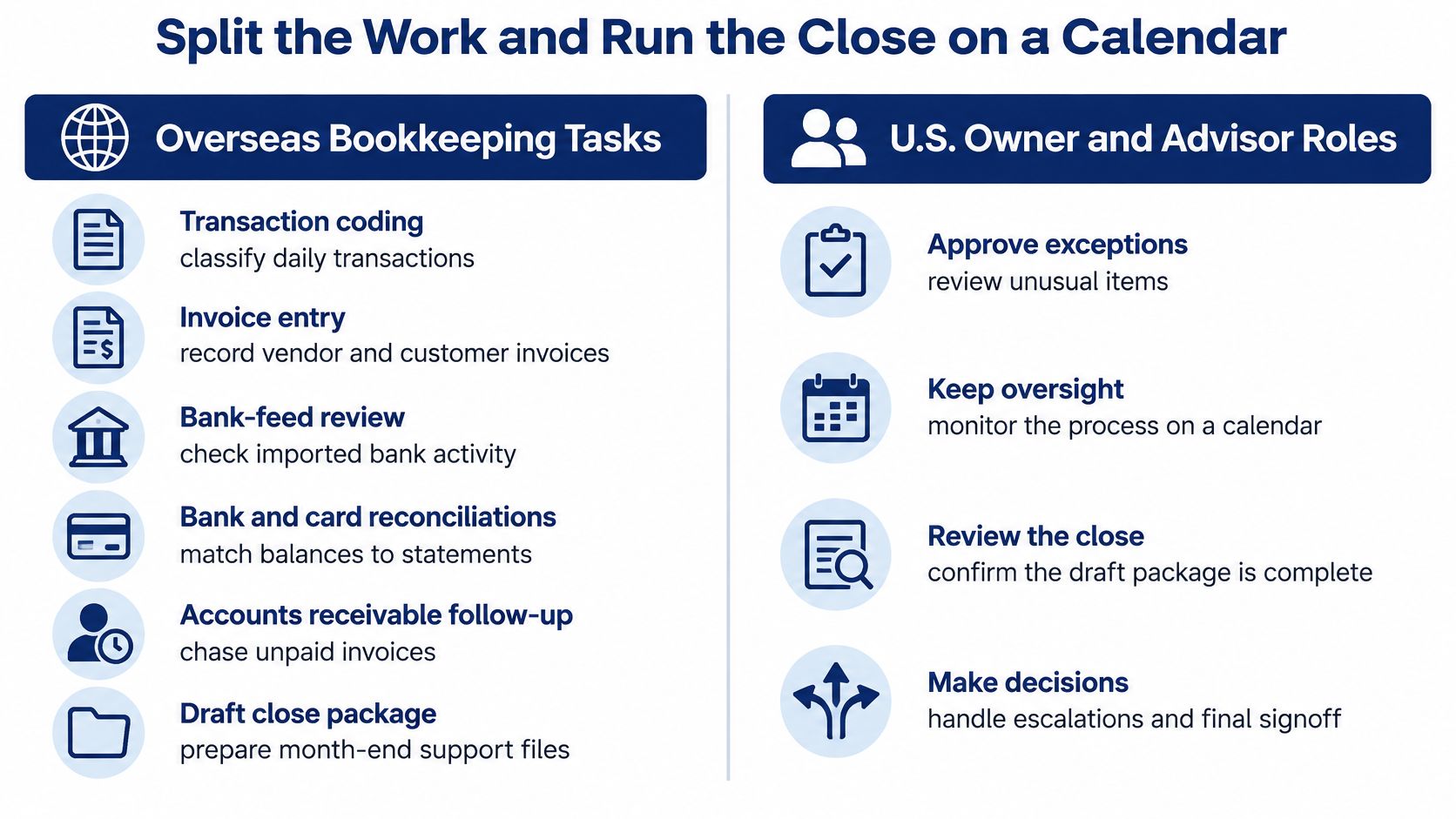
Separate entering a bill from authorizing its payment. Your bookkeeper can assemble supporting documents and flag the due date, but the authorized US approver decides whether money moves.
Write an approval threshold for journal entries into the procedure. The controller should choose the dollar amount based on the business, then require escalation for unusual entries regardless of size. A small adjustment to revenue can deserve more attention than a large, routine prepaid-expense release.
Treat vendor bank-detail changes as a hard stop. Require US approval and independent verification using established contact information, not the phone number in the change request.
This is a capacity model, not an attempt to export the entire finance department. The 2025 National Management of an Accounting Practice survey found that 29% of responding firms used offshoring, primarily to increase capacity rather than replace their operating model.
Use this as a proposed close calendar, adjusting it to your reporting commitments:
Make the close package concrete: balance sheet, income statement, reconciliation support, receivables aging, payables aging, and an exception log. A folder full of exports isn't a reviewed close package.
Keep chart-of-accounts rules beside the workflow in a shared workspace such as Notion or SharePoint. Record how you treat software subscriptions, merchant fees, owner transactions, and recurring accruals. When the reviewer changes a treatment, update the rule rather than correcting the same entry forever.
For covered businesses, the FTC Safeguards Rule also reinforces the need to oversee service providers protecting customer information. A signed engagement doesn't substitute for ongoing supervision.
Track close-cycle days, unreconciled items, error reversals, and reviewer hours. Distinguish errors the bookkeeper created from missing documents your own team failed to supply.
For a pilot, review the results after two closes. That's a decision checkpoint, not a promised improvement deadline. If the reviewer still rebuilds every reconciliation, investigate the instructions, source documents, and candidate's competence.
A cheerful status call is pleasant. A reconciliation that ties without forensic reconstruction is useful.
Sharing the owner's QuickBooks password isn't onboarding. It's giving someone broad access while making their activity harder to distinguish from yours.
Before the first login, decide what the bookkeeper needs to see, change, download, and approve. Moving the bookkeeper doesn't move your obligations, and the access design should reflect that.
The responsibilities remain with the company even when another team performs the work.
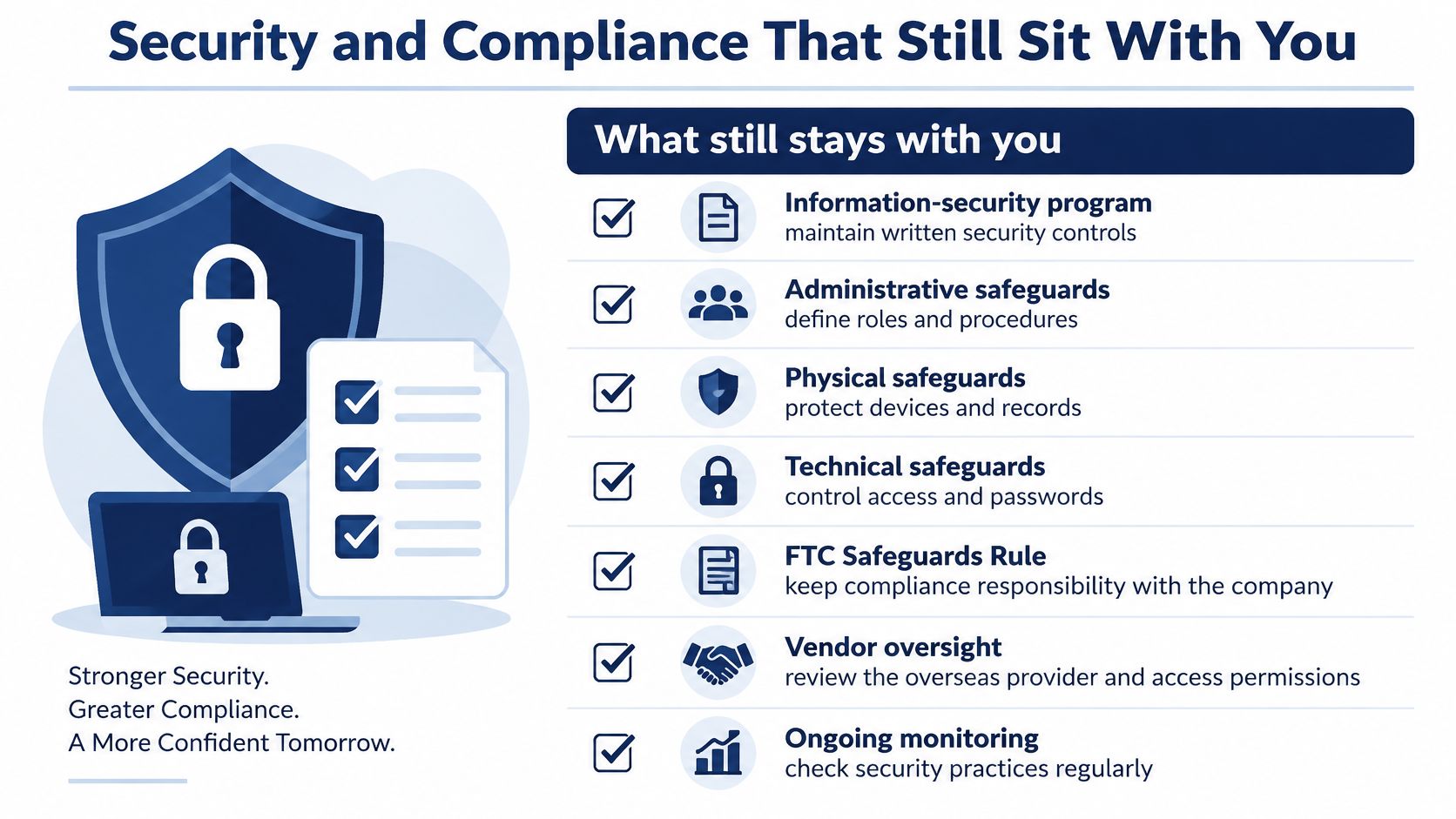
The Federal Trade Commission's data-security guidance explains that financial institutions covered by the Safeguards Rule must maintain an information-security program with administrative, technical, and physical safeguards and oversee service providers; covered notification events involving at least 500 consumers' unencrypted information require FTC notice as soon as possible and no later than 30 days after discovery. Don't turn that into a blanket claim that every small business falls under the rule. Have counsel establish which obligations apply to your company.
Your operational baseline should still be clear: unique accounts, role-based permissions, multifactor authentication, encryption in transit and at rest, endpoint protection, and audit logs. Remove access when someone leaves, including connected apps and shared document folders.
Keep work inside your accounting platform or a controlled virtual desktop. Where appropriate, disable local downloads and removable media rather than relying on a promise not to copy files.
A SOC 2 report can help evaluate a provider, but it isn't a magic sticker. QX Accounting's offshore-partner guidance recommends independent control evidence, documented access controls, a traceable data-flow map, and a written incident-response process. Read the report's scope, testing period, locations, exceptions, and covered systems.
If the reviewed environment isn't the environment holding your books, the badge answers the wrong question.
Name every country and subcontractor permitted to access company information. Require equivalent controls for those personnel, prompt incident escalation, cooperation with investigations, and secure return or deletion when the engagement ends.
For an ecommerce company, payment operations deserve their own review alongside bookkeeping access. Paylithix's guide to managing cross-border sales for high-risk e-commerce provides context for evaluating that adjacent payment arrangement. It doesn't replace diligence on the person reconciling your settlements.
Use documented financial controls to connect policy to actual permissions. Someone should be able to demonstrate who can change supplier details, export customer records, or release payments, not merely assure you that access is restricted.
Drop these requirements into the statement of work:
A withholding surprise can wreck an attractive quote. The IRS instructions for Form W-8BEN explain that a nonresident alien uses the form to establish foreign status and that failure to provide requested documentation may trigger 30% withholding in applicable circumstances.
That does not mean every payment to an overseas bookkeeper is automatically subject to that rate. Work location, income sourcing, recipient status, and the arrangement matter. A missing form and entirely offshore services aren't interchangeable tax questions.
Which contractor form applies
| Form | Use it when | What goes wrong without it |
|---|---|---|
| Form W-8BEN | A nonresident alien certifies foreign status and the payer requests it | The payer lacks foreign-status documentation and applicable withholding may follow |
| Form 8233 | A nonresident independent contractor claims an applicable exemption from withholding on personal services, including a treaty-based claim | The claimed exemption isn't documented, so the payer may need to withhold |
Form W-8BEN isn't a universal contractor solution. Form 8233 addresses a different issue: claiming an applicable personal-services withholding exemption. Don't assume both forms are required because the contractor lives abroad.
An overseas company also isn't the same recipient as a foreign individual. Send entity arrangements, treaty claims, subcontracting structures, and mixed work locations to your tax adviser before selecting documentation.
Keep the practical file boring and complete:
A contractor who starts working during a US visit can change the analysis. Don't let an old onboarding answer stand in for current facts.
If your team also runs a contracting operation, AurenWell's guide to simplify invoicing for your contracting business is relevant to organizing the invoice trail. Organized invoices support the file; they don't determine worker classification or withholding.
Likewise, a comparison of 1099-NEC versus 1099-MISC can help distinguish domestic reporting categories, but don't automatically apply either form to a foreign recipient.
Keep three gates separate: worker classification, where services are performed, and the correct reviewed tax documentation.
Get those answers before the first payment. Reconstructing them later is how a cheap engagement becomes a paperwork piñata.
The following are hypothetical composites, not customer results or performance promises. They show how I'd structure the work and judge whether the arrangement deserves more volume.
The useful comparison isn't remote versus local personalities. It's who produces the work, who answers questions, and who reviews the result.
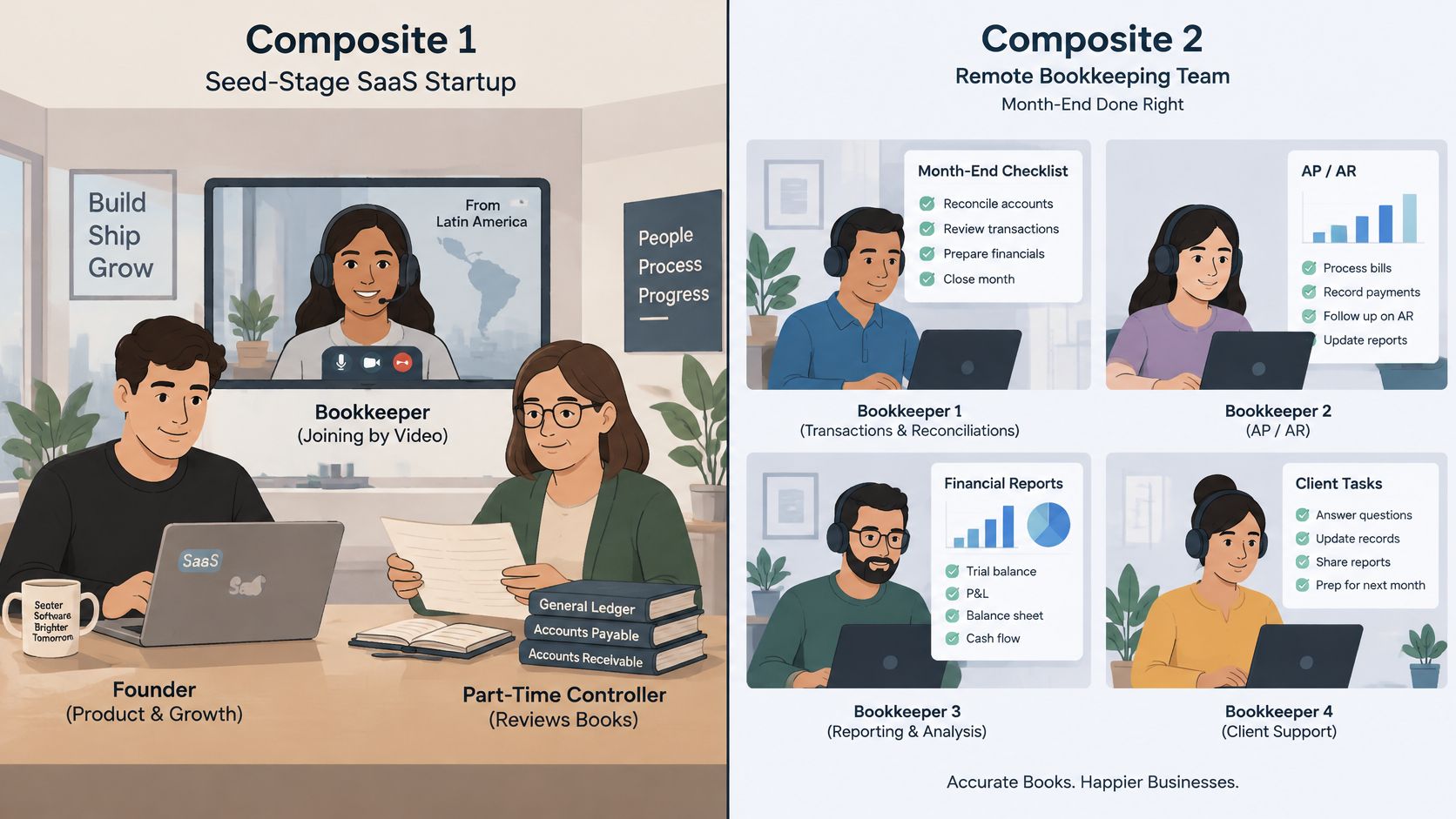
A seed-stage SaaS founder is spending Sunday evening sorting bank-feed transactions. The part-time controller can review the books but doesn't have enough allocated time to process every software charge and customer receipt.
In this scenario, the company budgets around $10 an hour for a Latin America bookkeeper working agreed US hours. That's a hypothetical hiring budget, not a market guarantee. The assignment covers coding, bank-feed review, reconciliation preparation, and a draft close.
The bookkeeper finds an annual customer payment and asks whether it belongs entirely in current revenue. Because the controller is online, the question gets answered before the bookkeeper posts an unsupported treatment.
For this hypothetical calendar, coding is due by business day three and reconciliations by business day five. The controller still approves bills and determines the revenue treatment. The founder stops handling routine categorization, but the company doesn't pretend its need for a controller has disappeared.
The test: Does the controller spend more time reviewing supported work and less time assembling it? If not, the company hasn't bought usable capacity yet.
An ecommerce brand's office manager has inherited vendor bills, card reconciliations, and settlement questions. Supplier emails interrupt everything else, and nobody can explain which reconciliation items are outstanding.
The company assigns bill preparation and card reconciliations to an overseas bookkeeper. A US finance lead retains every payment decision and every approval of new vendor bank details.
The opening month feels slower in this scenario because the team finally documents how to classify inventory purchases, freight, merchant fees, and refunds. The bookkeeper exposes inconsistent rules that the office manager previously resolved from memory.
By the second hypothetical close, the company wants fewer unexplained reconciliation items and fewer corrections. Those are acceptance criteria, not promised outcomes. Faster invoice entry alone wouldn't justify expanding the assignment.
A bookkeeper can follow a documented process. They can't reliably follow the accounting policy that exists only in the founder's head.
In both composites, the main benefit is access to a decision-maker during production. Agree on actual working hours, holiday coverage, and response expectations. A Latin America address alone doesn't guarantee availability.
India and the Philippines can suit a firm with a written production queue, clean source documents, and an intentional overnight handoff. Choose that arrangement because the workflow supports it, not because every distant team is assumed to be interchangeable.
Outsourcing bookkeeping overseas can initially add management work when nobody has standardized the books. The Intuit-commissioned 2025 survey of US accounting professionals found that 81% had outsourced accounting services during the prior year, but outsourcing participation isn't proof of effortless implementation.
For a US startup with frequent same-day questions, I'd choose overlap over a heroic handoff routine.
The lowest hourly rate can turn into the most expensive hire if you spend your time fixing the work. Choose a US-hours Latin America hybrid for repeatable bookkeeping, with a named US reviewer responsible for judgment and approvals. A domestic bookkeeper still makes sense when business context or communication needs warrant the higher cost. A farther-time-zone team can work when overnight delivery fits the workflow.
Ask candidates to explain an unreconciled balance in plain English. Month-end disagreements require clear communication, not just a polished introduction.
Use a paid, anonymized reconciliation exercise in your accounting software, such as QuickBooks Online or Xero. Ask the candidate to document missing evidence and questions for escalation. Do not reward someone for forcing every item to balance.
Before signing, ask whether the provider employs the bookkeeper locally, acts as an employer of record, or introduces an individual you contract with directly. Get the arrangement in writing and have the relevant adviser review local classification obligations.
A US tax form does not settle employment rules in another country. Clarify who handles payroll administration, statutory obligations, replacement coverage, and termination.
Start with a scoped workflow and a short pilot. Add volume only when the work arrives with supporting documentation and your reviewer can approve it without rebuilding it.
The right hire can take repeatable work off your team's plate while leaving judgment, payments, and accountability in US hands. Contact HireAccountants to discuss a US-hours bookkeeping hire. Bring a defined workflow and a named US reviewer, and ask for candidates who can demonstrate the reconciliation work you need.
Let's simplify your finances today!