


The usual advice on small business balance sheets is to make sure everything balances, then check whether equity is positive. That's a dangerously low bar. You can pass both checks and still scramble to pay employees because your money is sitting in unsold stock, overdue invoices, or equipment nobody wants to buy this week.
Read the statement as a set of obligations and usable resources, not a certificate of financial health. The useful question isn't whether the report looks respectable. It's whether you can defend the numbers and make a sensible spending decision from them.
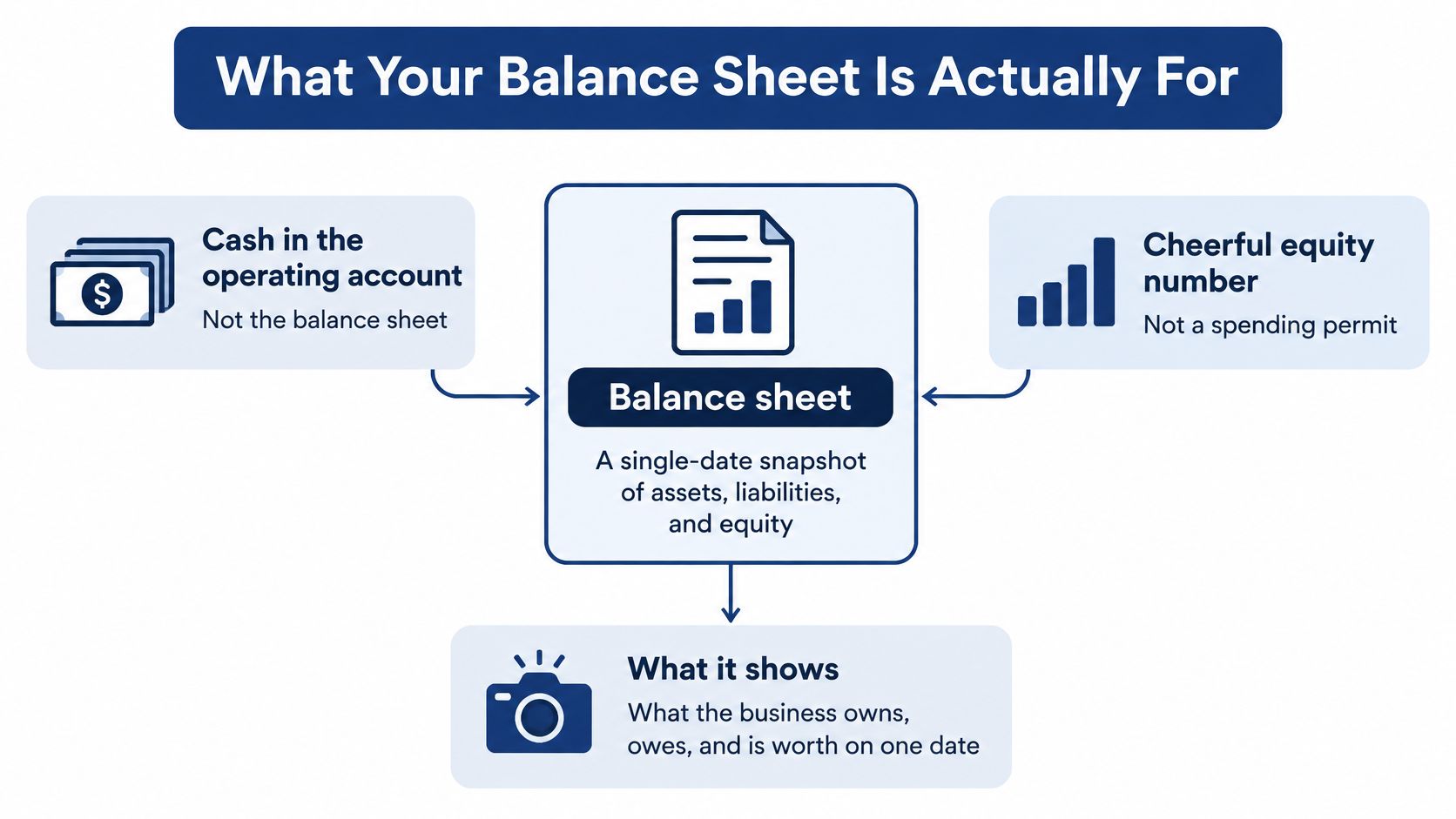
Cash in the operating account is not a balance sheet. A cheerful equity number is not a spending permit. Neither tells you, on its own, how much of the business is already spoken for.
The U.S. Small Business Administration calls the balance sheet the foundation of financial management: it captures assets, liabilities, and equity at a single date, showing what the company owns, owes, and has left for its owners after liabilities are deducted.
Assets = Liabilities + Equity
Before discussing a ratio, make that equation work. If the sides disagree, investigate a missing transaction, a duplicated entry, an unreconciled bank account, then owner spending that never made it into the books. Don't assume the software has somehow blessed the report.
A balanced report proves the arithmetic works. It doesn't prove the bookkeeping is right.
A company card payment coded as equipment might belong in owner draws. An invoice can remain in receivables after the customer paid if nobody matched the deposit. Both errors can survive inside a perfectly balanced statement.
The statement date tells you when the snapshot was taken. The accounting basis tells you what the bookkeeper allowed into the picture: cash accounting waits for payment, while accrual accounting records earned sales and incurred bills before settlement.
That timing difference can change receivables and payables even when the underlying business activity is identical. Label the basis beside the date so nobody compares unlike reports and calls the difference growth.
Use the statement to answer practical questions:
The standard is a sheet you can defend with records, not a pretty year-end PDF.
A usable balance sheet starts with consistent labels. Put the company name, statement date, currency, and reporting basis at the top. Then group the lines so an owner or lender can find assets, liabilities, and equity without decoding the spreadsheet.
Small business balance sheet lines
| Bucket | Line | What it captures | Current or long-term |
|---|---|---|---|
| Assets | Cash and equivalents | Bank balances and money-market funds on the statement date | Current |
| Assets | Accounts receivable | Invoices earned but not yet collected | Current |
| Assets | Inventory | Goods held for sale, plus raw materials that become merchandise | Current |
| Assets | Prepaid expenses | Rent, insurance or software paid ahead of the period they cover | Current |
| Assets | Equipment and vehicles, net | Cost minus accumulated depreciation | Long-term |
| Liabilities | Accounts payable and cards | Unpaid vendor bills and credit-card balances | Current |
| Liabilities | Tax and payroll accruals | Sales tax, payroll tax and wages earned but not yet paid | Current |
| Liabilities | Current debt | Principal due within 12 months, including the current slice of long-term loans | Current |
| Liabilities | Deferred revenue | Cash collected before the work or product is delivered | Current |
| Liabilities | Long-term debt | Remaining principal due after 12 months | Long-term |
| Equity | Owner contributions and draws | Money put in, minus money taken out | Equity |
| Equity | Retained earnings | Cumulative profit kept in the business after draws | Equity |
List leasehold improvements with fixed assets when applicable. Keep accumulated depreciation visible in the supporting schedule; otherwise, a van or laptop can look worth its original purchase price long after it isn't.
Classify deferred revenue by when the promised work or product is due. The portion due in the current period belongs in current liabilities. Classify an owner loan from its actual repayment terms, not an assumption that the owner will wait.
Under IRS Publication 538, businesses that produce, purchase, or sell merchandise generally keep inventory and use accrual accounting for purchases and sales. Qualifying taxpayers whose average annual gross receipts for the three prior tax years are below the inflation-adjusted threshold, excluding tax shelters, may use the small-business exception.
An eligible business can elect an alternative that clearly reflects income, including treating inventory as non-incidental materials and supplies or following its applicable financial statement treatment. The election still requires a consistent way to account for stock. Confirm eligibility for the applicable tax year before choosing a method.
For contractors connecting job records, receipts, and bookkeeping, Truespeak's guide to choosing accounting tools for your trade business offers practical context for selecting the system behind these schedules.
A large equity plug is a clue to investigate, not a cosmetic fix.
Take a hypothetical online shop with $1.2 million in annual revenue. These illustrative figures are in USD at a single statement date, not results from an actual company.
Its current assets are cash of $48,000, receivables of $62,000, inventory of $115,000, and prepaid software and insurance of $9,000. Together, that's $234,000 in current assets.
Sample balance sheet at one statement date
| Line | Bucket | Amount in USD |
|---|---|---|
| Cash and equivalents | Current asset | $48,000 |
| Accounts receivable | Current asset | $62,000 |
| Inventory | Current asset | $115,000 |
| Prepaid expenses | Current asset | $9,000 |
| Equipment and vehicles, net | Long-term asset | $85,000 |
| Total assets | Total | $319,000 |
| Accounts payable and cards | Current liability | $71,000 |
| Tax and payroll accruals | Current liability | $18,000 |
| Current debt | Current liability | $24,000 |
| Long-term debt | Long-term liability | $76,000 |
| Total liabilities | Total | $189,000 |
| Owner contributions and draws, net | Equity | $20,000 |
| Retained earnings | Equity | $110,000 |
| Total equity | Equity | $130,000 |
Current liabilities total $113,000, comprising supplier and card balances, tax and payroll accruals, and current loan principal. Adding long-term debt produces total liabilities of $189,000.
The check works: $189,000 + $130,000 = $319,000. Nobody had to invent an opening-balance adjustment to make the spreadsheet behave.
Working capital is $234,000 minus $113,000, or $121,000. The current ratio is $234,000 divided by $113,000, or 2.07.
Looks comfortable, doesn't it? But $115,000 of those current assets is inventory that still needs a buyer, and $62,000 depends on customers paying.
Decision check: The shop has $48,000 in cash, not $234,000 available for its next payroll.
A lender can see positive working capital and a balanced capital structure. The owner still needs collection dates, inventory sell-through, and a payment calendar before approving another purchase order.
Build your own version using these lines and add a supporting-record column. Cash should point to a reconciliation, receivables to an aging report, inventory to a count and valuation schedule, and debt to lender statements. If a figure has no identifiable origin, don't treat it as decision-ready.
Why does your bookkeeper's balance sheet differ from the one the bank wants? Often, they're answering different questions under different reporting rules, not arguing about the same arithmetic.
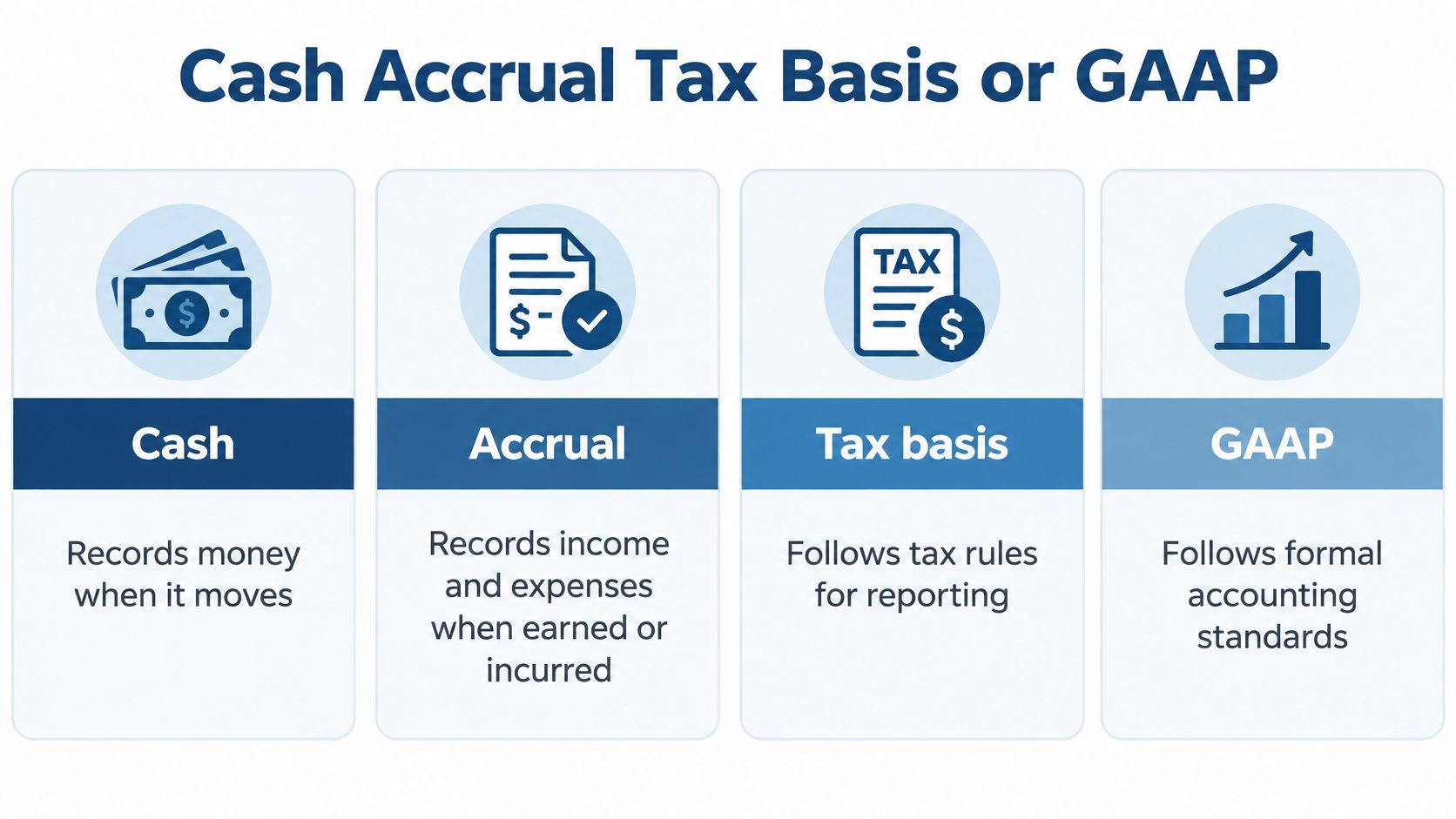
The IRS explains in Publication 583 that cash-method income is generally reported when received and expenses when paid, while accrual-method income is generally reported when earned and expenses when incurred. That's why reported profit and available cash can head in opposite directions without either statement being wrong.
Which balance sheet basis fits the job
| Basis | When results hit | What the sheet often misses or distorts | Use it for |
|---|---|---|---|
| Cash | Income when received, expenses when paid | Receivables, payables and earned-but-unbilled work | Owner cash tracking only |
| Accrual | Income when earned, expenses when incurred | No major timing omissions if cutoffs are complete; cash still needs a separate look | Monthly management |
| Tax basis | Follows the return, including allowed inventory and depreciation choices | Accruals, lease treatment, owner-pay normalization | Filing and keeping one set of books |
| GAAP-oriented | Accrual cutoffs plus documented adjustments off the tax books | Still not a forecast; assumptions must be written down | Banks, investors, buyers, credit lines |
Cash and accrual are timing methods. Tax basis and GAAP are broader reporting frameworks, so these aren't four mutually exclusive settings in accounting software. Tax-basis books can themselves use a permitted cash or accrual method.
Tax-basis reporting can reduce the burden of maintaining separate records, but it has limitations for external reporting, as the Journal of Accountancy explains. Convenient for filing doesn't automatically mean useful for a credit committee.
Start with the compliance books and build an adjustment schedule. Add missing accruals, reconcile inventory and depreciation differences, review leases, and document related-party balances.
Keep normalized owner compensation in a clearly labeled management or diligence schedule. Don't rewrite statutory results to make the business look more attractive.
For the underlying timing mechanics, use this explanation of cash and accrual accounting methods. Then agree on the required framework with the intended reader before preparing the reporting package.
A GAAP-oriented management sheet is not automatically a GAAP-compliant financial statement. Formal compliance can require additional recognition, measurement, presentation, and disclosures.
Switching methods isn't a spreadsheet mood. Keep the original books, adjustment entries, and assumptions traceable, and get tax advice before changing the tax reporting method.
A new loan isn't revenue, and a large liability balance isn't automatically a distress signal. Read the amount with its terms attached.
The OECD's SME-finance framework defines outstanding business loans as lending outstanding at the end of a reporting period. That makes the balance a stock, not the amount borrowed during the year.
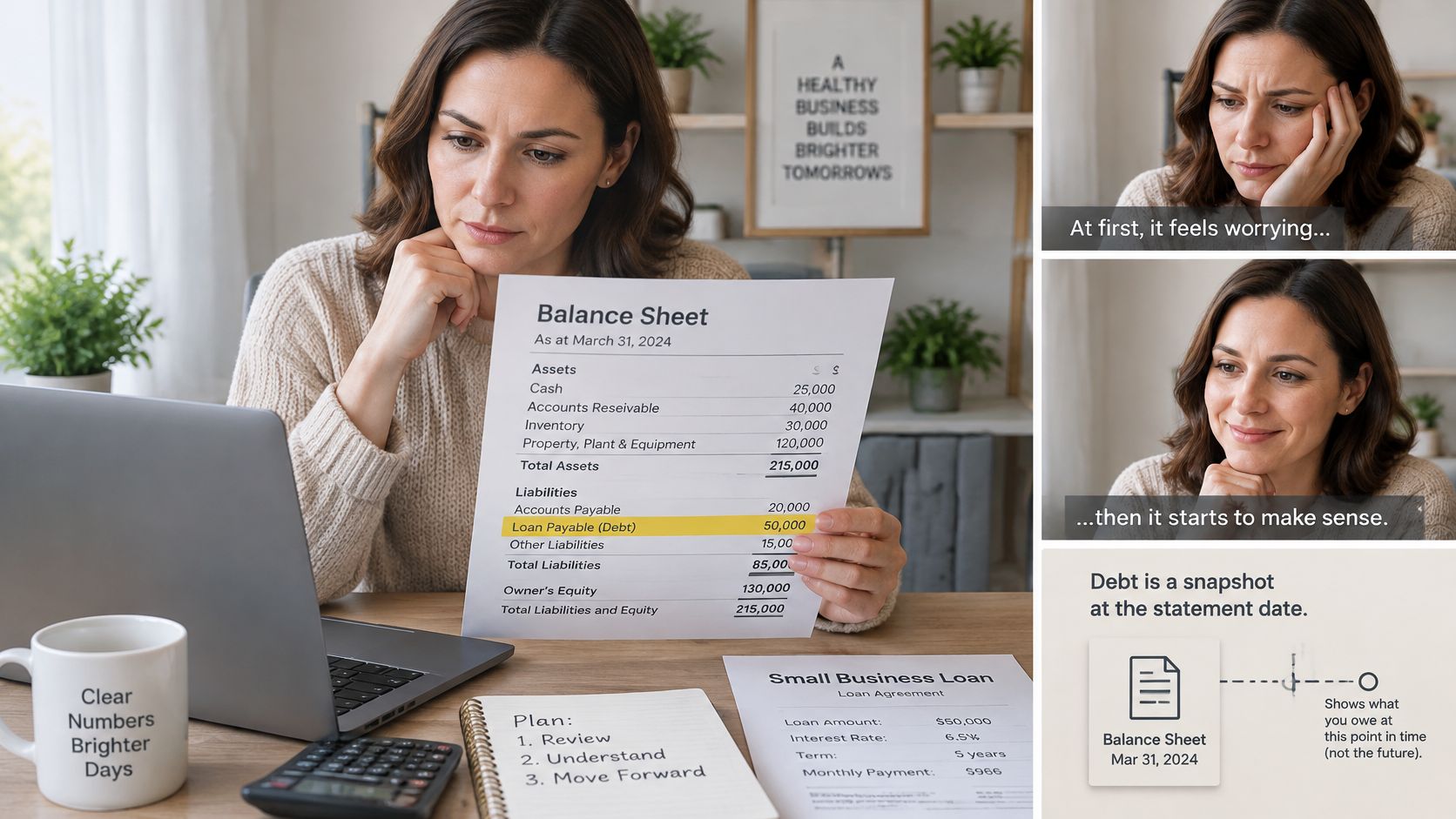
The ending stock reflects accumulated borrowing, new draws, and repayments across overdrafts, credit lines, and short- and long-term loans. A substantial new facility can coexist with flat or falling liabilities when repayments exceed new draws; an undrawn facility isn't itself an outstanding loan balance.
Personal credit-card debt and the owner's residential mortgage aren't business borrowing. If business books contain personal spending, classify the underlying transaction properly rather than calling the owner's lifestyle growth capital.
Short-term borrowing can support payroll, inventory, receivables, and seasonal gaps. Long-term borrowing is better matched to equipment, property, or a genuine expansion, but its upcoming principal installments still belong in current liabilities.
Read every material borrowing against these checks:
A quiet borrowing year can still end with a nasty maturity problem. Likewise, financing inventory can be reasonable when the stock is saleable and collections arrive before repayment, rather than whenever everyone feels optimistic.
One flattering month is a postcard, not a financing history. Bring reconciled comparative statements, supporting schedules, and explanations for material movements.
For a young company, clean monthly records and explicit projections beat invented historical depth. A lender can evaluate assumptions; they can't sensibly evaluate a mystery novel with a balance-sheet cover.
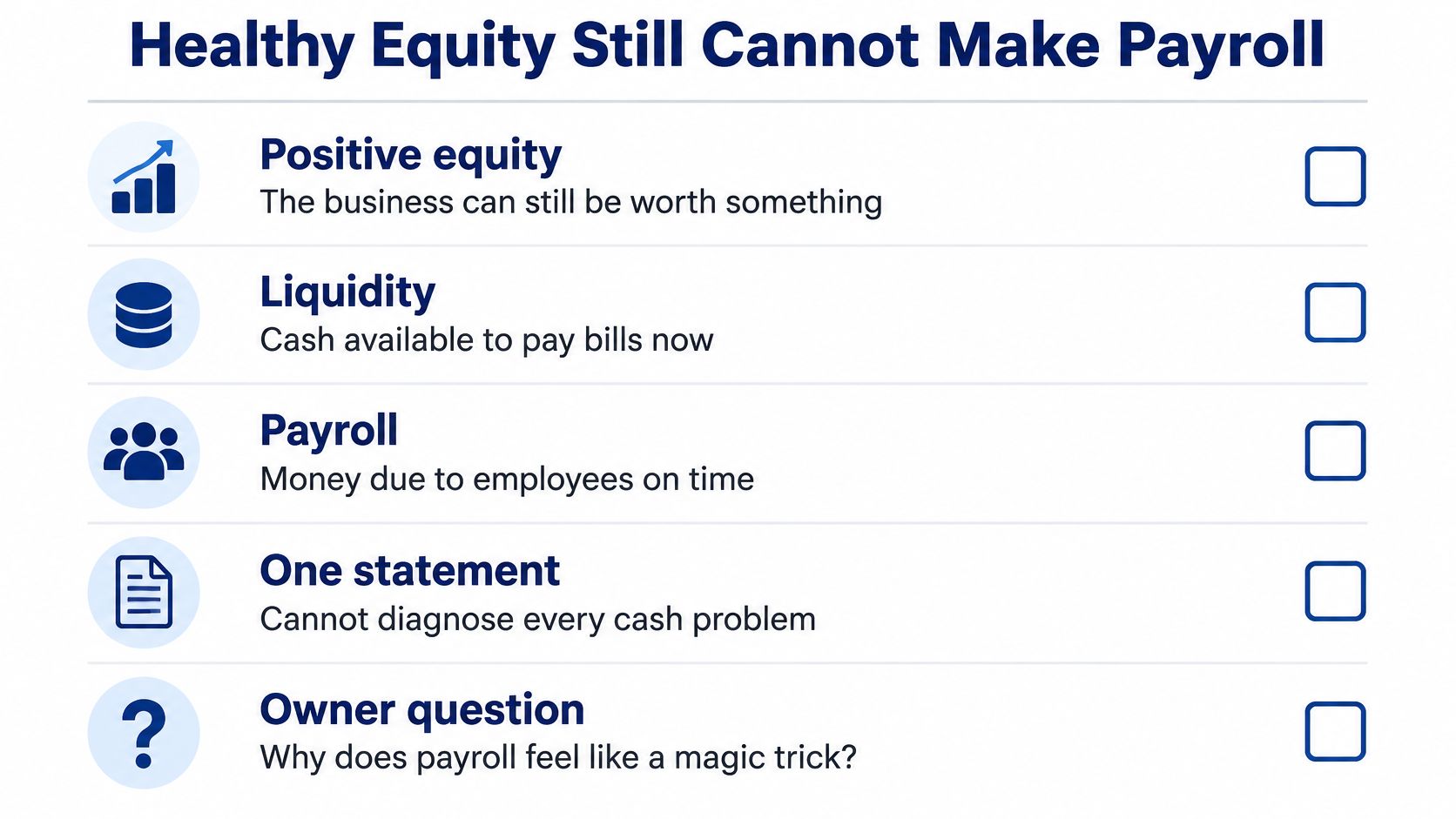
The sheet says the business is worth something. Why does payroll still feel like a magic trick?
Positive equity is not liquidity. The Illinois SBDC warns that one statement cannot diagnose financial health and recommends reading the balance sheet alongside the income statement and cash-flow statement.
Working capital, current assets minus current liabilities, measures the short-term balance-sheet cushion. Debt-service coverage asks whether earnings or cash available for debt service, under the applicable definition, cover required payments. Neither replaces a dated cash forecast.
Say your receivables take 70 days to collect in a hypothetical scenario. Add slow inventory and annual insurance paid ahead, and you have assets that won't fund Friday's payroll.
Use a rolling 13-week forecast as a management tool, not a promise that every expected receipt will arrive. Put weeks across the columns and actual payment dates behind the estimates.
For a practical spending gate, compare unrestricted cash plus credible receipts expected within 30 days with the next payroll cycle, taxes due, and current debt payment. If they don't cover those commitments, don't hire or distribute cash.
That's a proposed decision rule, not a universal lending covenant. Also inspect every weekly closing balance because a month-end surplus won't rescue a payroll shortfall in the middle.
Where a healthy sheet misleads by business type
| Business | Flattering line | Cash reality | Check before you spend |
|---|---|---|---|
| Ecommerce | High inventory and positive equity | Card and supplier bills come due before discounted stock sells | Sell-through and cash after the next card payment |
| SaaS or prepaid service | Large bank balance | Deferred revenue still has to be delivered | Unrestricted cash versus remaining delivery cost |
| Service firm | Strong receivables and retained earnings | Draws taken on uncollected invoices | Receivables aging and collected cash before owner withdrawals |
In an illustrative ecommerce case with a card bill due in 25 days, slow purchasing until projected sell-through supports the payment. For SaaS or prepaid services, staff only against collected or reliably contracted cash after reserving delivery costs.
For a hypothetical service firm with invoices past 45 days, stop the draw and assign collection responsibility. Billings aren't permission to withdraw money.
A payable increase or credit-line draw can support growth when the matching assets are genuine and collectible. Use cash-flow statement analysis to distinguish that timing gap from operations that repeatedly consume cash.
If obligations are already unmanageable, get jurisdiction-specific legal advice early. LifeBack Law Firm, P.A.’s bankruptcy guidance for Minnesota business owners is a relevant starting point for Minnesota owners evaluating financial trouble.
Set an internal deadline to close within ten business days of month-end. That's a recommended operating target, not a legal deadline, and it puts usable numbers in front of you before another month of spending slips through.
Reconcile every bank and card account, update the template, age receivables, split current debt, and check working capital before approving a hire, distribution, or loan. Use a documented month-end close checklist so the process doesn't depend on whoever remembers the missing statement.
Pair the balance sheet with the month's profit and a cash recap. For established businesses preparing a business plan, the SBA recommends three to five years of income statements, balance sheets, and cash-flow statements; younger companies should provide the clean history they have and clearly labeled projections.
Hand off the work when:
That's accounting labor, not a personality test. At HireAccountants, our Full-Time Accountant plan includes month-end close and US GAAP financial statements; our Part-Time Bookkeeper plan costs $999 per month for 10 hours a week, and accountants and bookkeepers can be hired from $10 per hour.
Fix the basis, close monthly, and test the cash calendar before deciding the business can carry another commitment.
We help US businesses hire pre-vetted accountants and bookkeepers, including support for month-end close and financial statements. Visit HireAccountants with your current balance sheet, reporting basis, and close requirements so you can find support for numbers you can borrow or hire against.
Let's simplify your finances today!