


You're staring at a QuickBooks file full of uncategorized transactions, receipts are scattered across email and coffee-shop counters, and the tax deadline is getting uncomfortably close. The business may be doing fine on the surface, but the books tell a different story, mostly because nobody has had the time, process, or patience to make them trustworthy.
That's the core bookkeeping services San Diego problem. Finding a provider isn't difficult. Finding one that can clean up old records, preserve compliance documents, close the books consistently, and charge for the work you need is much harder. The cheapest quote can become the most expensive option once you discover what it excludes.
A San Diego business owner usually doesn't wake up thinking, “Today I'd love to reconcile every bank account.” They wake up thinking about customers, payroll, inventory, permits, sales, and the next urgent email. The books get pushed to Friday, then next month, then “after tax season.” Eventually, QuickBooks becomes a digital attic full of unexplained deposits and transactions categorized as “Ask My Accountant.”

The obvious solution seems local. Search for a San Diego firm, schedule a meeting, hand over the login, and wait for clean financial statements. That can work, but “local” doesn't automatically mean responsive, thorough, or suited to your business. A nearby provider can still deliver slow month-end closes, vague reports, and a tidy-looking ledger that falls apart when someone asks where the numbers came from.
Local providers commonly advertise monthly bookkeeping, QuickBooks support, reconciliations, AP and AR, payroll, reporting, cleanup, and catch-up work. Those services matter, but the marketing language often blurs the difference between basic transaction entry and full financial stewardship.
A startup with simple bank activity doesn't need the same setup as an e-commerce business managing payment processors, inventory, refunds, and sales-tax obligations. A growing SaaS company may care more about deferred revenue, customer billing, and reliable monthly reporting than a face-to-face meeting.
Practical rule: Choose the service model around the work, not the provider's street address.
The useful question isn't “Who offers bookkeeping near me?” It's “What's broken, how often does it need attention, and what evidence must exist when a tax authority or lender asks questions?” Once you answer those, local, remote, and hybrid options become much easier to judge.
San Diego pricing reflects a professional labor market, not the number of receipts in your inbox. The 2024 Talent Demand Report for San Diego found monthly job postings in San Diego County were 7% higher than the national average, and it identified bookkeeping, accounting, and auditing roles as hard to fill, with low turnover reported by more than 50% of employers. The report also identified a regional accounting talent pipeline of 15.1K jobs and 524 average annual wages of $89K in the related occupation grouping. The San Diego Talent Demand Report places bookkeeping inside a broader finance-services ecosystem with real demand for capable people.
The professional wage benchmark is higher still. In May 2023, the U.S. Bureau of Labor Statistics reported 13,180 accountants and auditors employed in the San Diego–Carlsbad metro area, with a mean annual wage of $98,740. Nationwide, BLS reported 349,320 workers in Accounting, Tax Preparation, Bookkeeping, and Payroll Services, representing 31.73% of accountants and auditors employed in that industry, with a mean annual wage of $93,060. The San Diego bookkeeping market data summarized by Clutch shows why experienced finance support carries a professional-services price tag.
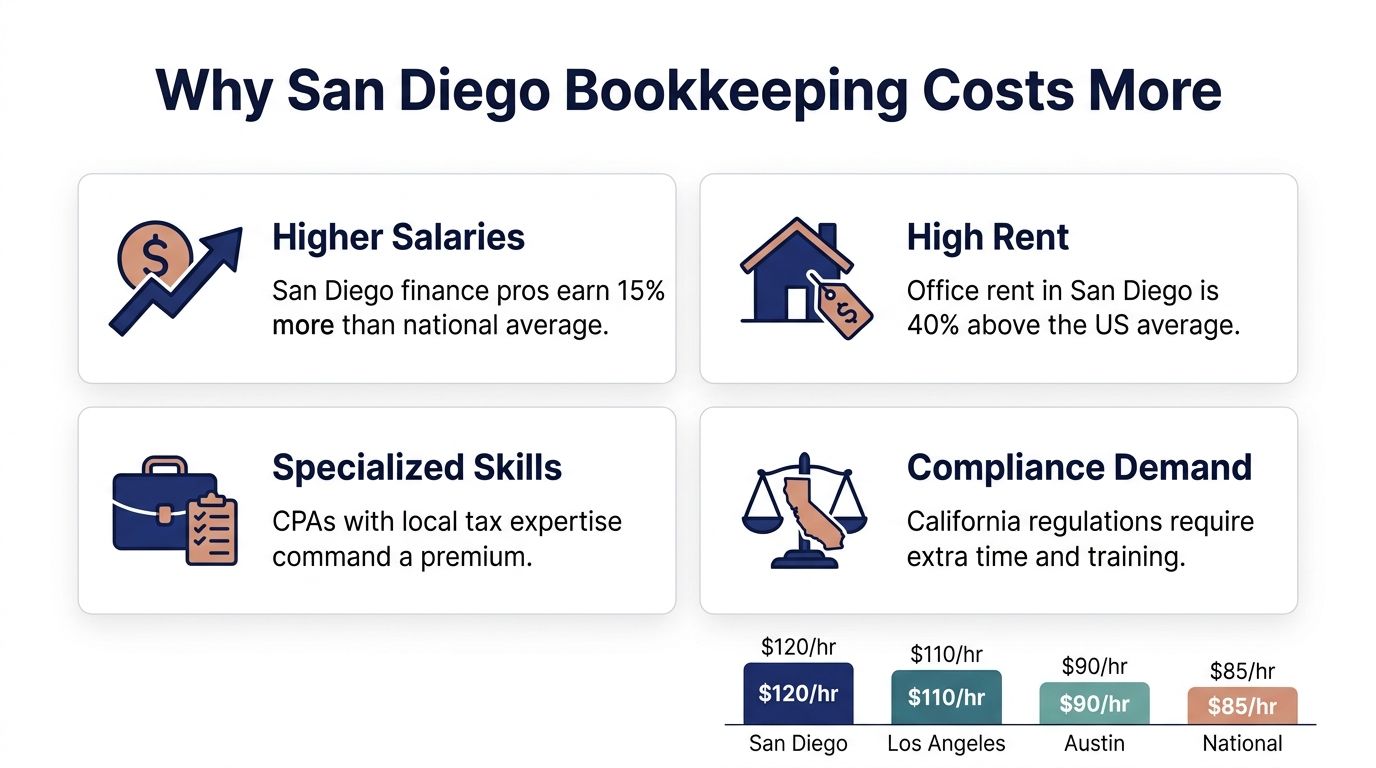
The relevant comparison isn't always an accountant's salary. The BLS reports a national median annual wage of $49,210 for bookkeepers, with hourly wage percentiles ranging from $15.61 at the low end to $33.11 at the 90th percentile. The BLS occupational wage table helps explain the structural floor beneath outsourced pricing.
An outsourced firm still has to cover software, payroll taxes, supervision, quality control, client communication, insurance, and time spent reviewing source documents. So when a provider quotes a monthly fee, you're not paying only for keystrokes. You're paying for judgment, accountability, continuity, and the ability to tell a real business expense from a future headache.
Before signing, ask what the fee includes: reconciliations, monthly close, reporting, payroll coordination, sales-tax support, cleanup, and document retention. For a useful framework on separating transaction work from deeper accounting support, review what a bookkeeper really costs. A premium can be sensible, but only when the scope earns it.
The local-versus-remote debate gets silly when people treat geography as a quality guarantee. A San Diego firm can provide useful local context and in-person accountability, while a remote professional can work efficiently inside QuickBooks, Xero, Stripe, Gusto, Bill.com, or your document-storage system without commuting to your office. The right choice depends on the complexity of the workflow and how much oversight you can provide.
Published local pricing commonly frames basic bookkeeping around $200 to $600 per month, with more complex engagements reaching up to $1,000 monthly, according to the San Diego bookkeeping market overview. Local San Diego listings also show hourly pricing as low as $30 to $50 per hour, while broader accounting listings show approximately $170 to $220 per hour, and marketplace listings can range from about $40 to more than $300 per hour, depending on provider experience and geography. A San Diego bookkeeping pricing listing makes the important point indirectly: “bookkeeping” can describe very different levels of work.
| Factor | Local San Diego Firm | Remote Talent Platform |
|---|---|---|
| Pricing | Often higher because of local labor and office overhead | Often lower, with flexible part-time or full-time arrangements |
| Communication | In-person meetings may be available | Communication runs through video, chat, email, and shared systems |
| Best fit | Owners who value local presence or need complex advisory support | Startups, SaaS, e-commerce, and distributed teams with cloud-based workflows |
| Availability | May be limited during tax and reporting periods | Can offer broader access to pre-vetted professionals |
| Oversight | A firm may provide built-in review layers | You need clear processes, permissions, and review checkpoints |
| Cleanup work | Often available, but usually scoped separately | Can be assigned to a specialist, provided the platform matches the role properly |
Local isn't automatically better if the assigned bookkeeper is overloaded or junior. Remote isn't automatically cheaper if your team sends incomplete records, changes systems constantly, or expects a professional to repair years of untracked activity without a defined cleanup scope.
A remote platform such as HireAccountants' virtual accounting firm model can make sense when your finance work already lives online and you can document approvals, file sharing, and reporting expectations. You'll need to judge communication quality, time-zone overlap, accounting knowledge, and review discipline rather than relying on a handshake across a conference table.
My recommendation is blunt. Choose local for relationship-heavy work, unusual California issues, or hands-on controller support. Choose remote for repeatable cloud workflows where speed, coverage, and cost control matter more than office proximity. Choose hybrid when a remote bookkeeper handles the weekly rhythm and a local CPA or controller reviews tax and high-risk decisions.
Routine monthly bookkeeping is the easy part to sell because it sounds orderly. Many businesses don't start with orderly books. They start with a backlog, duplicated transactions, uncategorized expenses, disconnected bank feeds, missing invoices, and a founder who can't remember whether a charge was for software, inventory, or an ill-advised team dinner.
Local firms explicitly market cleanup, catch-up, and full-charge bookkeeping, which tells you there's meaningful demand for businesses that need reconstruction before steady-state service can begin. The cleanup may involve rebuilding opening balances, matching deposits to invoices, separating personal and business spending, checking payment-processor payouts, and reconciling accounts that were never reconciled properly.
A provider quoting a basic monthly rate may assume clean accounts, current statements, consistent transaction volume, and complete source documents. If those assumptions are wrong, the provider either adds a cleanup fee, slows the work, or produces reports that look complete while carrying unresolved errors.
That's why you should request a written onboarding assessment. It should identify the last reliable close, accounts requiring reconciliation, missing documentation, payroll or sales-tax complications, and the point at which regular monthly work can begin. Cleanup isn't a minor add-on. It's a separate project with a separate risk profile.
The broader labor picture reinforces the need for disciplined processes. The BLS projects bookkeeping, accounting, and auditing jobs to decline by 5% from 2023 to 2033, while still projecting about 170,000 openings per year on average. The BLS occupational outlook data reflects a field changing under automation while replacement and operational demand continue. Your business still needs someone who can interpret exceptions, protect the close, and fix bad inputs.
The founder test: Ask a candidate to explain how they'd diagnose a messy ledger before they tell you how quickly they can “get you caught up.”
Once the books are stable, automate the repetitive upstream work. A practical resource on reducing manual invoice handling is MakeAutomation's invoicing guide. Automation won't replace judgment, but it can stop the same preventable mess from returning every month.
Bad books waste time. Bad records create exposure. California's record-retention rules mean your bookkeeping system must preserve more than a polished monthly profit-and-loss statement.
The California Department of Tax and Fee Administration requires businesses to keep sales-and-use-tax records for four years and employee payroll-tax records for at least four years. California's recordkeeping guidance makes durable storage, clear categorization, and retrievable documentation part of responsible bookkeeping.
The IRS uses overlapping retention clocks. Its general rule is three years, employment-tax records must be kept for at least four years, and some circumstances extend retention to six years, seven years, or indefinitely, including certain unreported-income, fraud, worthless-security, bad-debt, or missing-return situations. The IRS recordkeeping rules are not a suggestion to keep whatever happens to survive in your inbox.

Ask candidates these questions directly:
For broader context on why compliance work creates operational cost, explore these banking compliance cost insights. If you're unsure where accounting responsibility ends and CPA work begins, CPA requirements by state offers a useful reference point. Don't hire someone who merely promises clean books. Hire someone who can show how the records stay defensible.
A bookkeeping hire earns trust through judgment, not typing speed. The right person recognizes patterns, documents exceptions, asks uncomfortable questions, and closes open items. Evaluate candidates against your actual workflow, whether they work from San Diego or remotely.
Start by testing the work they will own:
“Walk me through your first week with a disorganized QuickBooks file.” A capable candidate starts with access, scope, account mapping, bank statements, and an assessment. Someone who immediately categorizes transactions may create more cleanup later.
“How do you treat an unexplained payment-processor deposit?” Look for discussion of payout reports, fees, refunds, timing differences, and supporting documentation. The answer should show how they separate a real posting decision from an unresolved exception.
“What would make you stop and ask the owner before posting?” This tests judgment. A bookkeeper who never pauses can post confidently without enough evidence.
For a wider set of finance hiring prompts, use MyCulture.ai's finance interview guide as a supplement, then tailor the questions to your industry.
Score candidates on accuracy, availability, communication, systems knowledge, and escalation judgment. Someone who disappears during close is a poor hire, even if technically capable. A personable candidate who cannot explain a balance-sheet change presents the same risk. Ask for specific examples, then verify that their proposed workflow matches the records your business produces.
The decision gets clearer when you stop asking which provider is universally best and start asking which failure you can't afford. A fast-growing SaaS company may need a remote professional who works inside cloud billing and accounting tools, keeps the close moving, and provides consistent reporting without requiring office visits. A local retailer may value a nearby firm if the relationship includes hands-on oversight, payroll coordination, and complex review.

Use this decision filter:
Before you sign, request a sample monthly deliverable, a cleanup assessment, a list of included accounts, and the escalation process for unusual transactions. Confirm who owns the work, who reviews it, how documents are stored, and what happens if the assigned person leaves.
My strongest recommendation is simple: don't buy “monthly bookkeeping” as a vague bundle. Buy a defined operating system for your books. If the provider can't explain how they'll get you from messy records to a repeatable close, you're not hiring relief. You're postponing the same problem with a nicer invoice.
HireAccountants connects businesses with pre-vetted accounting and bookkeeping professionals, including remote talent working in U.S. time zones, with flexible full-time and part-time arrangements. If you're comparing local bookkeeping services in San Diego with a cloud-based setup, visit HireAccountants to review candidates and match the role to your cleanup, reporting, and ongoing support needs.
Let's simplify your finances today!