


Most advice on the candidate vetting process is too neat, too polite, and too wrong. It treats hiring like a checklist you complete once, instead of a risk problem you reduce stage by stage. That's how founders end up hiring the person with the clean resume, the smooth Zoom voice, and the accounting chops of a decorative fern.
I've hired enough remote finance people to know this the hard way. A polished candidate can still have inflated titles, shaky Excel, borrowed take-homes, weird employment gaps, or references who sound oddly like cousins doing improv. If your process can't catch that, you don't have a system. You have optimism wearing business casual.
The lazy version goes like this: resume looks solid, interview feels good, offer goes out. Then month-end arrives and suddenly your “senior accountant” can't explain a reconciliation break without sweating through their webcam.
That's not vetting. That's guessing.
A real candidate vetting process is a funnel. It takes a large pool of applicants and filters them into a small number of hires you can trust to do the work, handle the data, and show up consistently. It's not one interview. It's not one background check. It's not your “read” on people, however magical you believe your instincts are.
And yes, companies already treat this as standard operating procedure. 93% of organizations worldwide conduct some type of background screening, rising to 95% among organizations with at least one U.S. location, while 76% have a documented screening policy, according to PBSA data summarized in this background check statistics review. In the U.S. context summarized there, 92% of organizations conduct background checks, 87% of those focus screening at the pre-employment stage, and 98% of screening programs include a criminal-record search.
That tells you something important. Serious employers don't treat vetting as optional admin. They treat it as a control.
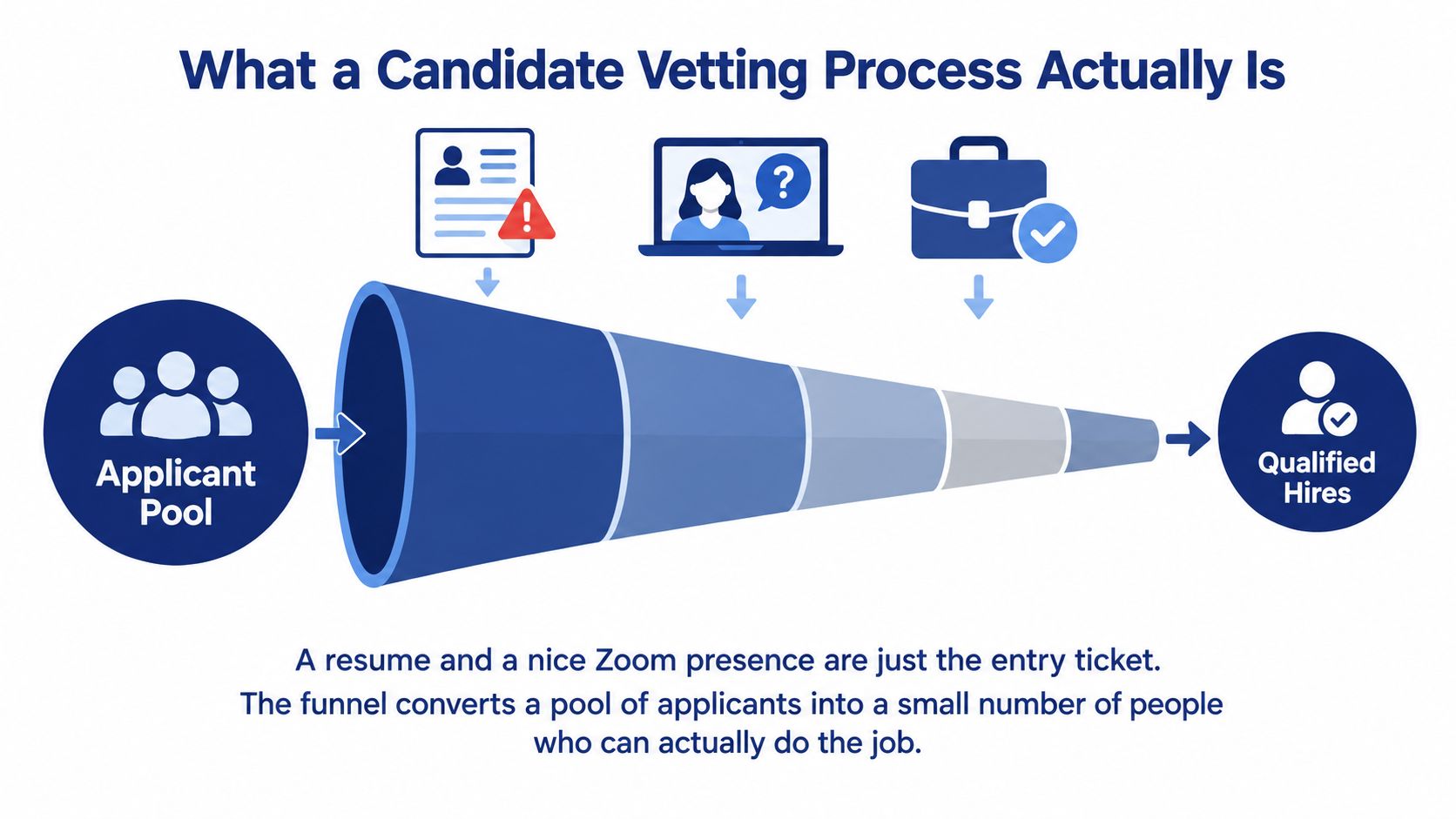
People mash these together and then wonder why hiring feels random.
Screening is your first pass. It answers simple questions. Does this person roughly match the role? Are there obvious red flags? Is the application coherent, complete, and relevant?
Vetting is the deeper process. It asks whether the candidate can perform, whether their claims hold up, whether they are who they say they are, and whether the risk profile is acceptable for the role.
For finance hires, that distinction matters a lot. A resume screen won't catch:
A resume is a claim. Vetting is what turns the claim into evidence.
The right mental model is simple. Every stage should reduce risk, not eliminate it in one dramatic leap.
RAND's personnel vetting model lays this out cleanly as a staged process that includes pre-initial vetting, initial vetting, and post-initial vetting, followed by ongoing checks after onboarding in its personnel-vetting framework. That's closer to reality than the cartoon version founders often use.
For remote accounting and finance roles, especially across Latin America, this matters even more. You're not just judging talent. You're filtering for identity, communication, reliability, verification, and compliance in sequence.
If risk only drops after the offer, you built the funnel backward. Toot, toot.
Founders love to pile random checks into hiring and call it rigor. It isn't. A strong process gives each stage one job and refuses to confuse one kind of evidence for another.
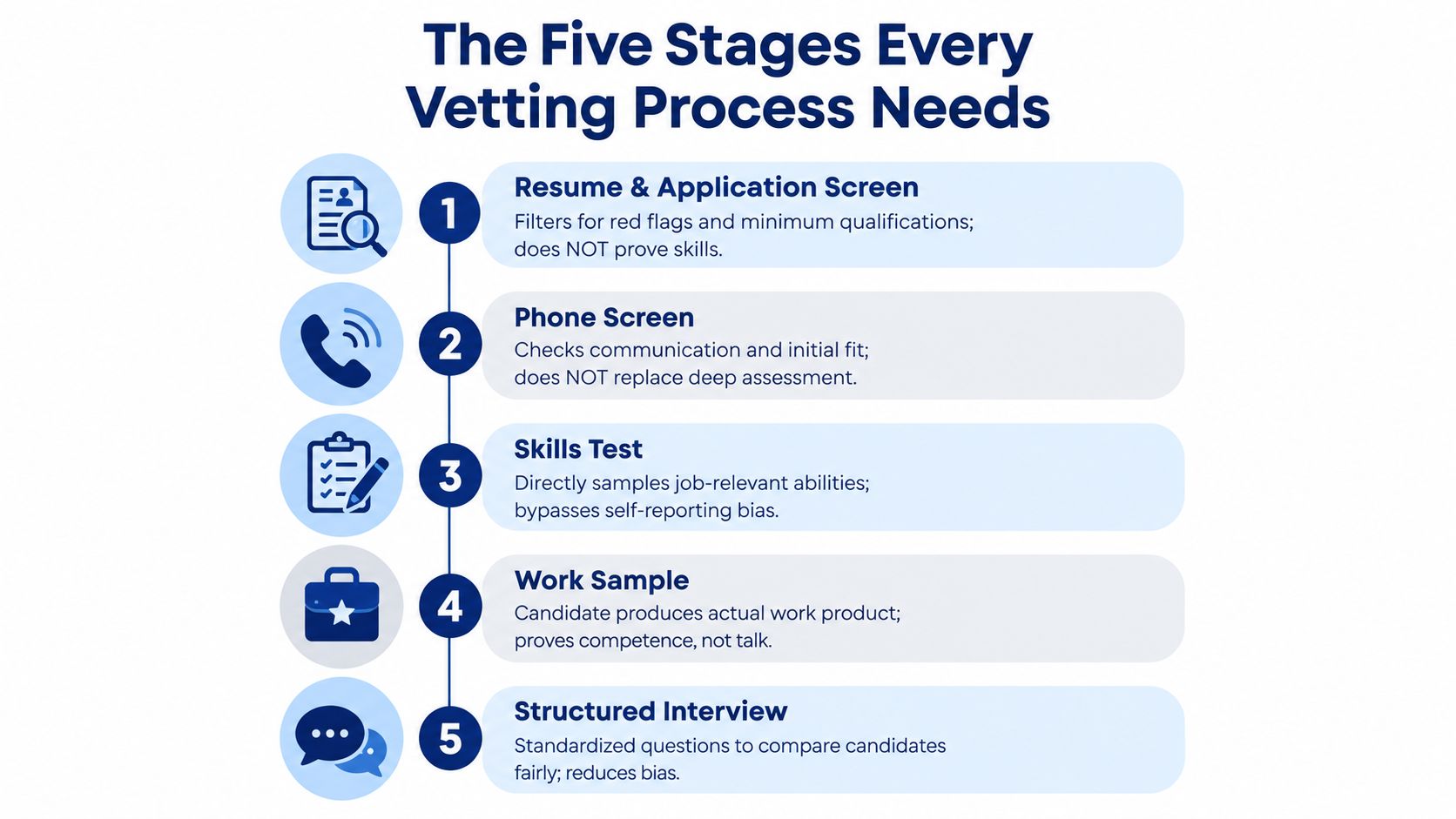
Start with the resume and application screen. This stage exists to remove obvious mismatches and surface candidates worth spending time on.
That's it.
It does not prove quality. It does not tell you whether someone can reconcile accounts, write a clean variance memo, or survive a messy close week without melting down. If you want a solid refresher on practical pre screening methods and tips, that framework is useful because it keeps this stage narrow instead of pretending early filters can answer every hiring question.
What this stage should catch:
A quick phone or video screen checks for clarity, professionalism, and basic alignment.
You find out whether the candidate can explain what they did, not just what their resume says they did. For remote finance work, communication matters because controllers, founders, and clients don't pay for silent mystery.
Still, don't overrate this stage. Good communicators can be weak accountants. Quiet accountants can be excellent operators.
Skills assessment is where the candidate has to stop narrating competence and start showing it.
For finance hires, this should be role-specific. Test reconciliation logic. Test Excel hygiene. Test how they explain a reporting issue. Test whether they can make judgment calls without inventing accounting policy on the spot.
Independent coverage of modern hiring increasingly emphasizes work-sample testing, live communication checks, rubric-based scoring, and identity verification as linked filters rather than one monolithic check, especially for remote and cross-border roles, as outlined in this candidate vetting process framework.
This is the stage too many teams skip, especially when hiring across borders. Then they act shocked when things get weird.
Reference checks and identity verification confirm who the person is and whether their history holds up. Employment verification is narrower than many assume. It confirms prior employers, job titles, dates of employment, and sometimes responsibilities. It also requires focused, job-related questions and proper documentation, as summarized in this employment verification guide.
Practical rule: if a candidate resists identity checks or gets squishy when you verify dates, stop romanticizing the hire.
Background checks, right-to-work checks, credential verification, and role-specific compliance belong here. If you need a CPA, verify the credential. If the jurisdiction permits criminal screening for the role, handle it lawfully. If you're hiring a contractor in another country, confirm the engagement structure before you start handing out system access.
One warning. Stacking weak stages doesn't create a strong process. Five soft checks still equal a soft process.
Unstructured interviews feel natural. They also produce a lot of false confidence.
When founders say, “I had a great conversation with them,” I hear, “I enjoyed talking to someone articulate for forty minutes.” That is not the same thing as predicting job performance.
Research summaries consistently show structured interviews outperforming unstructured ones. One summary reports validity coefficients around .50 to .60 for structured interviews versus roughly .20 to .30 for unstructured interviews in this structured interview validity overview. Another major review found that moving from low to high interview structure can raise validity from about 0.20 to about 0.57, and that combining general mental ability plus a structured interview reached mean multivariate validity around 0.76 in this interview review.
That's a huge difference in predictive power. Not a rounding error. Not an academic quibble.
Here's the plain-English version.
| Method | Validity Coefficient | Best Used For |
|---|---|---|
| Unstructured interview | About 0.20 to 0.30 | Early rapport, light context gathering |
| Structured interview | About 0.50 to 0.60 | Comparing candidates fairly and predicting job performance |
| High-structure interview design | About 0.57 | Roles where consistency and defensibility matter |
| GMA plus structured interview | About 0.76 | High-stakes selection when you want stronger overall prediction |
Every candidate gets the same core questions. Interviewers score against a rubric before discussing impressions. Competencies are role-specific. Scoring language is anchored.
For a senior accountant, don't ask “Tell me about yourself” and then freestyle. Ask how they handled a close delay, how they investigated a balance sheet variance, how they escalated a control issue, and how they communicate bad news upward. If you need help building sharper prompts, a focused list of accounting interview questions is a better starting point than generic startup banter.
Founders skip structure for three reasons:
If you can't describe what makes a score of 4 different from a score of 2, you aren't running a structured interview. You're running a lottery.
For finance roles, vibes are especially dangerous. Reconciliation discipline, GAAP judgment, and controller-level communication can all look identical to charisma until the work gets ugly.
Interviews reward confidence. Work samples reward competence. Those are not the same species.
When I'm hiring remote finance talent, the first thing I want is evidence that the person can produce correct work under mild pressure. Not TED Talk energy. Not a heroic LinkedIn summary. Work.
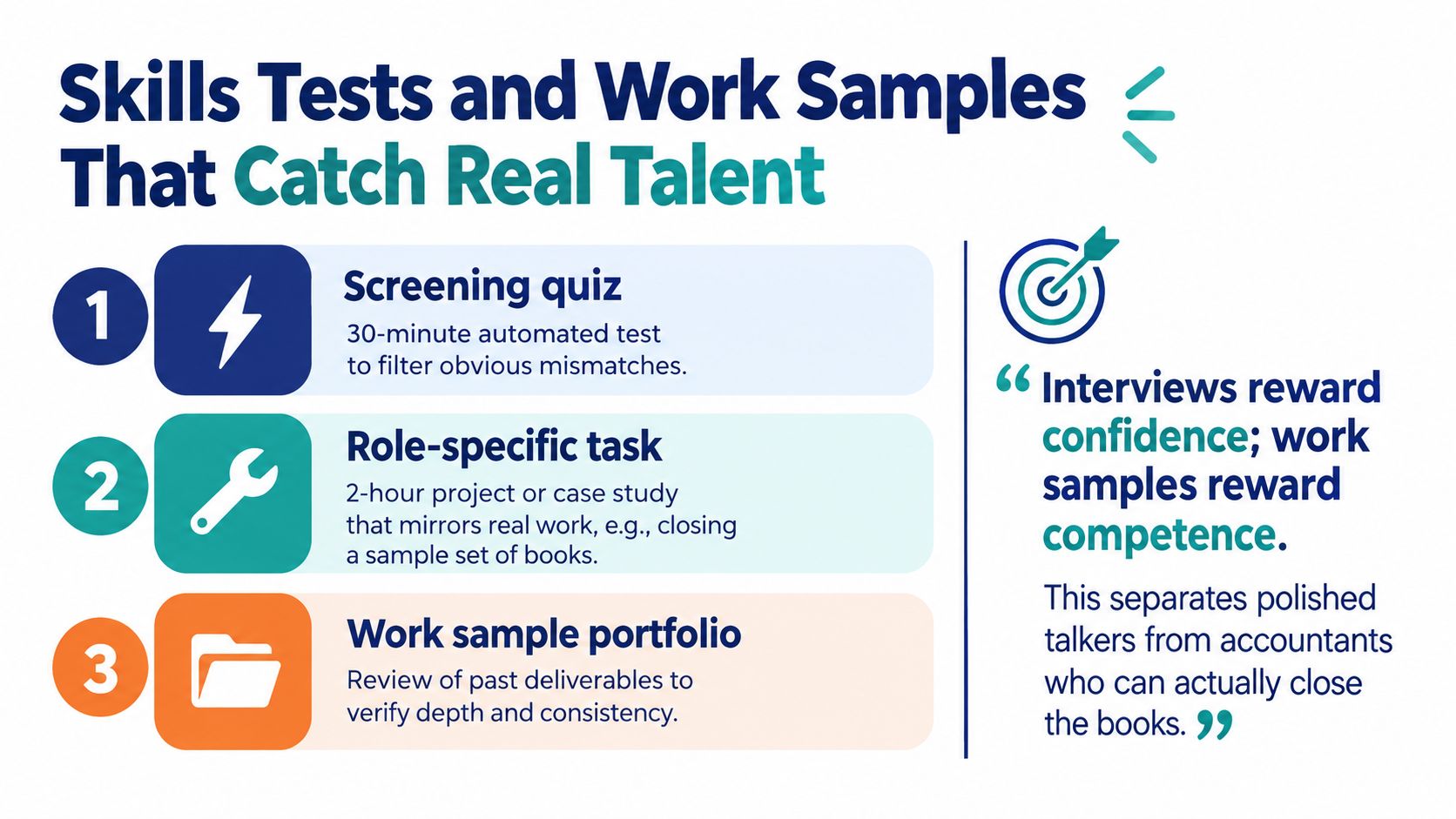
Use tasks that mirror the job. If the role is bookkeeping, test cleanup and reconciliation. If it's FP&A, test reasoning and communication around a model or variance.
A practical stack looks like this:
If you want a deeper case for how work samples can predict job performance with tests, that argument is worth reading because it aligns with what works in the field.
Without a rubric, teams drift back into arguments about “presence” and “polish.” That's code for confusion.
Score against clear categories:
| Scoring area | What you're looking for |
|---|---|
| Accuracy | Did they identify the real issue and avoid obvious mistakes? |
| Speed | Did they manage time well without rushing into nonsense? |
| Clarity | Can another finance professional follow the logic easily? |
| Defensibility | Can they explain assumptions without bluffing? |
Use tools that fit the role. Google Sheets works for custom reconciliation exercises. TestGorilla and Mettl can help with standardized assessments. For more senior roles, a custom case often tells you more than generic testing platforms.
Generic logic tests are often a detour for accounting hires. I care more about debit-credit instincts, reconciliation behavior, footnote literacy, and how someone handles incomplete data than whether they can solve abstract brainteasers.
To verify the candidate did the work:
If a dazzling take-home suddenly turns into verbal fog during review, congratulations. Your process worked.
One note on options. If you don't want to build all of this yourself, platforms and recruiting teams that pre-vet finance candidates can absorb some of this work. HireAccountants is one example. It provides pre-screened accountants and finance professionals for U.S. companies, with vetting focused on fit for remote finance roles.
A U.S. controller hires a senior bookkeeper in Colombia after one excellent Zoom interview. The candidate sounds sharp, references look fine, rate is reasonable, everybody's thrilled. Three months later, the controller learns the references were effectively useless, timezone overlap isn't what the team assumed, and the engagement setup created avoidable local compliance headaches.
None of that is exotic. It's normal sloppiness dressed up as cross-border hiring.
Remote hiring across Latin America adds friction in places many U.S. teams barely think about until something breaks.
Here's the risk matrix I'd use:
| Risk Layer | Mexico | Colombia | Argentina | Brazil |
|---|---|---|---|---|
| Identity and credential verification | Verify government ID details, tax registration context, and professional credentials where relevant | Verify cédula details and professional history carefully | Verify identity records and credential claims with extra attention to documentation consistency | Verify CPF-linked identity context and role-relevant credentials |
| Reference quality | References may default to polite confirmation without depth | Similar risk of soft, noncommittal references | Informal networks can blur title and scope validation | Language and employer-response friction can slow verification |
| Contractor versus employee classification | Misclassification risk needs local review | Contract structure should match actual working arrangement | Payment and labor terms need close review | Classification and payroll setup can become complex fast |
| Work-product and access control | Tight NDA and least-privilege access are essential | Same, especially for bookkeeping and client files | Same, with careful document handling | Same, with strong controls around systems and exports |
For LATAM finance hires, I'd verify four things every single time:
If you're building a distributed bookkeeping team, a practical benchmark is to study how firms package remote bookkeeping services around communication, oversight, and recurring workflows. It shows where ops expectations usually need to be explicit.
The biggest remote-hiring mistake isn't moving too slowly. It's assuming the same signals mean the same thing across borders.
I don't need ten meetings to make a no call.
Walk away fast if you see:
Cross-border hiring is fixable. Wishful thinking isn't.
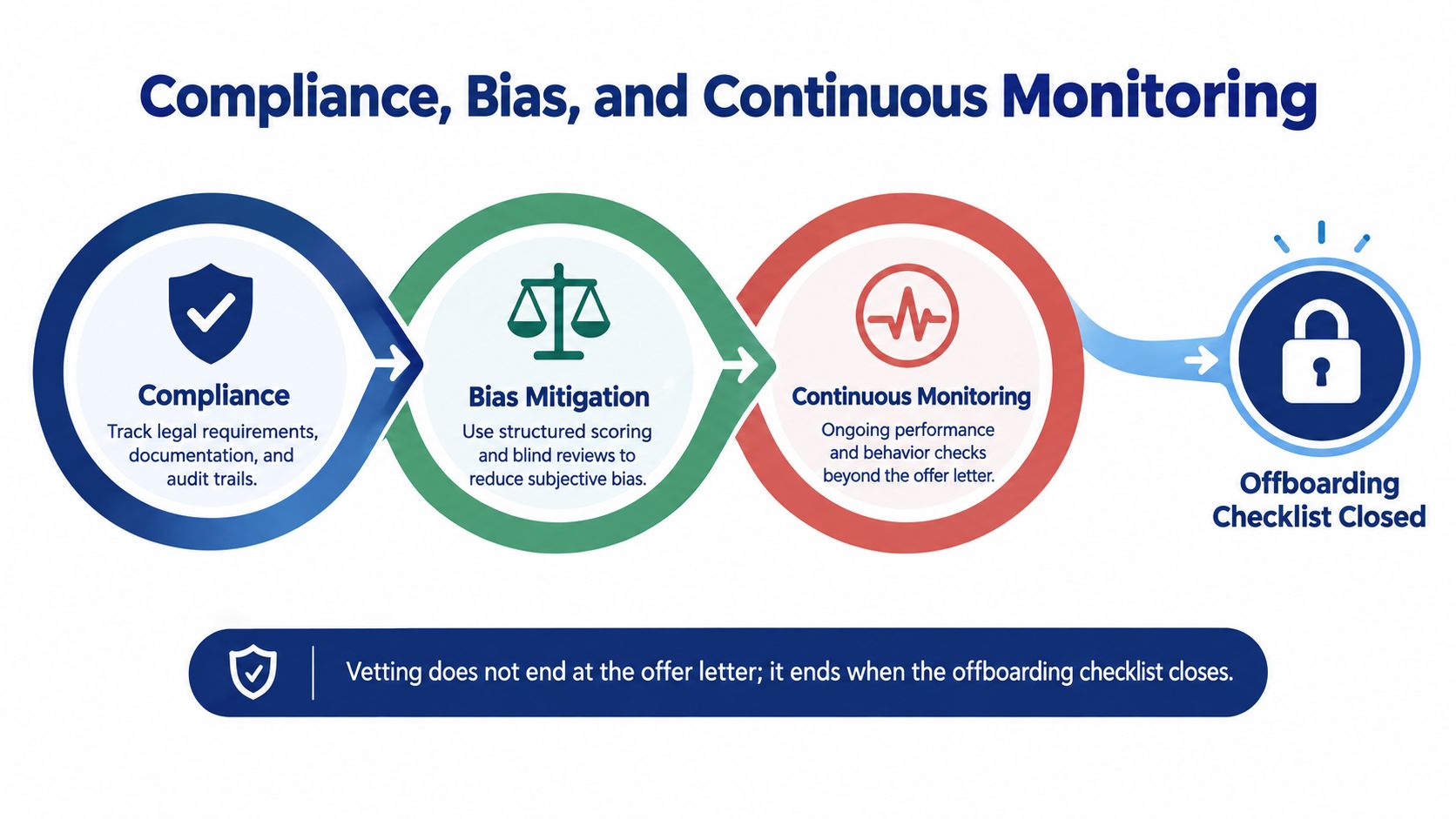
Vetting is often treated like a gate before the offer, but that approach is too short-sighted. For finance hires, especially remote ones, the process only works if compliance, bias control, and post-hire monitoring all connect.
That's the operational glue.
Some founders still act like background checks are just a vendor toggle. They're not. In the U.S., the EEOC says employers must give applicants a written, stand-alone notice before using a background report for employment decisions and must obtain the applicant's written permission to run the check, as explained in the EEOC guidance on background checks.
That means your process should include:
If you're comparing providers for screening workflows, even outside the nonprofit context, a roundup of what a nonprofit background check company looks like can still be useful for seeing how vendors package checks, consent, and audit trails.
Automation is not neutral just because the dashboard looks modern.
Recent research and industry reporting highlighted in this AI hiring bias paper show that biased hiring algorithms can disadvantage women even when they're highly qualified, and that 15% of AI systems fail fairness metrics for at least one demographic group. That should make any sane hiring manager more demanding, not less.
Ask vendors blunt questions:
If the answer is hand-wavy, the tool is not ready for meaningful hiring decisions.
The strongest candidate vetting process doesn't stop after onboarding. It narrows risk before the hire, then keeps watch after the hire.
Use a light recurring cadence:
| Monitoring area | What to check |
|---|---|
| Work quality | Spot-check workpapers, reconciliations, and memo quality |
| Access control | Review permissions, downloads, and system changes |
| Capability drift | Re-run a small practical exercise when responsibilities expand |
| Trust and compliance | Refresh relevant checks at sensible intervals and document outcomes |
Operator's note: the offboarding checklist matters as much as the onboarding checklist. Finance access lingers unless somebody owns the cleanup.
A lot of founders say they'll just do the vetting themselves. That sounds thrifty until it eats half the week and still leaves you with fuzzy evidence.
The comparison isn't “free versus paid.” It's fragmented internal effort versus a narrower, pre-filtered pipeline.
| Dimension | In-House DIY Vetting | Pre-Vetted Finance Platform | Typical Range |
|---|---|---|---|
| Candidate volume handling | Your team reviews and coordinates everything | Platform narrows the pool before you engage | Varies by role and urgency |
| Process design | You build rubrics, tests, and reference workflows yourself | Platform usually supplies a repeatable screening layer | Varies by provider maturity |
| Speed to shortlist | Depends on recruiter and hiring-manager bandwidth | Usually faster because sourcing and early vetting are bundled | Faster when the provider already has talent inventory |
| Quality control | Strong if your team is disciplined, weak if everyone improvises | More consistent if the platform specializes in finance roles | Depends on role fit and provider rigor |
| Cross-border logistics | You own verification, compliance coordination, and handoffs | Many platforms support these steps directly or through partners | Especially relevant for LATAM hiring |
| Replacement risk | Internal process may or may not have backup candidates ready | Some providers structure replacement support into the engagement | Terms vary |
If you hire finance roles constantly and already have a disciplined recruiting operation, DIY can work. Most startups don't. They have one stretched operator, one impatient founder, and one controller trying to close the month while also interviewing strangers.
That's when pre-vetted platforms start making sense. If you want a cleaner explanation of when external help is worth it, recruitment process outsourcing is the broader model to compare against your internal setup.
The trap is assuming ad hoc effort is a system. It isn't. It's just hidden labor with a smiley face on it.
Before you post the role, answer a painful question. Do you have a candidate vetting process, or do you have a sequence of meetings?
If it's the second one, fix that first.
Use this before the next finance hire:
A hiring process should produce evidence in layers. If one layer fails, the next one shouldn't have to rescue the whole decision.
That means no more “great energy” hires for accounting roles. No more guessing whether the take-home was outsourced. No more realizing after onboarding that nobody checked title inflation, employment dates, system depth, or local compliance details.
If even one critical box is empty, you don't have a vetting process. You have a hope and a handshake.
Build the funnel. Tighten the rubrics. Verify the boring details. Then hire with a straight face.
HireAccountants helps U.S. companies hire pre-vetted accountants and finance professionals without building the entire pipeline from scratch. If you want remote LATAM talent that's already been screened for finance-role fit, communication, and hiring readiness, take a look at HireAccountants.
Let's simplify your finances today!