


The usual advice on hiring a virtual accountant is backwards: find someone pre-vetted, hand over the logins, and relax. That's how access becomes an afterthought.
Pre-vetting doesn't end your risk. It starts it. Your job is to design controls around the hire and score skills and access together before signing. A strong forecaster who can approve payments without review creates a segregation-of-duties problem, not a bargain.
There's more than one way to get clean books without mortgaging your office ping-pong table. Start by matching the accountant's level to the work, then decide what systems and approvals the role needs. A good hiring choice weighs both.
Paying CPA rates to reconcile Shopify payouts is the classic expensive mistake. The second classic mistake is the mirror image. You hand revenue recognition to a junior bookkeeper because his hourly rate looked friendly.
Both errors come from hiring a title instead of hiring for tasks. Different recurring work needs different judgment, different credentials, and different supervision. If you want a plain-language breakdown before you write the post, find hiring guidance and compare it against your own task list first.
| Task | Right Level | Skill to Check First |
|---|---|---|
| Bank reconciliations, AP/AR entry, payout deposits | Bookkeeper | Reconciling a messy month accurately without guessing |
| Month-end close, accruals, journal review | Senior accountant | Spotting a wrong balance, not just an unmatched item |
| Sales tax, payroll tax, annual return prep | CPA or enrolled agent | Current federal and state rules and filing deadlines |
| Forecasting, variance analysis, board packs | FP&A analyst | Building a model that holds up in a bad quarter |
| Revenue recognition, audit prep, controls design | CPA with industry depth | Explaining a judgment call in writing |
If you're still fuzzy on where bookkeeping stops and licensed work starts, this comparison of CPA and bookkeeper responsibilities draws the line in practical terms. Read it before you interview, not after you've already promised someone tax work they shouldn't touch.
List every recurring finance task from the last three months. Don't use the job description you copied from another company. Use your actual calendar, bank feeds, and close checklist.
Tag each task with a level from the table, then total the hours. Be honest. That weekly AR chase counts, as does the monthly scramble for missing receipts.
Practical rule: Anything under about 10 hours a month suits a part-time or fractional arrangement rather than a full seat you're inventing work to justify.
Most startups need no more than two levels in year one. Say a SaaS company needs daily transaction coding plus a monthly board forecast. That's a bookkeeper for volume and an FP&A analyst for a few focused hours, not one mythical unicorn who does both brilliantly at bookkeeper pay.
Let the task list set the mix. Titles are marketing. Hours and judgment are the job.
Start with the anchor number. The U.S. Bureau of Labor Statistics put the median annual wage for bookkeeping, accounting, and auditing clerks at $50,670 in May 2025, or $24.36 per hour. That's the starting line, not the bill.
That role typically requires some college but not necessarily a bachelor's degree. In plain English, don't hire a CFO to reconcile Shopify deposits, and don't expect a junior bookkeeper to design your revenue recognition policy. Match the talent level to the work, then decide how many hours you need.
| Cost Line | In-House Bookkeeper | Virtual Bookkeeper |
|---|---|---|
| Base pay | $50,670 a year median (BLS, May 2025) | Hourly or monthly fee set in the contract |
| Payroll taxes and benefits | Often 20-30% on top of base (estimate) | Usually inside the provider fee; confirm |
| Recruiting | Job boards, agency fees and interview hours | Platform or agency fee; get it in writing |
| Equipment and software | Hardware, licences and desk space | Often provided; confirm who pays for software |
| Management time | Onboarding, reviews and benefits admin | Similar review time plus time-zone planning |
| Exit cost | Notice, severance and rehire cost | Contract notice period; confirm in writing |
Payroll taxes and benefits are the line people forget. Budget an estimated 20 to 30 percent on top of base for an employee, then confirm the actual figure with your payroll provider. That estimate is for planning, not a quote.
For a virtual hire, ask what the fee covers. Are taxes, equipment, and software included? Who pays for QuickBooks Online, Xero, or NetSuite licences? What notice period applies if the fit fails in month two?
This breakdown of what it costs to hire an accountant is useful when you're comparing quotes side by side. Compare total monthly cost, including your own review time, not the hourly rate alone. A cheap rate with sloppy work costs you twice.
Set a budget rule now. Fix a monthly ceiling, start at about 20 hours a week for bookkeeping, and add hours only after the first close lands clean. If the close doesn't land clean, more hours just produce a bigger mess faster.
Good remote candidates rarely show up where you're probably looking. The New York State Society of CPAs report on remote accounting listings noted that fully remote positions represented 0.85% of accounting job listings analyzed by Vintti in 2025, while 70.61% required on-site work. Generic boards skew heavily on-site.
So where do you look? Each channel trades speed, trust, and vetting effort differently.
| Channel | Best For | Your Vetting Effort | Typical Speed |
|---|---|---|---|
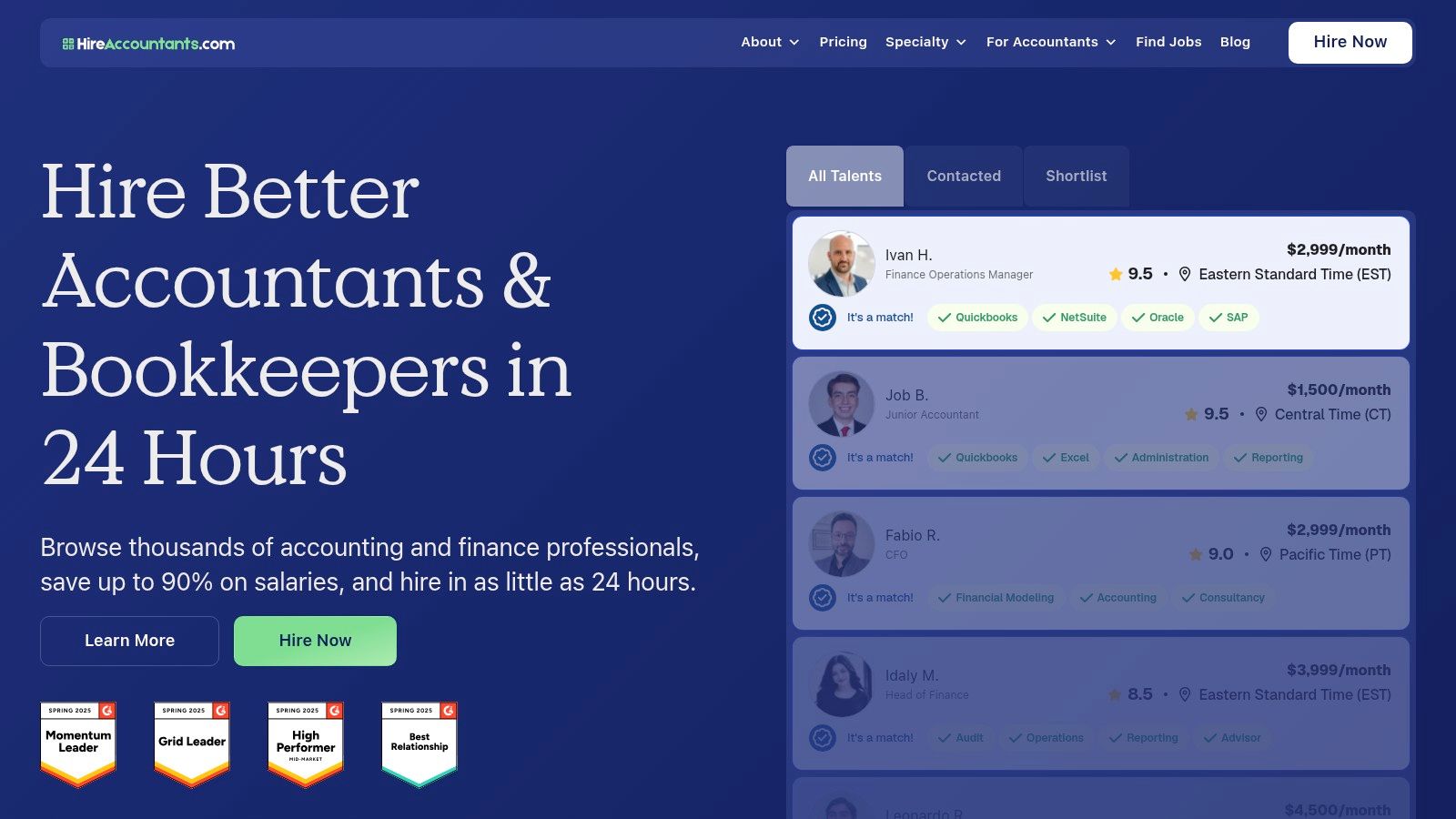
| Specialist talent platform (HireAccountants) | Bookkeepers, senior accountants and FP&A in US time zones | Low to medium; still run your own test | Vendor-stated; verify in a trial |
| General freelance marketplace | Short, clearly defined projects | High; you check licences and references | Days to weeks |
| Accounting firm managed service | Outcome-based close or tax work | Low; you manage the firm, not the person | Weeks to start |
| Local staffing agency | Roles that need on-site presence | Medium | Get a start date in writing |
| Referral from CPA or banker network | Controller-level or CPA-level hires | Medium; trust already exists | Often fastest to a first call |
A specialist platform gives you pre-vetted profiles, AI-assisted shortlisting, and English-fluent talent working US hours. That's useful for bookkeepers, senior accountants, and FP&A hires. You can also submit a remote job listing if you want to widen the funnel beyond a curated pool.
A general freelance marketplace gives you a wider pool and leaves vetting entirely to you. Hope you enjoy spending your afternoons fact-checking resumes and running technical interviews, because that's now your full-time job. An accounting firm's managed service sells you outcomes, but you give up control of the individual doing the work.
My verdict is simple. Use a specialist platform for bookkeeper, senior accountant, and FP&A roles, and chase a CPA referral for controller-level or tax roles where personal trust matters most. Referrals carry the most trust and the smallest pool, so use them where trust is the constraint.
Whatever the channel, pre-vetted profiles still need your own paid sample test and reference checks before access is granted. Toot, toot for any platform that screens well. You still verify.
Resumes are cheap. Reconciliations are not.
Score every candidate from 1 to 5 in five categories, separately, with identical questions and a predefined rubric. The U.S. Office of Personnel Management guide on structured interviews reports that more highly structured interviews produce greater validity, rater reliability, and agreement, while reducing adverse-impact risk. Conversational chemistry is not a scoring category.
Define the role by measurable outputs first. Think monthly close completion, bank-reconciliation accuracy, aged-receivables reduction, or forecast variance. Then run a standardized exercise using your chart of accounts and a fixed time limit.
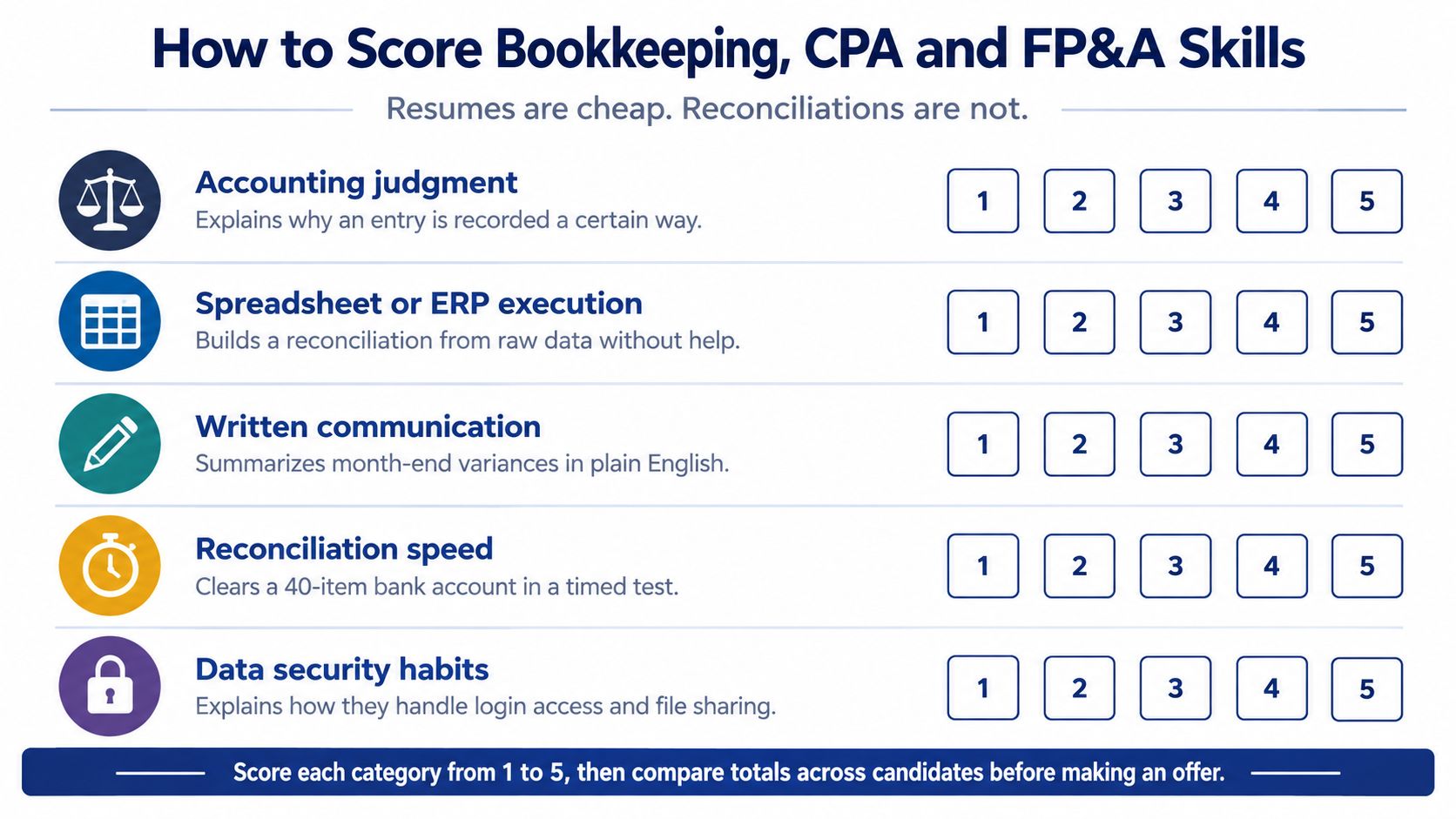
| Category | Pass Rule | What a 5 Looks Like |
|---|---|---|
| Accounting judgment | Scored and averaged | Spots a wrong balance and explains the fix |
| Spreadsheet or ERP execution | Floor of 3 of 5 | Finishes a timed reconciliation accurately in your system |
| Written communication | Scored and averaged | Explains a trade-off in two clear paragraphs |
| Documentation quality | Scored and averaged | Leaves support an auditor could follow without a call |
| Control awareness | Floor of 3 of 5 | Names approval and access limits without prompting |
Set a floor of 3 out of 5 on reconciliation and control awareness, and treat it as pass or fail. A strong average can hide one dangerous gap. A candidate who's brilliant at forecasting but careless with approvals isn't safe with your bank login.
Add one data-security scenario. Ask how they'd handle a request for bank credentials from an unknown sender. Score whether they insist on verification and role-based access, or whether they start being helpful in exactly the wrong way.
Common failure points are predictable. Testing only bookkeeping mechanics, accepting unverifiable experience claims, and asking finalists different questions all produce confident, wrong decisions. We're not saying this scorecard is perfect. Just more accurate more often.
One question filters out more people than any credential check. Walk me through clearing a bank account with 40 unmatched items at month-end.
A good answer sorts items by type and asks about timing differences first. A weak answer starts clicking. That difference matters, because the CFO report on finance outsourcing concerns found that 59% of executives cited quality and accuracy as outsourcing concerns and 56% cited loss of control, while 32% cited communication problems and 25% cited process or systems integration. Data security and compliance were also identified as the leading adoption barrier by 29% of respondents.
Your interview has to test those exact risks before access, not discover them after.

If you want a longer bank to draw from, these accounting interview questions for finance hires cover the technical basics. Keep your final list identical for every finalist. Changing questions mid-process turns scoring into storytelling.
Then run the paid sample test. Give two hours on anonymized data, identical for every finalist, timed, and paid at their going rate. Unpaid tests select for people who are desperate, not people who are good.
Score the work against your rubric, not against your gut. Did they reconcile accurately? Did they document assumptions? Did they escalate the item that looked like a duplicate payment instead of forcing it to match?
Finish with a reference check that asks about month-end close timeliness and how the candidate handled a missed deadline. Ask what broke, who noticed first, and what changed afterward. Vague praise tells you nothing.
Interview three finalists at most. More than three usually means your shortlist criteria are mushy, and you'll start choosing on personality because you're tired.
Pre-vetted doesn't eliminate operational risk. It shifts your job from finding a trustworthy person to designing controls around that person.
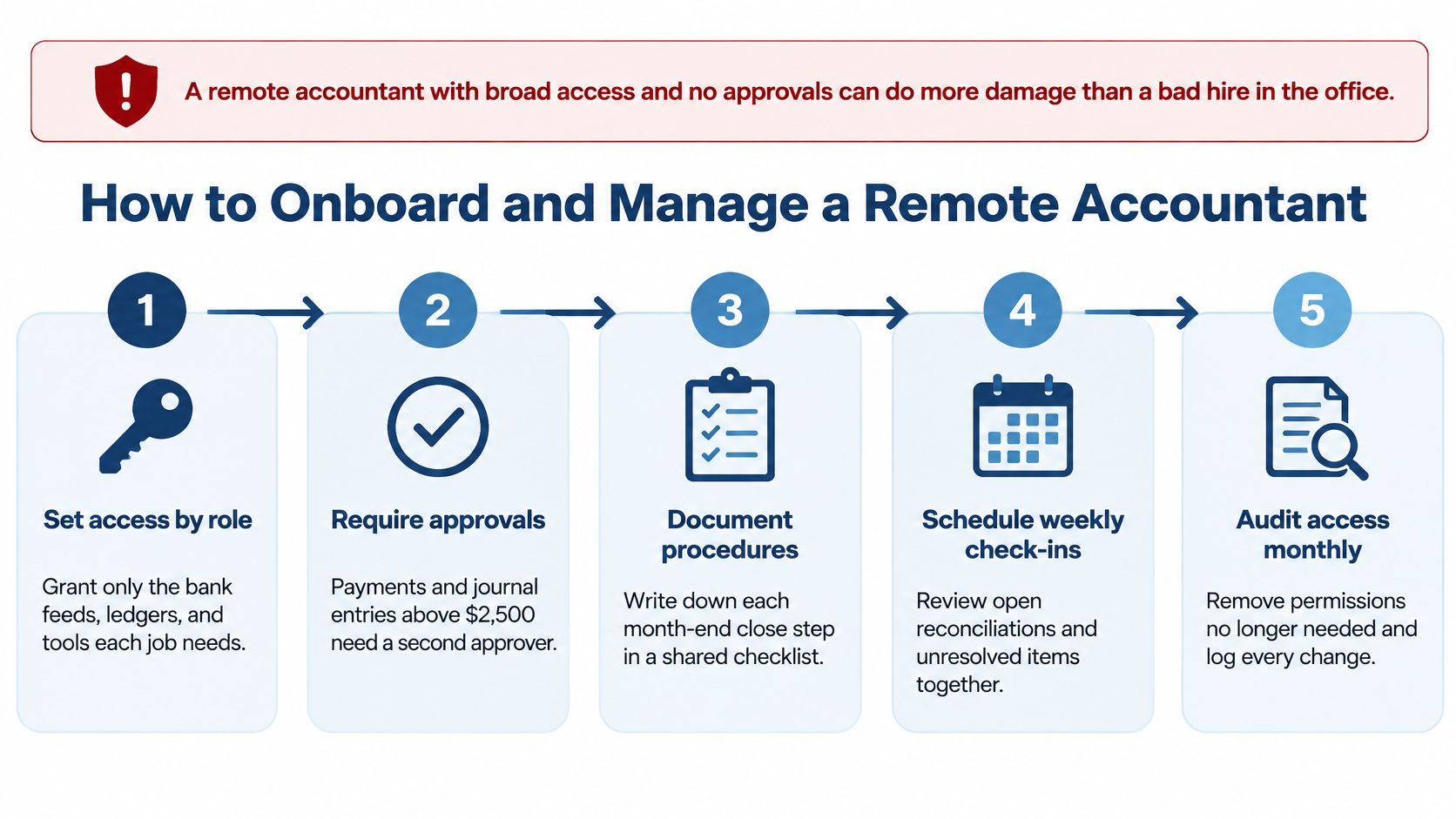
A remote accountant with broad access and no approvals can do more damage than a bad hire in the office. Office presence never stopped a bad journal entry. Controls do.
Manage by outcomes, not presence. U.S. Bureau of Labor Statistics research on remote work and productivity found a statistically significant positive association between increased remote work and total-factor-productivity growth across 61 private-sector industries, with a one-percentage-point increase in remote workers associated with approximately a 0.08-percentage-point increase in TFP growth. That's an association, not a guaranteed uplift for your close, so measure your own baseline.
Give clear ownership of reconciliations and deadlines, plus direct access to the people who can answer business questions. Then judge by accuracy, cycle time, unresolved exceptions, and close timeliness. Hours online and message counts tell you someone owns a keyboard.
The person who enters transactions should never also release payments. Separate transaction entry, payment release, and financial reporting, even if that means you personally approve payments for a while. Inconvenient beats sorry.
Set response windows in the same document as the approvals. Name the hours the accountant must answer transaction questions, the overlap with your team's working day, and who covers when time zones don't overlap. Same-day clarification keeps exceptions from sitting idle overnight.
Seen online at 9:02 a.m. is not a KPI. A clean reconciliation with support an auditor can follow is.
Don't sign a long contract on interview performance. Run a 30-day pilot with written acceptance thresholds and let the work argue for itself.
Pick three to five metrics you'll measure against the baseline you captured during onboarding. Use concrete thresholds you define in advance, such as close completed by a set business day, reconciliation accuracy above a stated percentage, unresolved exceptions cleared within the SLA, and forecast variance inside a band you set. Write them down before day one, while you're still objective.
Keep the scope narrow. Bookkeeping for one bank account and one payout channel, not the whole ledger. A narrow pilot shows you accuracy, documentation, and escalation habits without betting the entire close on a stranger.
Match the structure to the workload. Stay part-time while the load stays under about 20 hours a week, and go full-time once close and reporting fill a week on their own. Don't buy a full seat to feel serious.
Do the first action this week. Shortlist three finalists, send the paid sample, score it with the rubric, and set the pilot start date before anyone signs a long contract. That's how you hire virtual accountant talent without the regret, the cleanup bill, or the awkward call to your CPA.
Ready to put this into practice without spending your month screening resumes? HireAccountants connects US companies with pre-vetted remote bookkeepers, CPAs, senior accountants, and FP&A analysts working in US time zones, with flexible part-time and full-time arrangements. Browse profiles, run your paid sample test on the finalists, and start with a controlled pilot before you commit.
Let's simplify your finances today!