


You're staring at a spreadsheet at 11:47 p.m., trying to remember whether that vendor payment belongs in supplies, equipment, or the growing category called “I'll fix it later.” Tax season is approaching. Payroll is no longer just you. A second owner wants cleaner reports. Somewhere in the inbox, an IRS deadline is waiting to become a problem.
That's usually when founders search for hiring a CPA for small business and make the first mistake: they compare prices before defining the risk. The right CPA isn't the cheapest preparer. They're the person who understands your industry, answers when needed, and catches problems before you're paying premium hourly rates to clean them up.
A bookkeeper can keep transactions organized. Software can categorize routine expenses. Neither replaces judgment when your business structure, tax obligations, or reporting needs become complicated.
The trigger often arrives without fanfare. You hire employees and payroll filings enter the picture. You add an owner and the old filing process stops fitting. You carry inventory, sell across state lines, prepare for financing, or discover that your spreadsheet doesn't explain why cash keeps disappearing while revenue looks healthy.
That's the point where a CPA starts earning their keep.

Ask yourself three blunt questions:
A basic business may only need clean books and straightforward filing. A growing business needs someone who can connect bookkeeping, tax planning, compliance, and decisions about structure. Waiting until a notice arrives is a poor hiring strategy. By then, you're not buying guidance. You're buying cleanup.
Founder rule: Hire for the complexity you're entering, not the simplicity you're leaving behind.
The buyer's side matters too. A 2025 survey of 350 U.S. businesses found that 57% found their current accountant through peer referral, while only 3% found one through advertising. The same survey reported that dissatisfaction centered mainly on poor responsiveness and weak industry insight, rather than price alone. See the survey findings on how small businesses choose and evaluate accounting firms.
That's the uncomfortable truth about referrals. A recommendation can get a candidate onto your list, but it doesn't prove they understand ecommerce sales tax, SaaS revenue, construction billing, restaurants, agencies, or your particular brand of financial chaos. Use the referral. Then test the person.
If you're still handling a simple operation with clean records, deferring a CPA may be sensible. If you're losing sleep over filings, spending productive hours fixing books, or making structural decisions without advice, the cost of waiting is already showing up. It just isn't printed on an invoice yet.
A CPA isn't a bookkeeper with a more expensive business card. A bookkeeper records transactions and reconciles accounts. An accountant interprets financial information and prepares reports. A CPA carries state-regulated authority and can handle higher-stakes tax, assurance, and advisory work.
In the United States, CPA licensure is governed by state boards and follows the three E's, education, experience, and examination. The usual path includes a bachelor's degree, 150 total semester hours, at least one year of accounting experience, and passage of the four-section Uniform CPA Examination, as outlined in this overview of CPA requirements.
That credential matters. It still isn't a performance guarantee.
Monthly close and reporting give you reliable financial statements, reconciliations, and a clearer view of what happened. This is useful when you need operating decisions based on something more solid than your bank balance.
Tax preparation and planning cover filings, estimated payments, entity decisions, and opportunities to plan before the year closes. Filing is backward-looking. Planning gives you a chance to act while choices still matter.
Payroll and sales tax compliance become critical once you have employees, taxable transactions, or activity across jurisdictions. These workstreams punish casual ownership because deadlines recur whether you feel ready or not.
Entity and advisory work enters the picture when you're choosing or changing a business structure, adding owners, preparing for financing, evaluating an acquisition, or trying to understand the financial consequences of growth.
A tax-focused CPA may be excellent at returns but weak at monthly management reporting. A fractional controller may improve your close process but not be the right person for complex tax representation. A bookkeeper may be exactly what you need for transaction accuracy, but not for entity planning.
Write down the workstream before searching. “Need a CPA” is too vague. “Need monthly close, payroll support, sales tax filings, year-end tax preparation, and quarterly planning” gives candidates something concrete to price and prove.
For California businesses, verify jurisdiction-specific qualifications rather than assuming every CPA is interchangeable. California requires a baccalaureate degree or higher, 150 total semester units, specified accounting and business coursework, at least 12 months of general accounting experience, and a valid U.S. Social Security Number or Individual Taxpayer Identification Number. The state also replaced the old PETH exam requirement effective July 1, 2024, with a CBA-approved regulatory review course for first renewal, according to the California CPA licensure requirements.
The lesson is simple. Credentials tell you what someone cleared. Your scope tells you what they must deliver.
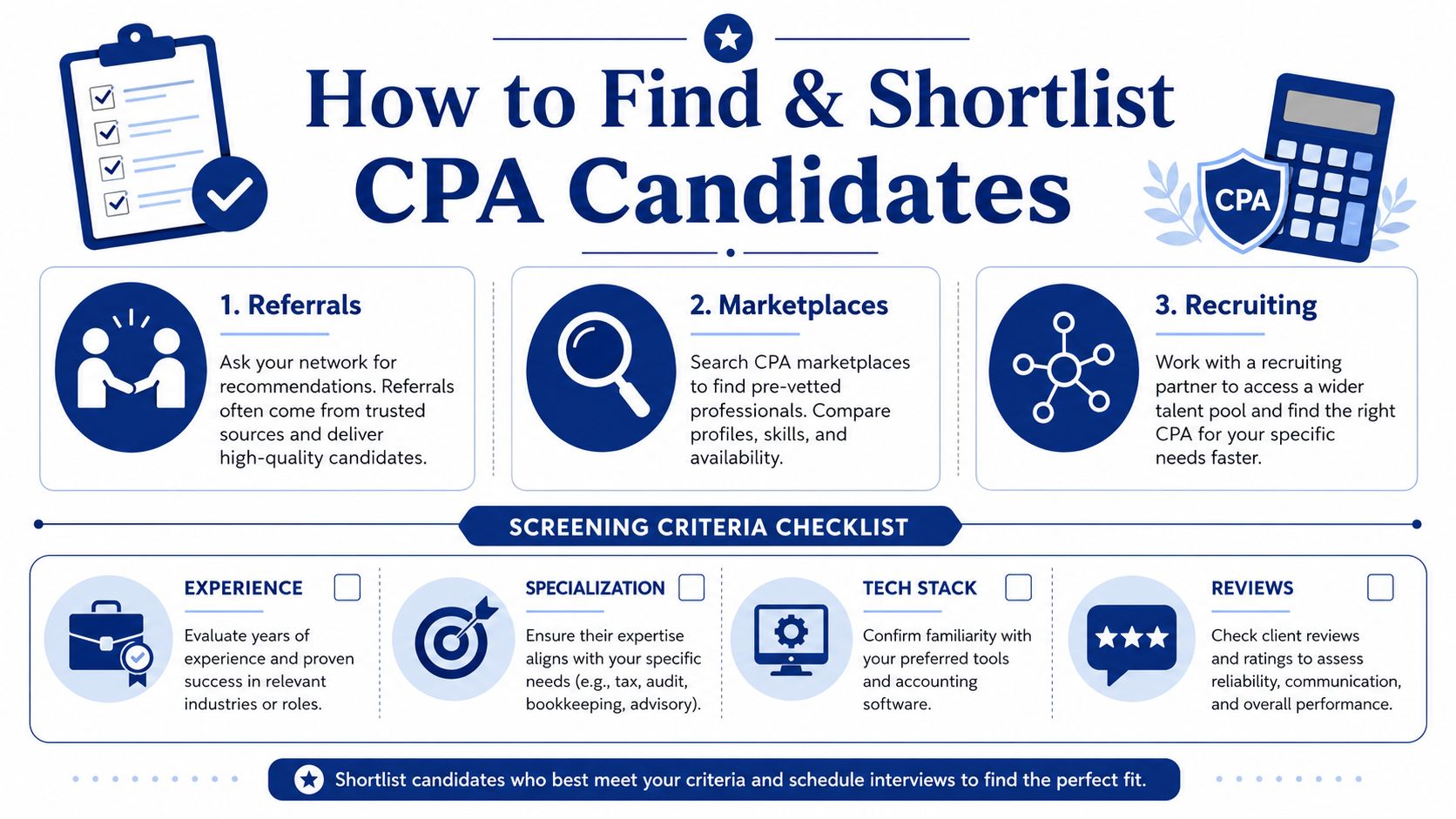
Start with referrals, but don't stop there. A referral answers one question, “Who has worked with someone I know?” It doesn't answer the questions that determine whether the relationship survives tax season.
Marketplaces widen the pool and make profiles easier to compare. Recruiting-led searches help when your needs are specialized, urgent, remote, fractional, or difficult to describe in a generic job post. None of these channels removes your responsibility to evaluate the work.
Referrals are useful for trust signals. Ask the person making the introduction what the CPA handled, how quickly they responded, and whether they stayed proactive after the initial engagement.
Marketplaces help you compare specialties, software familiarity, availability, and engagement models. They're particularly useful when you need part-time or remote support rather than a traditional local firm.
Recruiting makes sense when the role has multiple requirements, such as tax expertise plus US time-zone coverage, or bookkeeping plus financial planning and analysis. A recruiter can also help distinguish a tax preparer from a broader accounting operator.
The shortlist should be built around your work, not the candidate's title. Score each person on:
A practical hiring method is to scope the exact workstream first, run a real technical screen before the shortlist, and prebuild a 90-day onboarding plan. Those steps address common accounting hiring failures, including choosing the wrong sub-discipline, testing credentials instead of actual work, and starting without a first-90-days plan, as described in this analysis of why accounting hires fail.
A referred CPA still needs to pass the same screen as everyone else. Ask for a written scope, a sample reporting package, an explanation of their review process, and references from businesses with comparable needs. You're not being difficult. You're preventing a friendly introduction from becoming an expensive engagement.
Build a shortlist of candidates who match the role, then test them before you fall in love with the credential. This guide to finding a good accountant is useful as a companion checklist, but your own scorecard should remain specific to your operation.
The best candidate often isn't the person with the broadest menu of services. It's the person who can say, “Here's what I'll own, here's what I need from you, here's how you'll hear from me, and here's what happens when something goes wrong.”
A license proves education, examination, and professional qualification. It doesn't prove that the candidate can find a transposed entry, complete a reconciliation that doesn't balance, or communicate clearly when payroll is due.
That's why the interview needs a work sample. Keep it practical. Give the candidate a sanitized reconciliation with an error, a short list of transactions to classify, or a deadline scenario involving incomplete records. Ask them to explain their reasoning, not just produce an answer.
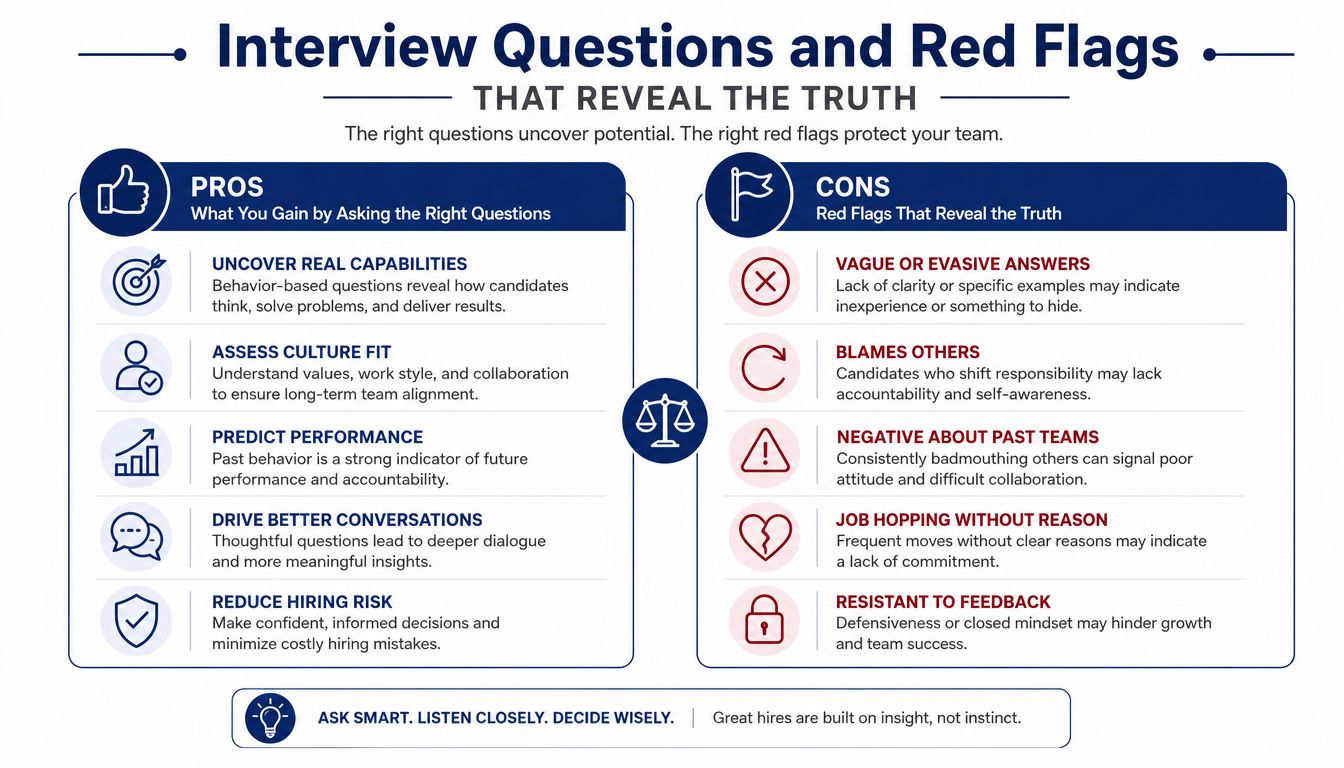
Try these:
Use this accounting interview questions guide to expand the script, then adapt the questions to your industry and software.
Vague industry experience means you may pay while the CPA learns your business model.
Slow follow-up during the sales process predicts pain later. If a candidate disappears before you've signed, don't assume they'll become wonderfully responsive afterward.
Reluctance to show a work sample is a problem. Protect confidential information, of course, but a capable professional should be able to demonstrate their process with anonymized or synthetic material.
Only discussing the credential is another warning sign. The screening guidance from HireTruffle's accountant hiring guide makes the point directly: certification shows study and exam passage, but it doesn't prove day-to-day performance.
Price matters. Responsiveness matters more than most founders admit. A cheaper CPA who misses your question, gives weak industry advice, or forces you to chase every deliverable can cost more than a higher-priced specialist who keeps the business moving.
No-hire test: If you can't explain what the candidate will own, how you'll measure delivery, and how quickly they'll respond, you aren't ready to sign.
Your first CPA quote may look reasonable until the “quick question” becomes cleanup, payroll work, state filings, or an amended return. Budget for the work your business needs, not the credential on the invoice.
CPA pricing rises with complexity. A simple Schedule C return averaged about $640 nationwide in one 2026 analysis, while S-corporation and partnership returns typically ranged from $850 to $1,300, according to this small-business tax preparation cost benchmark.
That same benchmark reported broader 2026 ranges of $190 to $800 for a Schedule C return, $1,200 to $3,500 for an S-corporation return, and $1,000 to $5,000 or more for partnership returns. These figures reflect different ownership structures, reporting requirements, compliance work, and levels of complexity. Compare scope before comparing quotes.
The benchmark placed hourly advisory rates at $150 to $450 per hour. Smaller firms often fell around $150 to $275, while specialized work reached the higher end of that range. A CPA cost and hiring guide can help you compare engagement models before you assume an hourly arrangement will stay inexpensive.
Recurring support changes the math. One 2026 industry summary put monthly bookkeeping support at $190 to $900 per month, with advisory retainers adding $400 to $1,500 per month at small-business scale. A separate breakdown found that most small businesses spend $1,000 to $5,000 annually on accounting, and 77% spend more than $1,000 annually on accounting-adjacent costs, as summarized in this small-business CPA cost guide.
| Pricing Model | Typical Cost Range | Best For | Watch Out For |
|---|---|---|---|
| Hourly | $150 to $450 per hour | One-off advice, cleanup, notices, or planning | Open-ended work and unclear estimates |
| Flat-fee return | $190 to $5,000+ depending on entity and complexity | Annual tax filing with defined scope | Add-ons for payroll, states, owners, or amended work |
| Monthly bookkeeping | $190 to $900 per month | Recurring books, reconciliations, and reporting | “Monthly accounting” that excludes key tasks |
| Advisory retainer | $400 to $1,500 per month | Ongoing planning and decision support | Paying for access without defined deliverables |
| Fractional support | Scope-dependent | Businesses needing recurring expertise without a full-time employee | Weak ownership if responsibilities aren't written down |
A written quote and engagement letter protect the budget. Define included filings, reporting cadence, response expectations, cleanup boundaries, notice handling, payroll scope, and the rate for work outside the agreement. If those details are missing, the quote is incomplete.
Niche expertise can justify paying up to 25% more, particularly when the specialist understands your industry and prevents expensive mistakes. Businesses above $1 million in revenue were twice as likely to hire niche specialists, as reported in the SMB accountant selection survey.
Pay extra for relevant judgment, reliable communication, and defined deliverables. Remote or fractional support often fits better than a full-time hire when you need recurring expertise but not a full internal workload. Referrals can identify candidates, but your budget should follow responsiveness and ownership, not familiarity.
A good hire can still fail inside a bad process. Give your CPA clean access, a clear calendar, and defined ownership. Don't hand over a password and call that onboarding.
Days one through 30 should establish control. Provide prior returns, entity documents, accounting-system access, bank and credit-card records, payroll information, and existing reconciliations. Confirm who owns each recurring filing and where documents live.
Days 31 through 60 should establish rhythm. Set the monthly close date, reporting package, meeting cadence, escalation path, and response expectations. Your CPA should identify missing records, open reconciliations, unresolved notices, and upcoming obligations.
Days 61 through 90 should produce insight. Review the first reporting cycle together. Ask what changed, what looks risky, what needs correcting, and which decisions deserve planning before the next filing deadline. If the relationship only produces forms, you hired a filing vendor, not an advisor.
The IRS calendar says EFTPS payments must be scheduled by 8 p.m. Eastern Time at least one calendar day before the tax due date, as stated in the official IRS small-business tax calendar. Put that requirement into your operating calendar, assign an owner, and make confirmation part of the process.
Most small businesses don't need a full-time CPA immediately. They need dependable ownership of a defined workload. Fractional or remote support can beat an in-house hire when work arrives in cycles, when you need specialist input without daily capacity, or when the talent market makes a direct hire slow and expensive.
Outsourcing is already a normal operating choice. Statistics Canada reported accounting, law, or other professional services as the most commonly outsourced category in the prior 12 months at 36.5%, while a separate SMB survey reported 37% of small businesses outsource at least one core function, as discussed in coverage of the accounting talent shortage and outsourcing tradeoff.
Manage a fractional CPA with the same discipline as an employee. Define deliverables, access permissions, meeting times, deadlines, and escalation rules. You don't need to micromanage. You do need to know who is accountable.
If you need pre-vetted remote CPAs, bookkeepers, or finance professionals, HireAccountants lets you browse candidates, build a shortlist, and interview for full-time or part-time support. Visit the platform, define the workstream you need covered, and stop waiting for tax panic to become your hiring process.
Let's simplify your finances today!