


It's Tuesday morning. Payroll needs approval, a customer still hasn't paid, and your marketing contractor wants permission to launch another campaign. You've got revenue on the books, work in progress, and an uncomfortable question: how much money can you spend?
The needs of small business aren't hard to name. The hard part is deciding which one deserves your attention before another bill lands. I'd rank them by how quickly neglect hits the bank account, not by which project looks impressive in a planning meeting.
Finance comes first. Not because accounting is more exciting than growth, but because you can't fund growth with an overdue invoice and excellent intentions.
An ordinary founder's Tuesday touches finance, operations, HR, sales and marketing, and tech before lunch. A supplier needs paying, an employee needs access, a prospect wants a proposal, and somebody's software subscription has renewed without permission.
These aren't separate departments yet. They're jobs, usually sitting on the same owner's crowded desk.
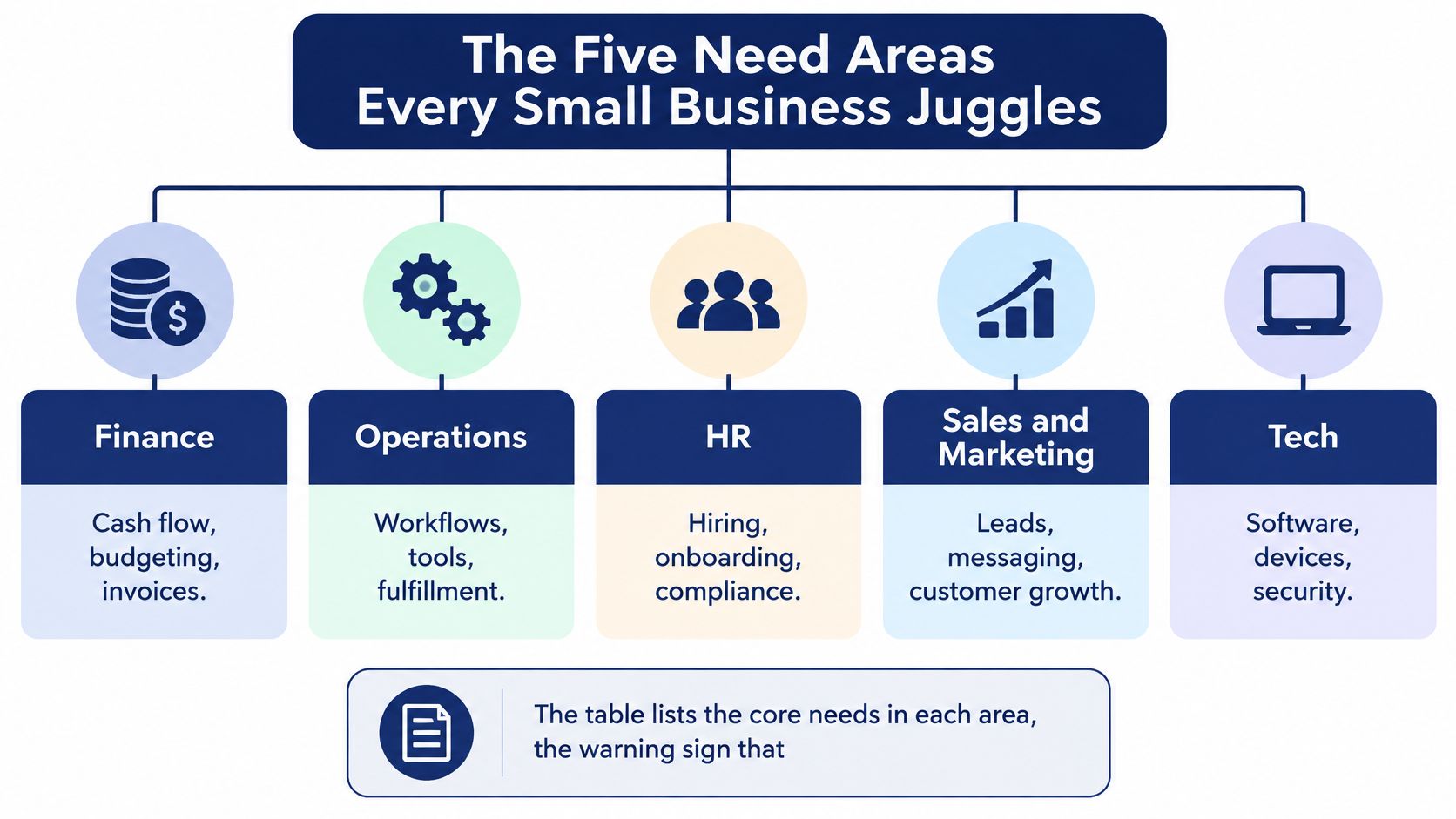
| Need area | Core needs | Warning sign | Usually owned by |
|---|---|---|---|
| Finance | Cash flow, bookkeeping, tax, financing | Payroll surprises and late reconciliations | Owner or outsourced bookkeeper |
| Operations | Vendors, inventory, compliance calendar | Missed filings and stockouts | Owner or operations lead |
| HR | Hiring, payroll administration, benefits | Open roles unfilled for months | Owner or HR generalist |
| Sales and marketing | Pipeline, lead tracking, retention | Flat pipeline and rising acquisition cost | Founder or marketing hire |
| Tech | Software stack, security, data access | Shared passwords and unsupported tools | Owner or IT contractor |
The pressure is widespread. The Federal Reserve's 2025 employer-firm report, reporting the 2024 Small Business Credit Survey, found that 75% identified rising costs of goods, services, or wages as a financial challenge, 56% had difficulty paying operating expenses, and 51% reported uneven cash flow.
Those problems need more than an optimistic sales target. Owners need to know which obligations are due, which receipts are dependable, and who's responsible for resolving the gap.
Use the warning-sign column to choose your top three needs. Rank them by the next unavoidable consequence: an unfunded payroll, an interrupted customer delivery, an exposed account, or a pipeline that won't support future expenses.
Finance problems usually deserve attention first because owners must settle cash obligations whether customers have paid or not. An active security incident or an unsafe operation can override that order, but a website redesign generally can't.
Give each priority a named owner and a concrete next action. Write “Maria will resolve unmatched bank transactions,” not “finance needs improvement.”
Practical rule: Fix the problem that can stop you paying people or serving customers before funding the project that makes the business look bigger.
You don't need a department for every row. You need someone accountable for the work, with enough time and authority to finish it.
Think of business cash as water in a bathtub. Sales turn on the tap, expenses open the drain, and your bank balance tells you what's left. Profit is useful, but it doesn't tell you whether a customer's money will arrive before payroll leaves.
The OECD's analysis of SME financing during COVID-19 found that operating expenses fall by only about 6% when revenues decline by 10%, and described many small firms holding cash for just two to three weeks of outflows; it also reported that approximately half of U.S. small and midsize enterprises had fewer than 15 days of cash reserves, while only about one in five could cover two months of missed revenue.
That historical analysis illustrates a practical problem, not a current reserve estimate for your company. Rent, software contracts, debt payments, and core staffing don't shrink neatly when sales weaken.
I'd start with a rolling 13-week cash forecast, updated weekly. Use actual bank balances as the opening position, then enter expected customer receipts and scheduled payments by week.
Don't put an invoice into the forecast just because it's due. Use the customer's likely payment date, flag uncertain receipts, and keep customer promises separate from cleared funds.
Run these habits together:
Your forecast doesn't need elaborate software. Excel or Google Sheets works if someone maintains the inputs and reconciles the opening cash to the bank.
These are recommended operating triggers, not universal lender requirements.
| Metric | What it signals | Check how often | Red flag |
|---|---|---|---|
| Cash runway in weeks of outflows | Liquidity cushion | Weekly | Under two to three weeks |
| Days sales outstanding | How fast customers pay | Weekly | Rising for two months in a row |
| Receivables aging | Which customers are late | Weekly | Overdue invoices without a confirmed payment date or action owner |
| 13-week cash forecast | Forward view of cash | Weekly update | Any negative week ahead |
| Payroll coverage | Can you meet the next payroll | Every pay cycle | Less than one full cycle covered |
Treat these triggers as prompts to investigate, not reasons to panic. Rising days sales outstanding might reflect a large invoice near month-end, but it might also mean customers are disputing bills or your team is sending them late.
For a practical operating routine, use these cash-flow management strategies to connect forecasting with collections and payment scheduling. The useful outcome is a decision you can make today, not another dashboard tab.
In the Federal Reserve's 2024 Small Business Credit Survey of U.S. employer firms with fewer than 500 employees, 59% sought new financing during the preceding 12 months; among applicants, 40% sought less than $50,000, 56% sought funding for operating expenses, and 46% for expansion or a new business opportunity, while 41% received all they sought, 36% received some, and 24% received none.
Many applicants needed modest amounts, but that doesn't mean most wanted small loans. Seeking financing did not guarantee receiving enough.
Distinguish a timing gap from a loss-making operation. Borrowing against a dependable receivable can address timing; borrowing repeatedly to cover work priced below its delivery cost merely adds repayments to the problem.
Expansion needs a different explanation. Show the expected contribution margin, startup costs, collection timing, and the point at which additional sales begin supporting their own expenses.
Borrowing can bridge a cash gap. It can't turn an unprofitable sale into a profitable one.
Before applying, set an internal target: can your team produce a monthly profit and loss, balance sheet, completed bank reconciliations, receivables aging, and a tax-ready chart of accounts within five working days of month-end?
That's a recommended management standard, not a legal deadline or financing guarantee. Its purpose is to expose whether your numbers are usable while decisions still matter.
If you can't meet it, identify the obstruction. Missing receipts require an expense workflow; unexplained transfers require investigation; stale receivables require collection work, not creative reclassification.
Clean books also help you assess financing offers. Compare repayment timing, total cost, security requirements, and restrictions against the forecast rather than choosing the offer with the friendliest headline payment.
Most missed deadlines start as ordinary unfinished work. Someone assumed the payroll provider handled a deposit, the contractor's tax details stayed in an inbox, or a renewal notice went to an employee who'd left.
A provider can perform a task without owning your entire compliance calendar. Assign a person inside the business to verify completion and retain evidence.
Use this as a planning checklist, then confirm applicable filing dates, deposit schedules, extensions, and state rules with your CPA or payroll provider. Payroll-tax deposits don't universally follow payday, and license-renewal schedules aren't universally annual.
| Task | Frequency | Consequence if missed | Owner |
|---|---|---|---|
| Payroll and payroll tax deposits | Review every pay cycle; deposit on the assigned tax schedule | Penalties and interest | Payroll owner |
| Sales tax returns | Monthly, quarterly or annual by state | Penalties and audit exposure | Bookkeeper |
| Bank and card reconciliations | Monthly, weekly at high volume | Unreliable books and missed fraud | Bookkeeper |
| Estimated income tax payments | Quarterly when applicable | Underpayment penalties | Owner with CPA |
| 1099 contractor forms | Each January 31 for applicable forms, subject to calendar adjustments | Per-form penalties | Bookkeeper |
| State annual reports or license renewals | Annual review; file or renew on the jurisdiction's schedule | Loss of good standing or license lapse | Owner |
Put recurring deadlines in one shared calendar, with a named owner, preparer, reviewer, and completion evidence. A calendar entry should link to the filing confirmation or reconciled report, not merely say “done.”
I'd review that calendar on the first Monday of each month as an internal routine. Paste the checklist into Asana, Trello, or the tool your team already opens, rather than buying another system everyone can forget to check.
Buying more ads is often easier than admitting nobody knows which leads became customers. Marketing is a tempting place to overspend because the spending feels like action, even when the owner can't connect it to collected revenue.
The core requirement is a repeatable pipeline: a defined ideal customer, a tracked lead list, consistent follow-up, and a record of the channels that produce paying customers. A shared spreadsheet is enough until the volume and handoffs justify a CRM.
Illustrative composite, local service firm. Say a plumbing business spends heavily on Google Ads but records calls without their source or outcome. The owner sees plenty of inquiries, while the dispatcher never records which callers booked profitable jobs.
The first fix isn't a larger budget. Add lead source, requested service, quoted amount, booking status, and collected revenue to the tracking sheet.
Illustrative composite, SaaS company. A software business celebrates healthy signups while customers cancel soon after onboarding. Paying to acquire more users won't repair a confusing setup process or a product that customers stop using.
Track these measures consistently:
Before adding overlapping subscriptions, review the growth tool trade-offs covered by Bazzly. Judge each tool by the decision or handoff it improves, not the length of its feature list.
Fund a channel you can measure before adding another you can't.
Finance should check promotion margins after discounts, fulfillment, refunds, and payment fees. A campaign that generates busy staff and weak contribution isn't a growth victory, it's expensive exercise.
You might need bookkeeping every week, tax advice periodically, and forecasting before a major commitment. That doesn't mean you need every specialist on permanent payroll.
In the Federal Reserve's Twelfth District survey findings, 51% of respondents identified hiring or retaining qualified staff as a challenge. The issue isn't finding applicants; it's finding the right capability for the work you have.
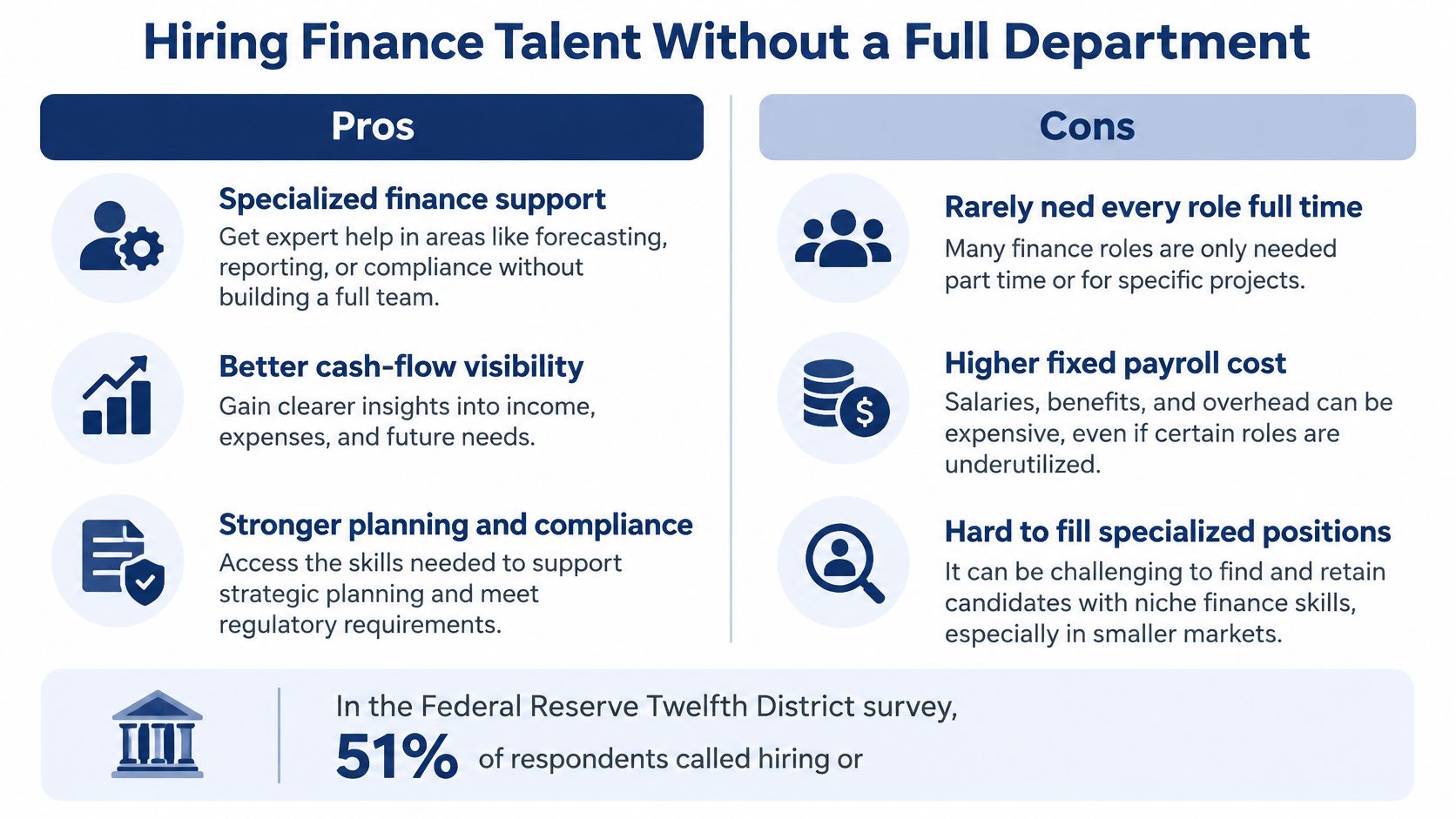
A full-time local bookkeeper brings availability and proximity, but the commitment includes salary, benefits, payroll taxes, equipment, and management time. That can make sense when daily workload is steady and coordination is intensive.
A pre-vetted remote specialist can cover a narrower scope, increase hours around close, and work under a defined notice arrangement. Don't confuse flexibility with frictionless cancellation, though; contracts, handovers, and unfinished work still need managing.
The U.S. Chamber's summary of NFIB's April 2025 jobs report reported that 34% of U.S. small-business owners had unfilled openings and 47% said they couldn't find qualified applicants. A narrowly specified finance role gives candidates a clearer target than an advertisement asking someone to handle everything involving money.
| Role | Typical work | Best fit | Engagement model |
|---|---|---|---|
| Bookkeeper | Coding transactions, reconciliations, monthly close | Startups and e-commerce | Part-time or full-time |
| AP and AR specialist | Bills, invoices and collections | Growing service firms | Part-time |
| CPA | Tax filings, sign-off within credentials and jurisdiction, and advisory | Any firm with tax exposure | Retainer or project |
| Tax accountant | Tax planning and returns | Multi-state or complex tax | Seasonal or retainer |
| Auditor or reviewer | Controls and account reviews | Firms preparing for funding | Project |
| Financial analyst or FP&A | Forecasting and variance analysis | Companies past early stage | Part-time to full-time |
| Accounting manager | Oversight and team lead | Teams of three or more | Full-time |
HireAccountants is one option alongside direct hiring, local accounting firms, and independent specialists: its platform offers pre-screened, English-fluent finance professionals in Latin America working U.S. hours, plus complimentary HR, payroll, and compliance support; its advertised pricing starts at $10/hour or under $3,000 per month, and its claimed 80–90% savings should be checked against your own comparable quotes.
Those are company claims, not a promise about your engagement. Confirm scope, credentials, working hours, included support, and total charges before comparing prices.
Outsourcing fails when owners outsource accountability too. Give the specialist a reviewer, an escalation route, and documented acceptance criteria; check time-zone overlap and data access before work starts.
When cash is tight, fix the risks that can stop payments, expose customer data, or delay routine work first. A breach can trigger notification and response costs that rise with the number of affected customers, before legal fees, remediation, downtime, lost sales, or reputational damage. NIST's small-business information security guidance offers small businesses practical security guidance, not a per-person cost estimate.
Review the accounts employees use to move money or export sensitive information before buying another tool.

If no one on the team owns these controls, compare outside support by its responsibilities and response coverage. Businesses seeking local support can assess managed IT services in NYC against their systems and security requirements.
The Federal Reserve's 2026 employer-firm report found that among AI users, 46% identified accuracy as a challenge and 43% identified adapting tools to business needs. Buying access does not solve either problem.
Before testing AI-assisted finance work, check that:
Begin with proposed coding or draft variance explanations, not autonomous payments. Keep payroll, tax, and customer data out of unvetted tools.
Use an accounting software selection framework to compare permissions, audit trails, integrations, and exports before weighing AI features. Reliable controls beat an impressive demo.
Don't write a job description while you're still guessing what's broken. A vague request for accounting help tends to produce vague proposals, mismatched candidates, and a surprisingly busy owner.
Define the outcome first, then choose the person and engagement that can deliver it. I'd use this decision sequence before approving any new finance expense.
Name your top three needs. Choose them from the business-area map and assign an owner to each. Describe observable failures, such as uncollected invoices or unreconciled accounts, rather than broad ambitions like better finance.
Inspect the cash position. Check the forecast and payroll coverage before committing to ongoing fees. If liquidity is tight, separate urgent recovery work from improvements that can wait.
Test reporting readiness. Confirm whether your team can meet your month-end reporting target with reconciled, reviewable statements. Ask which missing inputs prevent completion and who can supply them.
Distinguish recurring work from a project. Transaction coding and collections are ongoing responsibilities; tax cleanup, a funding review, or a systems migration may need a defined specialist assignment. Don't hire a permanent generalist to solve a temporary technical problem.
Choose the engagement deliberately. Match recurring workload to part-time or full-time support. For specialist work, consider a CPA project or retainer, and confirm that the professional's credentials and permitted scope fit the assignment.
Write a 30-day scope. Specify system-access rules, a named reviewer, deliverables, and a success metric. For example, require reconciled accounts with documented unresolved exceptions rather than a promise to improve accuracy.
If bookkeeping, tax, audit, or FP&A coverage is the gap, browse pre-vetted finance profiles and compare at least two other quotes before signing. Give every provider the same scope so you're comparing equivalent work rather than a low hourly rate against a fully managed service.
Ask who reviews the output, what happens when the assigned person is unavailable, and how you'll recover records if the arrangement ends. For audit work, confirm independence and appropriate licensing; a general account review isn't a substitute for a required audit.
The first engagement should make ownership clearer, not introduce another person everyone assumes is handling things. Keep the scope narrow enough that you can tell whether the work was completed correctly.
Put finance first. The cheapest need to fix is often the one you can already see on your bank statement, before it becomes an emergency.
HireAccountants offers pre-vetted finance professionals for part-time and full-time roles, including bookkeeping, tax, and FP&A support. Visit HireAccountants with your written scope, compare suitable profiles and competing quotes, and hire for the financial gap that needs fixing first.
Let's simplify your finances today!