


You've got the deck, the P&L, and a bank balance that makes no sense. The revenue line looks fine, the founder Slack is oddly quiet, and then Friday payroll shows up like a brick through a window. That's the moment understanding financial statements stops being an accounting exercise and turns into survival.
Most founders don't fail because they can't read a statement. They fail because they read only one of them, usually the one that flatters them most. Profit on paper can be real, but it can also be a very polite lie if you don't check the balance sheet and the cash flow statement beside it. The SEC's beginner guide frames the three core reports as the place to see where money came from, where it went, and where it is now, and that's the right mental model to steal from the SEC's beginner guide.
Practical rule: if you only look at net income, you're driving with one eye shut.
A founder I've seen before, and maybe you've been this founder, opens the month-end deck and sees a tidy profit. Then the bank balance hits. Then payroll lands. Then the mood changes from “we're scaling” to “who approved this?” That's the exact trap: the income statement says the business earned money, but the cash in the bank says something else entirely.
That's why the three core statements work as a set, not as decorative attachments. The balance sheet shows what the company owns and owes at a point in time, the income statement shows how profit changed over a period, and the cash flow statement shows how cash moved through operating, investing, and financing activities as the SEC lays out. Read one on its own and you miss the full story. Read all three together and the pattern becomes obvious.
The balance sheet answers, “What do we have right now?” The income statement answers, “Did the business make money over this period?” The cash flow statement answers, “Why did the bank account move the way it did?” That's the whole job.
NCERT's financial analysis guidance treats this as a comparative discipline, not a static one, and recommends comparing two points in time, calculating percentage change, and using comparative statements, common-size statements, trend analysis, ratio analysis, and cash flow analysis as core tools. In other words, you are not hunting for one flattering line item. You are tracing the financial story across periods and checking whether profit, obligations, and cash all agree.
Profit is an opinion until the cash clears.
That line should irritate you a little. Good. Founders who confuse profit with cash end up making stupid decisions with very expensive consequences, and the office ping-pong table never deserved that fate.
The balance sheet captures a single moment in time, a snapshot of what the company owns and owes, and what it owes to others. The accounting equation behind it is assets = liabilities + equity as Qvinci states plainly. If the numbers do not tie, the books are off. That is a bookkeeping problem first, a strategy problem second.
Take a tiny SaaS-style company, Cafe Ledger, with $180k in cash, $60k in unpaid invoices, $40k in credit card debt, and $40k in founder equity. Cash sits in assets. Unpaid invoices sit in receivables. Credit card debt sits in liabilities. Founder equity is what remains after obligations are counted. That is the balance sheet in plain English, no incense required.
Current assets are the items you expect to use or turn into cash soon, like cash and receivables. Non-current assets are the longer-haul items. On the other side, current liabilities are what you need to pay soon, while long-term liabilities stretch further out. If you want the blunt version, heavy short-term obligations paired with thin quick assets will squeeze a business fast.
Equity is where the founder story shows up. Contributed capital is money put into the business. Retained earnings is profit that stayed in the business instead of being distributed or otherwise removed. That difference matters because a balance sheet can look healthy while the company still runs short on cash if current liabilities grow faster than collectible assets.
A balanced statement means the accounting equation holds internally. It does not guarantee the business is healthy or liquid. I have seen perfectly balanced statements from companies that were one slow-paying customer away from panic.
For the mechanics of moving from trial balance to this finished view, a practical walkthrough like this trial balance to balance sheet guide helps when you are closing the books and the details are getting sticky.
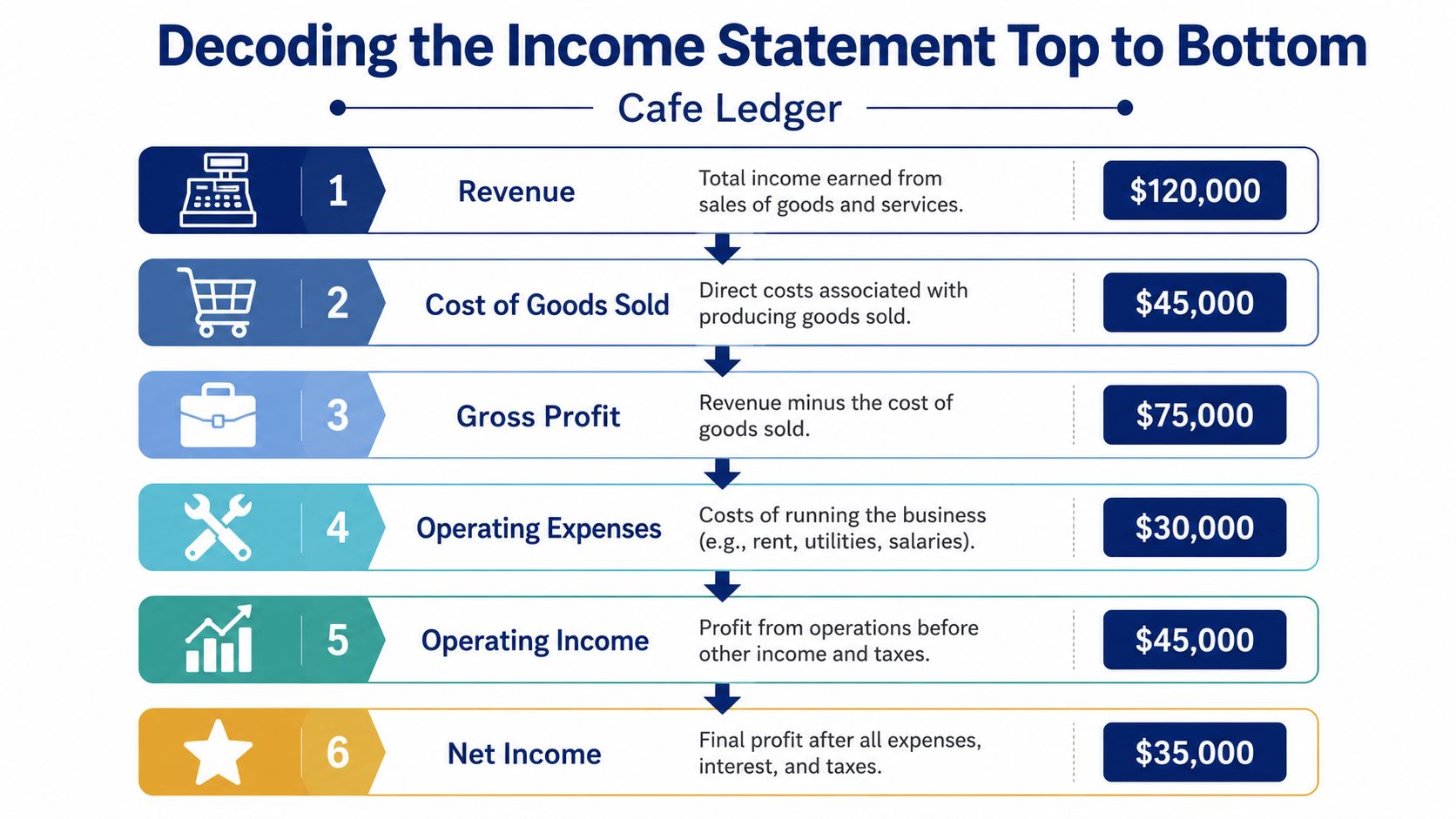
The income statement is where founders get ahead of themselves. Revenue lands at the top, everybody relaxes for a second, and then the rest of the statement decides whether the business earns its keep. With Cafe Ledger, start with revenue, subtract cost of goods sold, and you get gross profit. Subtract operating expenses and you get operating income. Anything below that, like interest or taxes, still matters, but it does not tell you whether the core machine works.
Gross profit tells you whether your product or service is priced and delivered well. Operating income tells you whether the business can run without burying itself under overhead. If gross profit looks fine but operating income is thin, the problem is spending. Usually, it is the kind of spending that creeps in through too many tools, too many hires, or too much office polish.
Profit and loss statements do the heavy lifting on this point, and a practical understanding profit and loss statement guide helps when you want the mechanics spelled out cleanly. Revenue alone does not tell you whether the business is growing well. It is the starting line before costs and expenses are counted.
Depreciation and one-time charges also deserve a side-eye. They can blur the story if you do not separate recurring performance from accounting noise. I am not saying ignore them. I am saying keep your eyes on the question that matters: can the business make money before growth spend and one-offs chew through it?
A founder who reads the income statement properly does not stop at the top line. They walk down the page and ask where the margin disappears, where the overhead swells, and whether the core operation still earns a clean profit after the costs show up. That is the part that keeps surprises out of the bank balance.
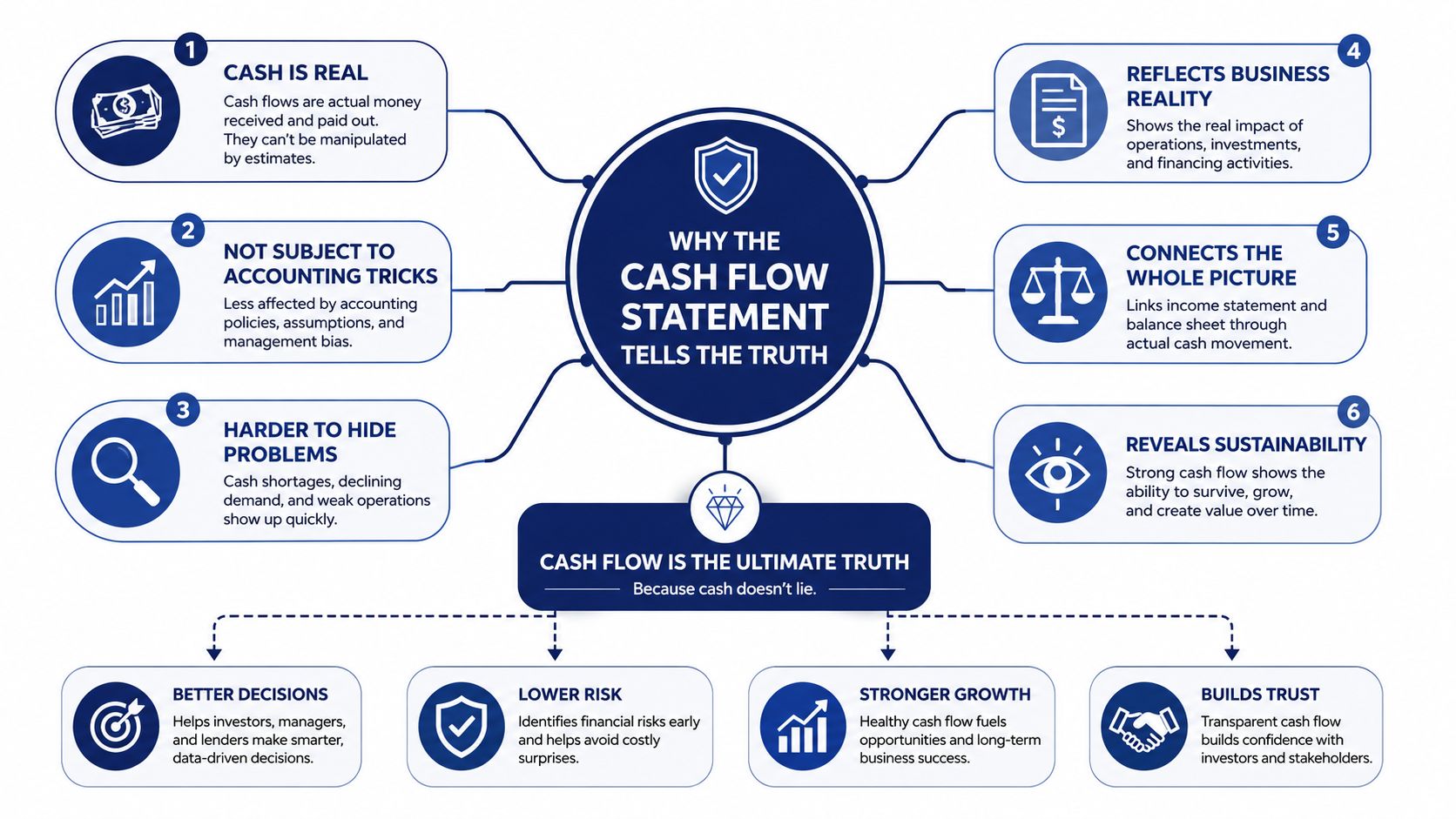
This is the statement that calls the bluff. A founder can look at profit and still be short on cash, and the cash flow statement is where that gap shows up in plain sight. It breaks activity into operating, investing, and financing sections, which is exactly why it matters.
With Cafe Ledger, operating activities show cash from the core business, investing activities show cash spent on long-term assets, and financing activities show cash from loans or owner funding. That is the clean read. The messy part is the gap between profit and cash. Receivables do not pay bills until customers pay. Prepaids, inventory buildup, and heavy capex can drain cash while the income statement still looks polite.
Companies can show net income and still have weak operating cash flow. That is a clear warning sign that earnings are not converting into collectible cash fast enough. It usually means the business is growing faster than collections, or revenue is being booked before the money lands. The bank balance stops being a bystander and starts acting like the scorekeeper.
The mismatch also shows up when revenue is recognized before cash is collected, or when year-end timing makes the P&L look stronger than the liquidity picture really is. Independent guidance on the profit-cash gap points to receivables spikes and unusual year-end transactions as red flags, and that lines up with what founders see when the month closes and the cash is missing in plain-English terms.
If collections are slow, your “profitable” business can still feel broke by Thursday.
If that sounds familiar, it should. The cash flow statement is not a nice-to-have appendix. It shows whether the business is producing spendable cash or just generating accounting comfort. For a practical walkthrough of the mechanics, this cash flow statement guide is the next tab to open.
A founder usually feels fine right up until the bills, payroll, and vendor calls all land at once. Profit on paper does not save you if the balance sheet is strained by debt, receivables are crawling, or cash is stuck in inventory. Ratios cut through the noise. They let you compare one period to another without getting distracted by absolute dollar amounts, and Xero's guidance treats a current ratio above 1 as a basic sign that short-term obligations can be covered while a lower debt-to-equity mix usually signals less financial risk as Xero summarizes.
| Ratio | What It Tells You | Healthy Band | Red Zone |
|---|---|---|---|
| Current ratio | Can you cover near-term obligations? | Above 1 | Below 1 |
| Quick ratio | Can you pay short-term bills without leaning on inventory? | Near or above 1 | Well below 1 |
| Debt-to-equity | How heavy is the debt burden? | Lower is safer | High debt burden, like the $2 debt for every $1 equity example the SEC uses to illustrate risk from Xero's guidance |
| Gross margin | How much stays after direct costs? | Stable or improving | Quiet erosion |
| Cash conversion cycle | How fast does cash come back? | Short and tightening | Slow and lengthening |
Current ratio tells you whether the company can survive the next bill cycle without scrambling. Quick ratio strips out inventory and asks the harder question. Debt-to-equity shows whether the business is leaning too hard on borrowed money or owner capital. Gross margin tells you if pricing and delivery are behaving. Cash conversion cycle tells you whether cash is trapped in the middle of the machine.
Read them together. A strong current ratio with a weak quick ratio usually means inventory is doing too much heavy lifting. A clean gross margin with a lousy cash conversion cycle usually means the business is selling fine and still starving for cash. That is the gap founders miss when they only stare at profit.
If you want a peer benchmark instead of making up your own benchmark in a meeting, the Gritt.io investor search and filter tool is useful when you are comparing similar businesses and trying to pin down what normal looks like. Use it for context, not theater.
Track these monthly. If one turns red, do not wait for the quarter-end ritual to explain it away. A ratio that drifts is usually the first honest warning.
Growth can hide a dying business. I've said it, I've seen it, and I'd say it again even if it made a roomful of founders uncomfortable. The statement that looks strongest on the surface is often the one hiding the ugliest plumbing underneath.
Receivables ballooning faster than revenue means customers owe you more while your cash waits in line. Revenue spiking in the last week of a quarter can be perfectly fine, or it can be timing gymnastics that deserve a hard look. Gross margin eroding means the business is buying growth the expensive way. Cash burn extending despite higher sales means scale is not solving the liquidity problem. And customer concentration showing up only in the footnotes is the kind of detail people skip right before regretting it.
Financial statements are useful only when read with the story around them. ScienceDirect notes that these reports are governed by publicly announced rules, are often audited, and are comparable only subject to accounting policies and GAAPs which is exactly why the notes matter. The numbers alone don't tell you whether the pattern is healthy. The footnotes and narrative do the finishing work.
A clean spreadsheet can still hide a rotten customer mix.
The most dangerous sentence in finance is, “We'll clean it up at audit time.” No, you won't. Audit time is when the mess gets documented, not magically erased. If the business is relying on aggressive timing, loose receivables, or footnote-sized surprises, the statements are already trying to tell you something. Listen before the market, lender, or board does.
A good monthly review should feel like maintenance, not ritual sacrifice. Pull the three statements, run the five ratios, compare the month to the prior month and the same month last year, scan for red flags, and write one paragraph that explains what changed. That's enough to keep most founders out of trouble, and it's a lot better than “I skimmed the deck and it looked okay.”
If you want to move from static reporting to more current visibility, a guide to live reporting for accountants is worth a look because it pushes the conversation toward faster decisions instead of prettier slides. That's the point, after all.
The smart teams start adding scenario analysis and cash forecasting. Not because it sounds complex, but because guessing is expensive and boring in exactly the wrong way. A monthly habit turns financial statements from a rearview mirror into a steering wheel.
The moment profit shows up on paper but cash still feels tight, stop pretending bookkeeping is a side quest. If you are dealing with multiple states, fundraising, investor reporting, or spending too many hours each week inside the books, the job has already outgrown founder-led cleanup. At that point, doing it yourself is not scrappy. It is expensive delay with better branding.
A full-time in-house bookkeeper makes sense when transaction volume is steady and the work is repetitive. A fractional controller fits when you need close discipline, sharper oversight, and someone who can keep the statements from drifting into fiction. A pre-vetted remote accountant is the fastest path when you need speed, flexibility, and less hiring drag.
There are teams that can help you get there faster, and HireAccountants is one of them. It is a talent platform for hiring pre-vetted accountants and finance professionals in as little as 24 hours, with English-fluent talent in US time zones and a setup that does not make collaboration feel like hostage negotiation. The platform also emphasizes cost savings of up to 80 to 90 percent relative to traditional hiring, which is the kind of math founders like reading from HireAccountants.
If you are also thinking about broader ops support, a guide to automated client acquisition can help you see how fast-moving service workflows get built around lean teams. Different problem, same lesson. Do not leave critical functions to improvisation.
You do not need to become a part-time bookkeeper to run a serious company. Hire someone who lives in the numbers, keeps the close tight, and gives you back your week. Get the right finance support before the next close turns into a fire drill.
Let's simplify your finances today!