


An accounts payable specialist records, verifies, and pays a company's bills by matching invoices to purchase orders and receipts, coding costs to the right accounts, resolving discrepancies, and keeping an audit-ready payment record. The job is really about protecting cash and catching what automation misses, not just moving paperwork.
That's why the popular advice to hire for fast invoice entry misses the point. A fast processor can still send money to the wrong account, overlook a duplicate, or wave through a bill that never should've been paid. A strong AP specialist is a control tower: they keep routine bills moving and know when an exception deserves a closer look.
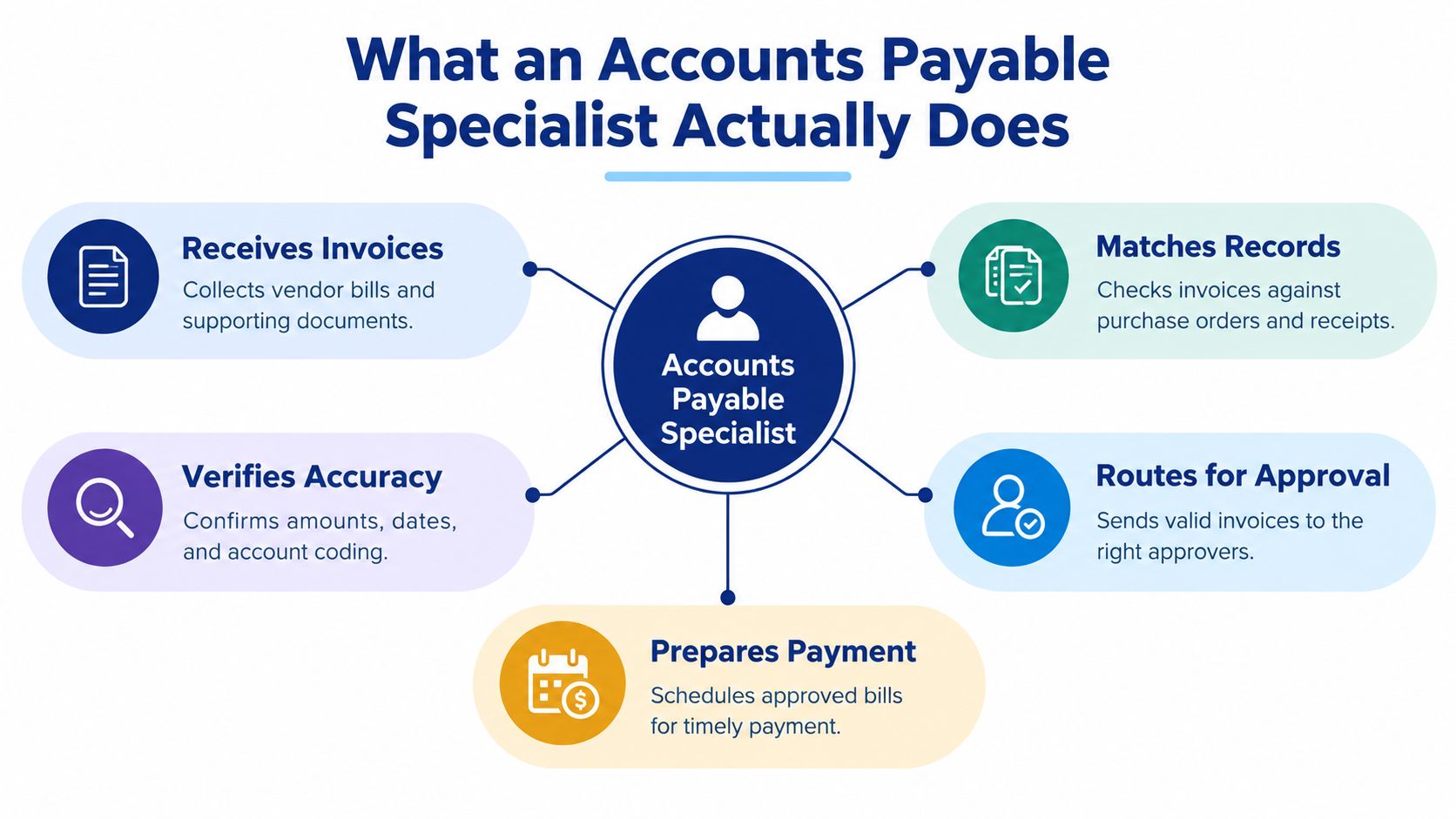
An AP specialist isn't a glorified bill typist. They're responsible for ensuring that company bills are accurately recorded, properly approved, and paid on time. That usually means receiving invoices, checking them against purchase orders or delivery records, coding costs to the correct general-ledger accounts, entering transactions into accounting software, resolving discrepancies, and maintaining an audit-ready record of payments.
The role sits within the broader bookkeeping, accounting, and auditing clerk occupation. The U.S. Bureau of Labor Statistics says workers in that occupation compute, classify, and record financial data, check figures and postings, reconcile differences, and produce reports such as balance sheets and income statements. It counted approximately 1,613,400 U.S. jobs in 2024 across the broader occupation, not AP specialists alone. The BLS overview of bookkeeping, accounting, and auditing clerks helps put AP in context: the specialist's work contributes to records that other finance decisions rely on.
At a smaller company, one person may handle AP alongside bookkeeping, purchasing, payroll, or general administration. At a larger organization, separate employees may manage invoice processing, vendor maintenance, payment execution, and exceptions. The job title can stay the same while the actual control responsibilities vary considerably.
The practical distinction is simple: AP work is accounting work. A software subscription coded to the wrong account, a missed credit memo, or a bill paid twice can distort expenses and cash reporting after the transaction leaves the inbox.
The useful hiring test: Can the candidate explain how they'll verify a bill, what they'll do when it doesn't match, and how they'll leave a record someone else can audit?
An invoice enters AP as a request to pay. Before it becomes a payment, the specialist checks whether the supplier and supporting documents are credible, whether the charges make sense, and whether the right person has authorized the purchase. Each step protects a different part of the process.
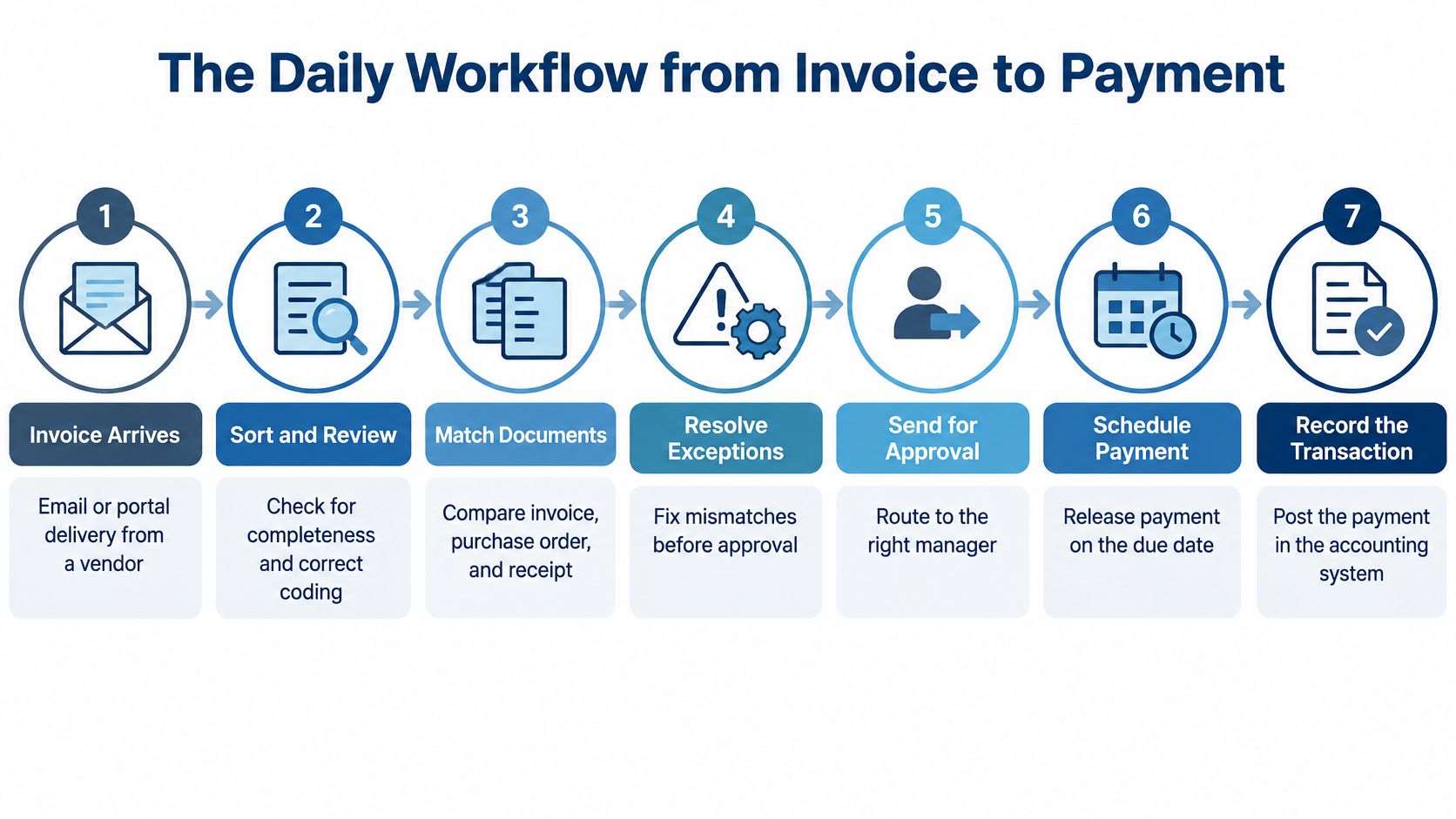
First, the specialist validates the supplier invoice, checks for a duplicate, confirms tax and payment terms, and codes the expense to the appropriate general-ledger account and cost center. Then comes three-way matching, the technical heart of the workflow: comparing the purchase order, receiving report, and invoice at the line level.
If the quantity and price fall within configured tolerances, the system may approve the invoice automatically. If the invoice exceeds the purchase order or there's no evidence that the goods arrived, the specialist routes the mismatch for resolution. A system can flag a discrepancy; a person has to determine whether it reflects a valid change, a recording error, or a bill that shouldn't be paid yet.
Once authorized, the invoice is posted as a liability. The specialist prepares payment batches, monitors due dates, communicates with vendors when documentation is missing or incorrect, and reconciles supplier statements to the AP subledger. That reconciliation catches differences between what the supplier believes is outstanding and what the company has recorded.
Teams considering ways to reduce repetitive handling can review accounts payable automation options, but software doesn't remove the need for judgment. Unusual transactions, policy exceptions, disputed charges, and unclear vendor explanations still require a person who understands the business context.
The employee who requests or creates a purchase order shouldn't independently approve the payment, record the transaction, reconcile the account, and control the disbursement. Berkeley's internal-control model separates initiation, authorization, recording, reconciliation, and custody or disbursement across roles. Its segregation-of-duties guidance shows why AP is part of a larger control system, not a free-standing inbox.
For lean teams, perfect separation may not be practical. Compensating reviews and clear approval limits still matter. Giving one person unchecked control over the entire payment chain is not efficiency. It's an invitation to discover your control gap the expensive way.
Most invoices are not the interesting part of AP. The work gets messy when the purchase order is missing, the price or quantity doesn't match, supplier details are wrong, tax treatment conflicts, an invoice may be a duplicate, or an approval sits unattended. Each exception interrupts straight-through processing and creates rework.
Manual handling remains common. Benchmark data reported by the Institute of Financial Operations and Leadership says 66% of surveyed organizations still manually key invoices into their ERP systems, while 63% spend more than 10 hours each week on invoice processing. The same data says 36% process more than 5,000 invoices monthly, including 14% above 10,000. The AP occupation benchmark puts those figures in perspective: invoice volume is only part of the workload when every mismatch needs attention.
Benchmarking reported by APQC puts average annual volume at about 10,853 invoices per AP full-time equivalent, compared with approximately 6,082 in a completely manual environment and 23,333 in a fully automated one. Those figures don't mean every team should chase maximum throughput. If exceptions are poorly controlled, faster processing just moves bad data and questionable payments along more quickly.
Reported invoice-processing costs average about $9.84, while best-in-class teams are near $2.67; average approval-cycle time is around 8.2 days. Exception rates average roughly 18.4% to 19.9%, compared with approximately 11.8% for best-in-class teams. The AP metrics benchmark makes a strong case for watching exceptions, not just counting invoices. Every recurring exception has a cause that a specialist can investigate and, ideally, eliminate upstream.
| Exception type | Typical root cause | Corrective action |
|---|---|---|
| Missing purchase order | Buyer skipped or delayed the purchasing process | Require a PO before commitment, with a documented exception path |
| Price or quantity variance | Contract, order, receipt, and invoice don't agree | Confirm the approved terms and correct the source record |
| Incorrect supplier details | Vendor master data wasn't verified or updated cleanly | Validate changes through an established contact channel |
| Tax mismatch | Invoice coding or supplier tax information is incomplete | Review the supporting documents and correct vendor or transaction data |
| Duplicate invoice | Duplicate submission or weak duplicate checks | Compare supplier, invoice number, amount, and payment history |
| Approval delay | The approver is unclear, unavailable, or assigned incorrectly | Set an owner and escalation route for stalled approvals |
A weekly dashboard should connect each exception category to an owner, aging, dollar value, and recurrence. That turns “AP is behind” into a specific conversation about which upstream process keeps creating the same blockage.
Fraud prevention isn't compliance theater. It's part of the payment job. In the 2025 AFP Payments Fraud and Control Survey, 79% of organizations reported actual or attempted payment fraud in 2024. The survey's key findings make it hard to argue that a familiar logo or polished PDF is proof a bill is legitimate.
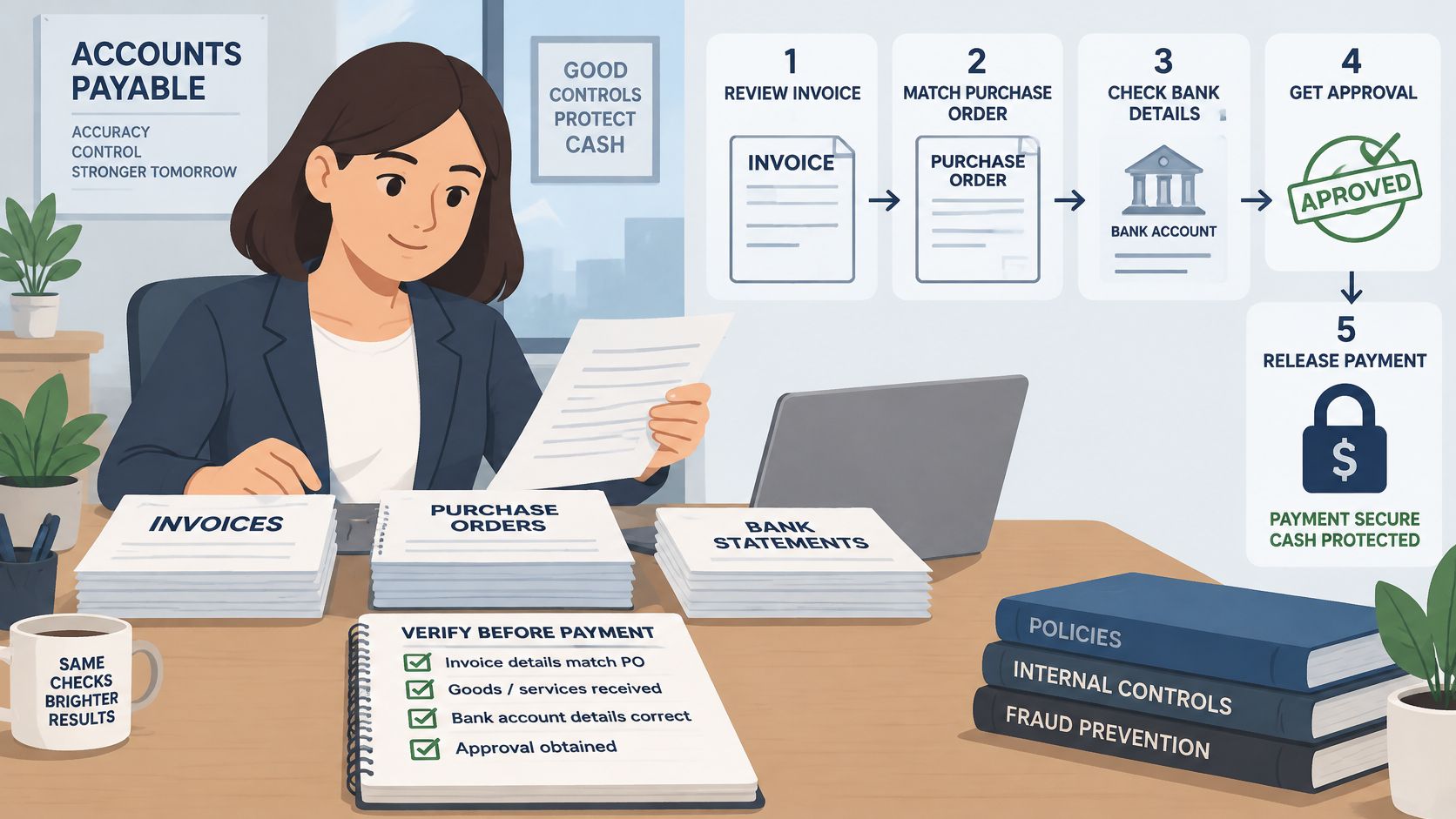
A request to change a supplier's bank details is a classic place for a payment to go wrong. The specialist shouldn't approve an emailed change just because the message looks familiar. They should verify it through a trusted, independently obtained contact channel, check the vendor record, and flag unusual urgency or new payment instructions before money moves.
That review sits alongside ordinary invoice controls: compare the charge with the contract or purchase order, confirm that goods or services were received, check for duplicates, maintain access limits on vendor changes, and keep approval separate from payment release. The Association of Certified Fraud Examiners classifies billing schemes as fraudulent disbursement schemes; its data reports they appeared in 21% of occupational-fraud cases, with a median loss of $63,000. The ACFE fraud classification material underscores why AP review has to go beyond document appearance.
For ACH payments, the initiating party is responsible for obtaining proper authorization and being able to prove it. If requested, that proof must be provided within 10 days. For business-to-business payments, an agreement must exist between the business partners, with both parties bound by ACH rules. Nacha's ACH guidance is a reminder to retain payment authorization and supporting documentation instead of treating the bank portal as the record of truth.
AP also helps keep vendor tax reporting on track. For reportable nonemployee compensation paid before 2026, the IRS threshold for Form 1099-NEC is $600, and the form is due January 31. The specialist needs accurate vendor details and a way to track cumulative payments, while distinguishing reportable services from goods and payments to exempt entities. The IRS's information-return guidance provides the filing details.
For a broader view of how approvals and access limits fit together, see this practical guide to financial controls. The operating principle is straightforward: verify before release, preserve proof, and don't let one person control the whole transaction.
A specialist's performance shouldn't be reduced to invoices processed. Volume without accuracy can mean duplicate payments, weak coding, and a pile of reconciliation work for someone else. A useful dashboard shows whether the process is controlled, timely, and getting less repetitive.
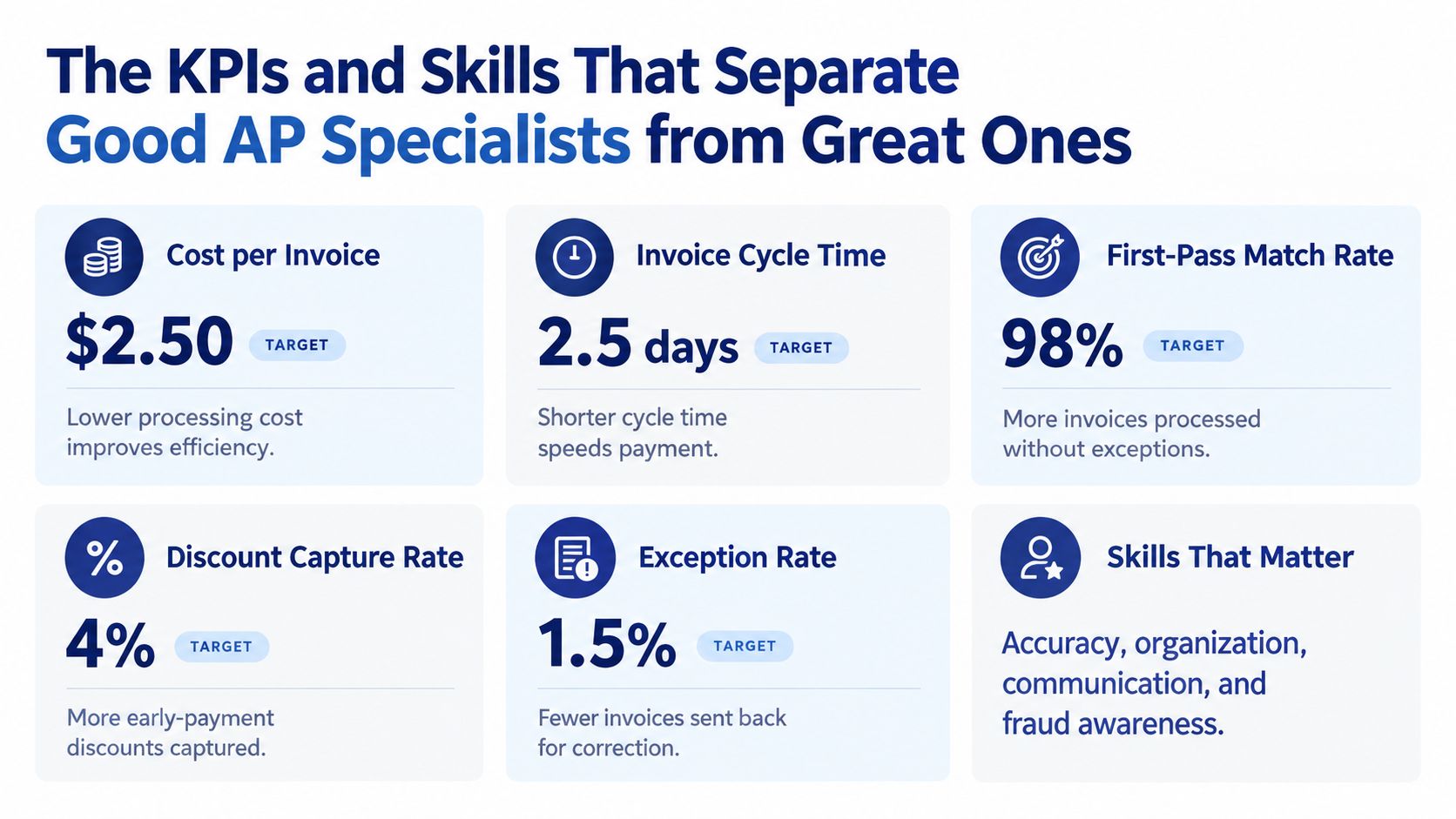
Use a weekly view of the operating metrics, then assign each one an owner and a response when it moves in the wrong direction.
A dashboard should not turn every metric into a target that employees can game. If you reward speed alone, someone may prioritize easy invoices and leave difficult exceptions to rot. Pair throughput with accuracy and resolution, and review patterns with procurement and budget owners when the cause sits outside AP.
Strong candidates understand how an invoice affects the ledger, communicate clearly with vendors, and escalate without turning every question into a crisis. They're skeptical without becoming obstructive. They also know that an automated match is a recommendation, not a substitute for checking a suspicious amount or an unusual change in payment instructions.
Automation shifts the work; it doesn't erase accountability. A 2025 AP automation survey reported 73% of teams were not fully automated, 27% had no automation, and AI use had increased from 7% to 29% in one year. The 2025 AP automation trends report identifies invoice extraction, matching and approvals, and duplicate or fraudulent-invoice detection among leading use cases. As routine handling gets automated, judgment on ambiguous or risky transactions becomes more valuable.
Measure the work that keeps money safe: Don't just ask how many bills cleared. Ask what kept coming back, why it happened, and who fixed the cause.
There isn't one staffing model that fits every company. A full-time in-house specialist gives you day-to-day context and direct oversight, but a single hire may not provide reliable coverage for every absence or volume spike. A part-time or contract bookkeeper can be practical when AP shares space with other accounting tasks, provided the business defines who approves and releases payments.
A talent platform offers another route: access to pre-vetted finance professionals without relying on a cold, solo recruiting search. The trade-off is the same as with any remote arrangement: you still need clear access boundaries, documented procedures, and an internal owner for approvals.
| Option | Typical cost | Time to hire | Control coverage |
|---|---|---|---|
| Full-time in-house AP specialist | Salary, benefits, and employer costs | Depends on recruiting and onboarding | Direct oversight; add review controls so one employee doesn't own every payment step |
| Part-time or contract bookkeeper | Flexible engagement, based on scope | Often easier to arrange than a permanent hire | Works well when responsibilities and approval limits are explicit |
| Vetted talent platform | HireAccountants candidates are often available from $10/hour or under $3,000 per month | The platform says companies can hire in as little as 24 hours | Pre-vetted remote talent; the company still retains approval and payment controls |
HireAccountants connects U.S. companies with pre-vetted accountants and finance professionals through a self-service marketplace, a recruiting team, and an AI matching engine. Its talent pool includes English-fluent professionals in Latin America working in U.S. time zones, with flexible full-time and part-time arrangements and complimentary HR, payroll, and compliance support. Those features may suit a team that needs AP capacity without adding a local permanent role, but no staffing provider should replace the company's own approval matrix or verification process.
When you compare candidates or providers, ask how they handle exceptions, protect vendor data, and document payment decisions. It also helps to test whether they understand the business behind the numbers. These interview questions assessing finance business acumen can help you look beyond software familiarity and find out how a candidate reasons through financial work.
Don't spend the interview asking only which accounting system a candidate has used. A tool can be learned. Control judgment is harder to bolt on after a suspicious payment clears.
Give the candidate a few scenarios and ask them to walk through the next action, the evidence they'd retain, and who they'd involve:
Look for calm, specific answers. A good candidate won't just say “I'd check it.” They'll explain how they'd verify the request independently, pause payment when appropriate, contact the relevant owner, record the resolution, and investigate whether the same problem could recur.
For a broader question bank, use these accounting interview questions as a starting point, then tailor scenarios to your company's approval flow and vendors.
Onboarding should establish who can create vendors, code bills, approve invoices, release payments, and reconcile accounts. Document an approval matrix, a callback-verification protocol for bank changes, role-based access boundaries, and a clear escalation path. Then build the weekly exception dashboard from day one, so recurring issues have owners rather than becoming office folklore.
The useful test is whether a new specialist can explain what they're authorized to do and where they must stop and escalate. That's more meaningful than a polished demo of your accounting software.
This week, write down your current payment controls, review the exceptions that keep recurring, and benchmark your invoice-processing cost if you have reliable figures. If the work is outgrowing your current setup, HireAccountants offers access to pre-vetted accounting and finance professionals, including AP talent for invoice and vendor-payment workflows. Visit HireAccountants to explore candidates and decide whether your next step is added AP capacity or a tighter process.
Let's simplify your finances today!