


Only 12% of employees strongly agree that their organization does a great job onboarding new hires, according to Gallup's onboarding research. That should make every founder who sends a contract, a login, and a cheerful “welcome aboard” email slightly nervous.
I've hired remote accountants and bookkeepers. I've also watched otherwise capable people lose days because nobody granted the right permissions, explained the close calendar, or identified who approves a payment. Onboarding isn't an HR ceremony. It's a risk-managed productivity system. Done properly, it turns a signed contract into an independently effective contributor without handing sensitive financial data to someone who's still guessing.
The onboarding process is the structured system that helps a new hire become effective, safe, and connected in the role. It starts before the first day and continues through the early weeks or months, covering administrative setup, role clarity, training, relationships, cultural context, feedback, and manager support.
That's different from orientation. Orientation might introduce company policies, benefits, and colleagues. Paperwork confirms employment. Induction helps someone settle in and understand the employer. Onboarding combines all of those pieces with practical work and measurable progress.
For a remote accountant, onboarding means more than sending a contract and credentials. The new hire needs access to the accounting platform, payroll tools, expense systems, reporting folders, and communication channels. They also need to understand confidentiality rules, approval limits, reporting lines, time-zone expectations, client context, and what a good first deliverable looks like. The definition of a virtual team matters here because distributed work removes the casual office explanations that normally fill knowledge gaps.
“Onboarding” often gets reduced to a first-day call, a handbook, and a pile of forms. That definition is convenient because it lets everyone declare victory before the employee has completed a single useful task.
A real process answers a harder question: When can this person safely perform the job independently, and what evidence will prove it?
The concept itself grew from organizational socialization theory. Edgar H. Schein published foundational work in 1971, followed by further work with Gerry Johnson in 1978 and John Van Maanen in 1979. The modern term “onboarding” emerged in the 1990s, as companies extended structured preparation beyond executives and treated it as a continuing process rather than a one-time orientation. By that decade, more than 63 onboarding studies and theories had reportedly been published, reflecting the broader shift toward helping employees understand responsibilities, relationships, and organizational norms. The historical overview provides further context.
Practical rule: If the employee can finish the checklist but still doesn't know what to do, who can approve it, or how quality gets judged, you haven't finished onboarding.
Onboarding shows up in the operating results long before anyone labels it an HR metric. A finance hire who waits for equipment, access, and answers isn't producing at full capacity, while the company still pays the full employment cost. Confusion also creates review work, delayed close tasks, duplicated effort, and avoidable security exposure.
The retention signal is just as direct. 86% of respondents believed a new hire's decision to remain with a company long term is made within the first six months, according to an Aberdeen Group study of approximately 1,000 respondents reported by SHRM. In that same survey, roughly one-third said they had quit a job within six months, and 16% to 17% left between the first week and third month. Among those who departed, 23% said clearer responsibility guidelines might have persuaded them to stay, while about one-third reported receiving little or no onboarding.
That's not a soft signal. It points to a process failure. If a bookkeeper doesn't know whether the manager values speed, documentation, reconciliation accuracy, or proactive escalation, the employee is forced to reverse-engineer the job while deciding whether the company is worth staying with.
Structured onboarding connects four practical outcomes:
A 2007 Wynhurst Group study cited by SHRM found newly hired employees were 58% more likely to remain after three years when they completed structured onboarding. That doesn't mean every company will produce the same result. It does mean improvisation is a poor default when retention matters.
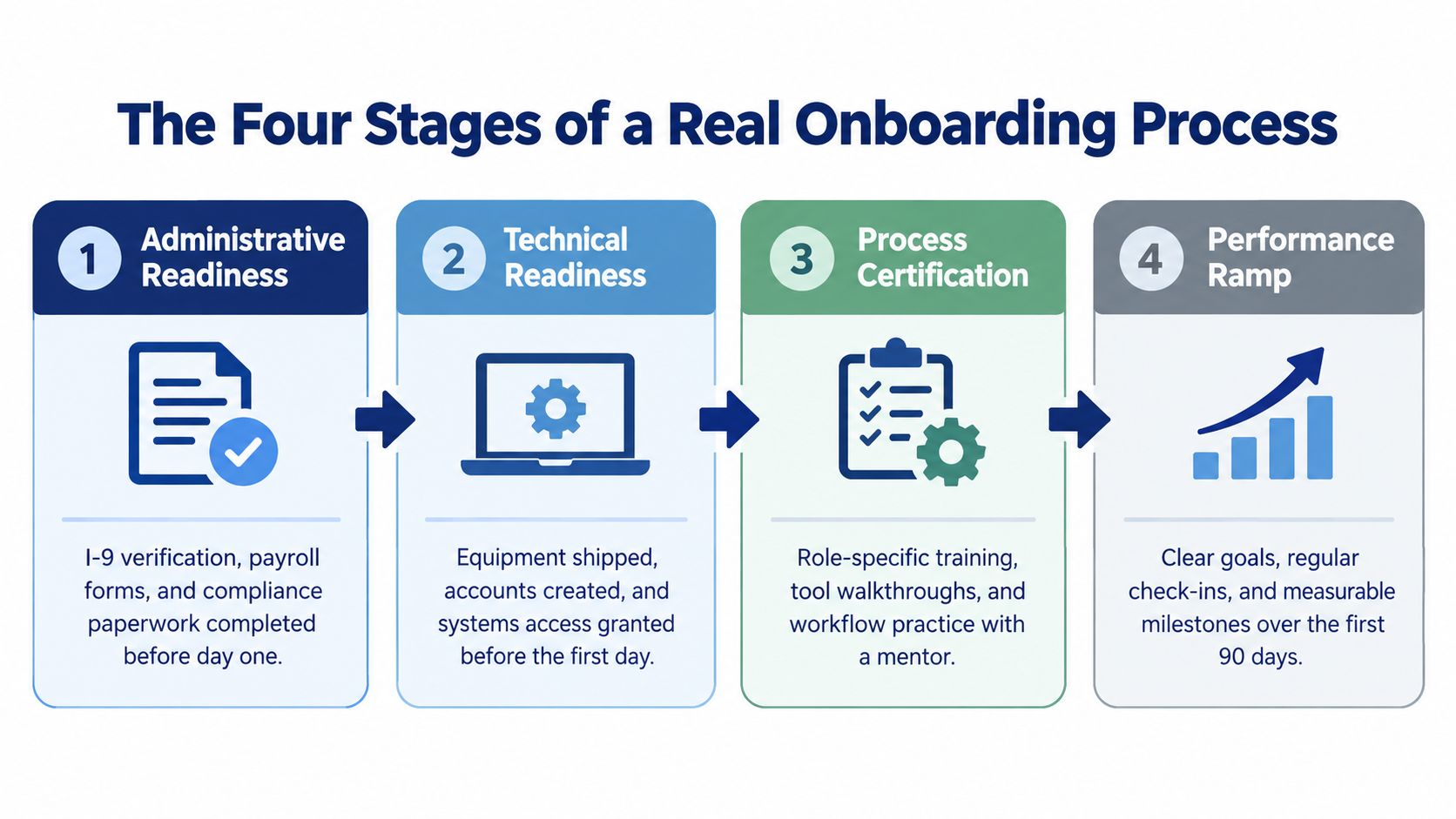
SHRM also reported that 83% of the highest-performing organizations began onboarding before the employee's first day. That timing matters because day one should be used for context, relationships, and useful work, not for discovering that the laptop still sits in a warehouse.
Treat onboarding as a sequence. Administrative readiness supports technical readiness. Technical readiness enables process certification. Process certification makes performance ramp possible. Skip one, and the next stage becomes guesswork.
Before the start date, verify identity, employment eligibility, signed agreements, payroll and tax information, and any required confidentiality acknowledgments. For a US company hiring a remote finance professional, this stage creates the legal and operational foundation for access.
The common failure is treating paperwork as the whole process. The forms may be complete while nobody has written down the role's reporting line, first deliverable, approval boundaries, or first-week schedule.
Provision the laptop, email, collaboration tools, accounting software, payroll platform, banking access, expense tools, and reporting folders. Use least-privilege access, mandatory multifactor authentication, individual accounts, and documented approval limits. Never solve a setup delay with a shared login. That shortcut is cheap until someone needs to investigate a transaction.
A technical owner should record what was granted, why it was granted, and who approved it. Access should be temporary, approval-based, or expanded only when the employee demonstrates the need.
Now the new hire learns how work moves. Walk through the chart of accounts, close calendar, documentation standards, client or vendor context, escalation paths, and communication routines. Then assign a supervised task, such as a bank reconciliation or month-end schedule.
Training isn't complete because someone watched a video. The employee needs to perform the workflow, receive feedback, correct the work, and demonstrate that the correction stuck.
The final stage turns learning into ownership. Set documented 30-, 60-, and 90-day outcomes, define the deliverables that matter, and schedule feedback checkpoints. A finance hire might move from shadowing a reconciliation to completing one under review, then owning a recurring slice of the close with documented handoffs.
The failure mode here is vague encouragement. “Get comfortable with the systems” isn't a milestone. “Complete the weekly bank reconciliation with no unresolved review comments and escalate exceptions through the documented channel” is a milestone.
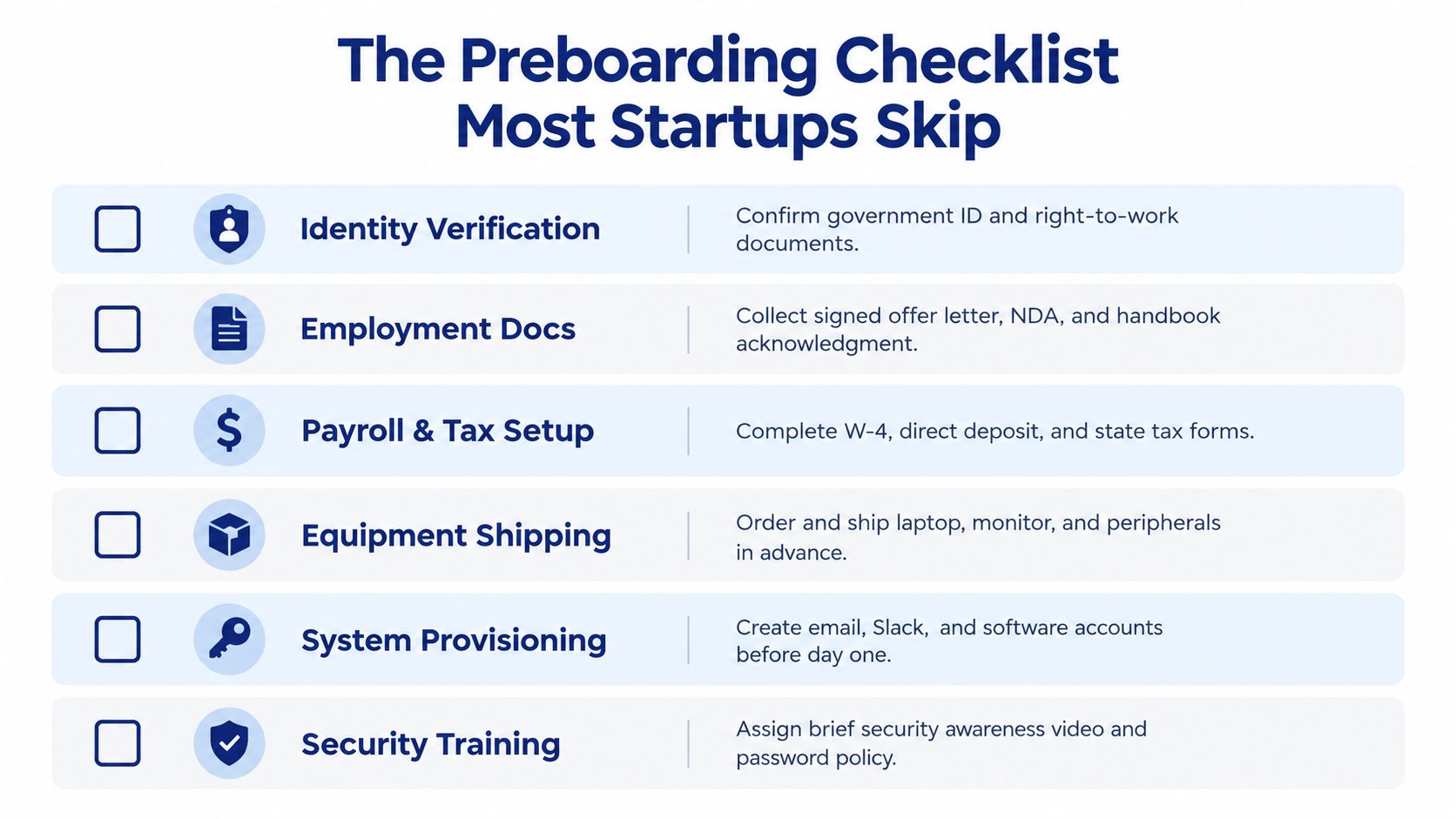
Preboarding begins after acceptance and before the first working day. The objective isn't to bury a new hire in content. It's to remove preventable friction and establish safe boundaries before sensitive work starts.
Use this checklist for a remote accountant or bookkeeper:
A structured new starter onboarding checklist can help teams avoid forgetting operational handoffs such as approvals, procedures, and access requests. For companies that don't have internal recruiting operations, recruitment process outsourcing can also separate hiring execution from the manager's responsibility for role-specific onboarding.
| Category | What It Covers | Day-One Outcome It Unlocks |
|---|---|---|
| Identity and employment | Identity verification, offer documents, confidentiality acknowledgments | The hire starts with the employment foundation complete |
| Payroll and tax | W-4, direct deposit, and state forms | Payroll doesn't become a first-day obstacle |
| Equipment | Laptop, monitor, peripherals, and device requirements | The employee can access work without improvising |
| Systems and security | Individual accounts, least privilege, multifactor authentication, security training | The employee can work inside controlled systems |
| Role preparation | Reporting lines, first-week schedule, procedures, and approval rules | The hire understands where to ask and what to do |
| Initial workflow | Supervised reconciliation, schedule, or reporting task | The manager gets early evidence of capability |
The security items look administrative, but they aren't. A device baseline, individual credentials, multifactor authentication, and approval limits protect financial data while giving the employee a clear operating perimeter.
Remote onboarding isn't broken by default. It exposes every undocumented assumption that an office used to hide.
Only 61% of fully remote employees said their onboarding helped them contribute faster, compared with 73% for hybrid onboarding and 69% for in-person onboarding, according to Munich Business School's discussion of remote onboarding. The gap makes sense. Remote hires can't lean over to ask where the close file lives, notice how colleagues communicate, or get immediate help when an authentication prompt fails.

A remote finance hire needs an asynchronous home base. Put procedures, system links, approval rules, close calendars, escalation paths, and examples of acceptable work in one searchable location. Then use live calls for judgment, questions, feedback, and relationship-building.
For a US company hiring talent in Latin America, align working hours explicitly instead of assuming “remote” means “available whenever.” State when live collaboration happens, which questions belong in Slack, which belong in email, and where urgent payment or payroll issues go. Guidance on remote onboarding for nearshore teams is useful when the team spans countries and time zones.
IT support needs a named owner. That person should verify device access, multifactor authentication, password setup, accounting permissions, file access, and the recovery path if something fails. A welcome call can't substitute for a functioning system.
Social integration doesn't require a calendar packed with awkward video calls. Introduce the new hire to the people who affect their work, explain each person's role, and create natural opportunities to observe how decisions happen. A short manager conversation about communication norms can be more valuable than another generic team presentation.
Remote onboarding works when the company makes invisible context visible. Document the work, assign real people to support it, and protect time for the new hire to practice rather than forcing every learning moment into a meeting.
Onboarding software can assign tasks, send reminders, and show completion status. It can't explain why one reconciliation exception matters more than another, reassure a new hire that questions are welcome, or tell someone how the CFO evaluates judgment.
Manager involvement has a measurable effect. When managers actively participate, remote employees are 3.5 times more likely to be satisfied with onboarding and 1.2 times more likely to feel they're making positive contributions early on, according to reporting on hybrid workplace onboarding.
Before day one: Send the schedule, confirm equipment and access, and write down the first useful task. The manager owns this, even if HR owns the paperwork.
During the first week: Hold brief check-ins often enough to catch a blocked login, unclear instruction, or missing file before it becomes a lost week. Review the first task live and explain the quality standard, not just the correction.
During the first month: Move to a weekly conversation focused on three questions: What has become clear? What remains blocked? What work can the employee now own with review? Introduce key teammates and explain how decisions move through the finance function.
Through the first 90 days: Review deliverables, adjust access, test ownership, and document handoffs. A finance manager should be able to answer who approves payments, how reconciliation quality is judged, where client questions go, and when the employee should escalate.
Manager rule: Don't ask whether the new hire is “settling in.” Ask what they completed independently, what required correction, and what they still can't access.
A ten-minute human conversation often beats another automated reminder. The software tracks the checklist. The manager creates competence.
“Checklist completed” is an administrative result, not a productivity result. The useful question is how long it takes a new hire to perform the work safely and consistently, and whether review errors or support needs are falling as ownership grows.
Define indicators for the role before the employee starts. For an accountant or bookkeeper, those might include error-free bank reconciliations, completed month-end schedules, response-time compliance, forecast-model accuracy, or the quality of supporting documentation. Don't borrow a generic benchmark and pretend the roles are identical. A routine bookkeeping role and a complex finance analyst role won't reach independence through the same path.
Track these measures monthly:
Use the quality of hire metrics framework as a prompt for connecting hiring outcomes with performance and retention, then adapt it to finance work. Your KPI in business should describe a decision or outcome, not just activity.
Harvard Business Review reported that organizations with strong onboarding practices achieved 82% higher employee retention and more than 70% higher productivity than organizations with weaker approaches. The figures are a benchmark for the business case, not a promise that every company will reproduce the same outcome. The useful lesson is that onboarding quality belongs in performance conversations.
If access delays correlate with slower first deliverables, fix provisioning. If review errors remain high after training, change the practice task or documentation. If retention drops when manager touchpoints disappear, protect the manager's calendar instead of blaming the recruiting pipeline.
SHRM guidance recommends checkpoints around 30, 90, 180, and 365 days, with hiring cohorts compared across retention, performance, and employee feedback. Separate voluntary exits from dismissals, transfers, and planned contract endings. Otherwise, the dashboard will produce tidy numbers and poor decisions.
During weeks one and two, complete access, introductions, security setup, and a supervised first task. By days 30 and 60, the hire should own a defined slice of work with review and documented feedback. By day 90, test full ownership, confirm handoffs, and adjust permissions.
Assign one owner to every stage. SHRM guidance recommends checkpoints around 30, 90, 180, and 365 days, comparing hiring cohorts across retention, performance, and employee feedback, as outlined in its onboarding measurement guidance. Most plans don't fail because the checklist was wrong. They fail somewhere after the first couple of weeks because the manager got busy. Toot, toot, welcome to operations.
HireAccountants helps US companies find pre-vetted remote accountants and finance professionals, with matching, recruiting, and HR, payroll, and compliance support that can make the handoff into onboarding easier. If you need finance talent who can work in US time zones, visit HireAccountants and build the role, access plan, and ramp milestones before the first day.
Let's simplify your finances today!